

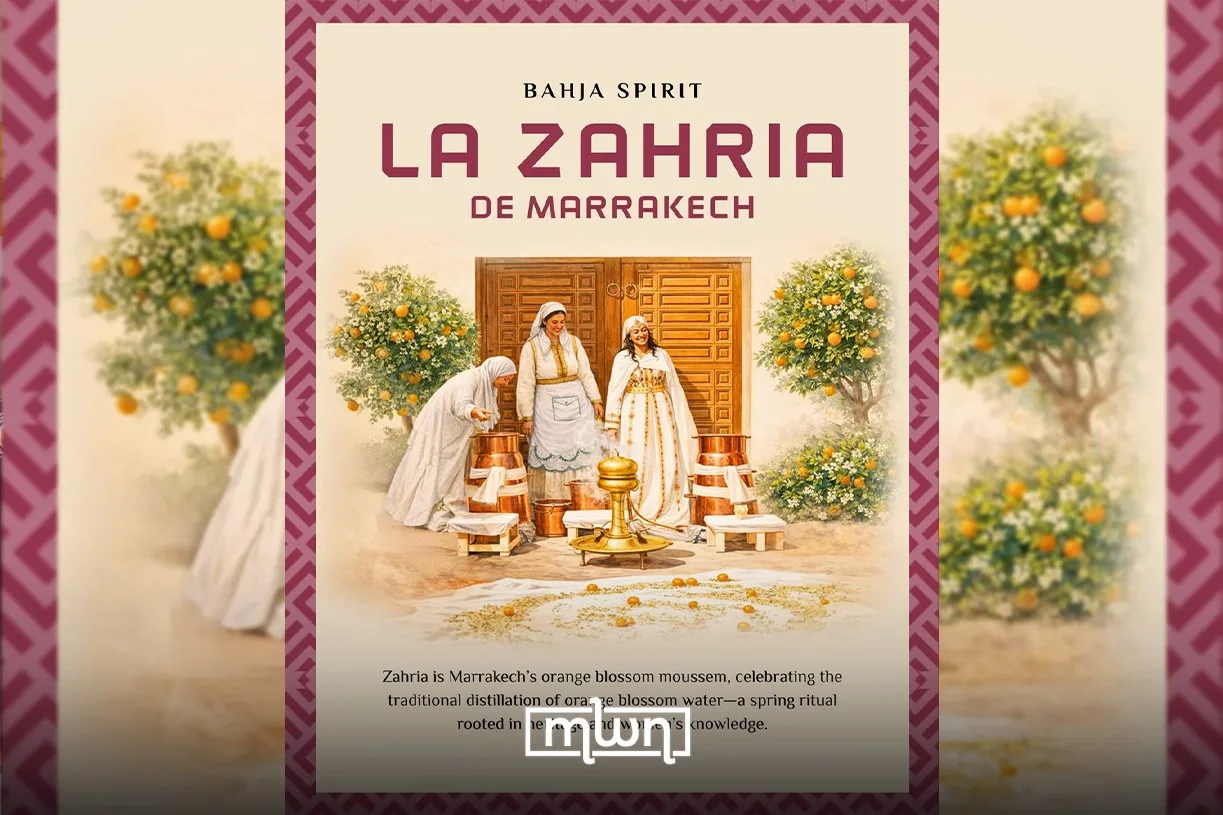
Fez — Marrakech’s “Zahria,” the annual moussem celebrating orange blossom distillation, is taking place from March 22 to April 12 in a year organizers describe as significant for Moroccan heritage.
The event is organized by the “Association Al Muniya de Marrakech” in partnership with institutions including the Ministry of Youth, Culture, and Communication, the Marrakech Communal Council, and the Marrakech-Safi Regional Council.
Zahria centers on “taqtar zhar,” or the traditional distillation of orange blossom water, a practice long carried by women in Marrakech and passed down across generations. Organizers and cultural promoters describe it as one of the city’s most deeply rooted seasonal rituals, tied to both sensory memory and intangible heritage.
This year’s edition comes with added symbolic weight because the moussem is already listed by Islamic World Educational, Scientific and Cultural Organization (ICESCO) as part of the heritage of the Islamic world, while organizers are still pushing for broader UNESCO recognition.
That effort is closely linked to Al Muniya itself, which appears on UNESCO’s list of accredited NGOs working in the field of intangible cultural heritage.
Heritage law moves to the foreground
One of the central moments of this year’s edition was an April 3 colloquium focused on Law 33.22, the new legal framework for heritage protection.
Coverage of the event said the discussion was held with the “Maroc Mémoire” collective and stressed that the law introduces new coordination mechanisms between public administrations, territorial authorities, civil society, and the private sector.
That legal backdrop gives this year’s moussem a wider relevance. Instead of presenting orange blossom distillation as a charming local custom alone, organizers are placing it inside a national conversation about how Morocco protects, documents, and promotes living traditions.
Beyond the medina walls
Another visible shift in the 2026 program is geographic. The moussem has expanded beyond the medina to other parts of Marrakech and the wider region, with activities hosted in schools, gardens, cultural venues, and academic spaces.
Program descriptions mention scientific and sensory encounters with perfume expert Khalid Bitar and Valérie Ogé, an olfactotherapist at Mohammed VI Polytechnic University (UM6P) in Benguerir, as well as distillation ceremonies at the Higher School of Technology of Kelaâ des Sraghna in partnership with Marrakech’s Cadi Ayyad University.
The 22-day program also includes distillation ceremonies in emblematic Marrakech venues such as “Les Jardins de la Médina,” Jemaa el-Fna square, and the Farid Belkahia Museum, alongside weaving workshops led by Mireille Loopuyt and musical interludes including samaa (sufi music) sessions by the Ibn Al Arif ensemble under Shaykh Idris Souabni.