Fez – Having wings is not much use when everyone around you insists that flying is forbidden.
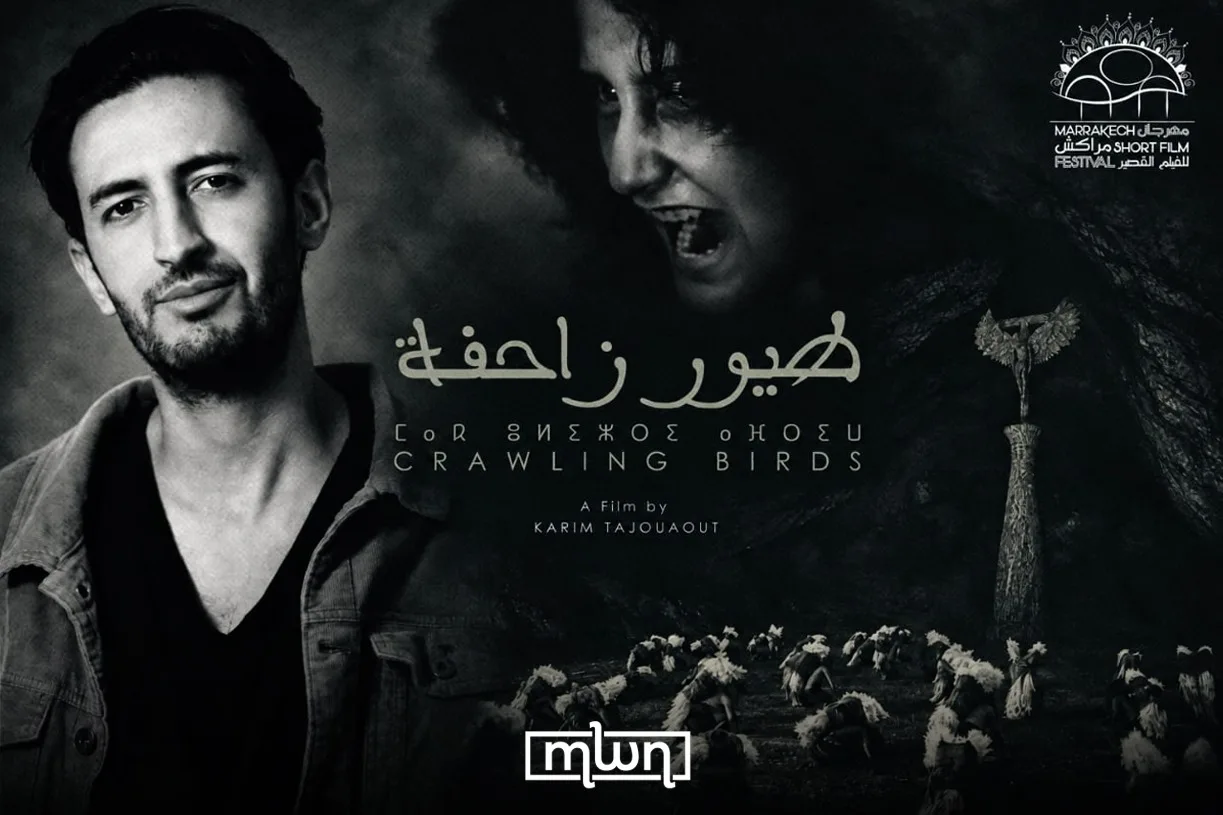
In Karim Tajouaout’s “Crawling Birds,” humanoid birds inhabit a cave, accepting a restriction they have inherited rather than tested. One of them discovers what his wings can do, ventures outside, and returns to share the discovery. Coming home is where his troubles begin.
“No one has the right to impose their vision on others,” Tajouaout told MWN Lifestyle magazine. His protagonist approaches the community with words, encouraging its inhabitants to try their wings themselves. “Wings are a capacity, just like the mind, and they deserve to be tested.”
Born in Oujda in 1992, Tajouaout studied applied arts before training in editing, special effects, and cinematography in Ouarzazate, alongside studies in creative writing, screenwriting, and directing. His background in photography informs a film whose stillness is as deliberate as its movement.
His references range from Plato and Nietzsche to Carl Jung, Molière, and Dan Brown. Each helps explain a particular choice: why the story begins with a return, why its inhabitants barely move, and why even its liberating figure should never become an unquestionable authority.
“Crawling Birds” initially belonged to a larger film project before Tajouaout developed it independently. The connection to Plato’s cave became intentional, he explained, because the allegory has entered humanity’s shared memory.
He is particularly interested in the fate of the person who leaves the cave, discovers another reality, and returns to awaken those still inside. In his reading, that danger recalls Socrates, whose questioning challenged the confidence of people who believed they possessed knowledge.
Socrates matters here because he recognises the limits of his own understanding. As Tajouaout explains it, exposing another person’s ignorance can provoke hostility, especially when that person has never considered the possibility of being wrong.
The filmmaker places this hostility within a much longer history of persecution. He invokes figures including Hypatia, Giordano Bruno, Al-Hallaj, Spinoza, Farag Foda, Galileo, and Ibn al-Muqaffa as people who, in different circumstances and to different degrees, faced punishment, exclusion, or death for their ideas.
Yet the film also questions what its returning figure owes the community. Must someone who has escaped always go back?
Tajouaout begins his answer with Nietzsche’s “Thus Spoke Zarathustra.” He recalls Zarathustra addressing the sun, asking what its happiness would be without those who receive its light, before descending from his mountain solitude to share his wisdom.
The image helps him describe the urge to communicate after an experience has transformed you. Knowledge creates a desire to give something back, even when the people receiving it may be unwilling to listen.
He connects this to Joseph Campbell’s account of the hero’s journey, particularly the return with the “elixir,” which is the experience or knowledge brought home after the adventure.
“‘Crawling Birds’ depicts precisely this moment of return,” he explained. Artists, philosophers, and scientists can undergo journeys that change them profoundly, he suggested. When they attempt to share what they have found, they encounter dogmatism, blind imitation, and beliefs protected from scrutiny.
These are “sharp thorns that may tear them apart,” he said. Fragments of their thinking may nevertheless remain caught there, acquiring significance long after their authors have been rejected.
Tajouaout refuses to turn that suffering into an obligation. “I don’t think it is a duty at all,” he said of returning. “It may indeed become the making of another martyr, whose image the community then preserves while emptying his idea of its meaning.”
His examples complicate the familiar ending in which a hero comes home and makes everything better. He mentions accounts of the Buddha’s initial hesitation to teach, Zarathustra’s rejection of disciples who merely imitate him, and Frodo’s inability to recover fully after returning home in “The Lord of the Rings.”
For Tajouaout, the journey may leave wounds that home cannot heal. Sharing knowledge can also fail if its recipients simply exchange one authority for another.
“The value of returning lies in giving others the possibility of experience and choice,” he said. “A freedom that needs followers who become copies of its author carries within it the seed of a new tyranny.”
The film’s symbols draw on another strand of his thinking: Jung’s collective unconscious and archetypes.
Tajouaout invokes these concepts to discuss images and patterns that recur across mythology, religious narratives, and folk tales. Campbell’s work, influenced by Jung, offers him a related way of considering why stories from different cultures can share recognisable structures.
“Some of its symbols, such as the cave, darkness, light, wings, and flight, belong to a shared human imagination and can be understood intuitively,” he said of “Crawling Birds.”
Other references require cultural or historical knowledge. He is interested in that difference, particularly when watching cinema from places whose traditions are unfamiliar to him. A gesture or image may carry an entire history that a first viewing cannot reveal.
Sometimes, he suggested, understanding requires watching again, researching a symbol, or interpreting the work through the cultural context that produced it.
That attention to inherited patterns also shapes the film’s conflict. Tajouaout sees people repeating mistakes under changing circumstances, with new explanations for old forms of domination.
His opposing characters, Socrates and Tartuffe, give that repetition recognisable faces.
Tartuffe draws on Molière’s hypocrite, who exploits religion and other people’s vulnerability while concealing his interests beneath moral language. In “Crawling Birds,” his authority depends on the cave remaining as it is.
“His existence, material interests, position, and authority are all tied to the continuation of that system,” Tajouaout explained. “This is why I called him the ‘guardian of illusion.’”
The conflict follows from those interests: “Socrates unsettles certainty through questions, while Tartuffe protects illusion through fear.”
But borrowed certainty is not confined to the villain. Tajouaout recognises it in the everyday habit of repeating arguments without examining them, sometimes defending contradictory positions because both were absorbed from elsewhere.
He jokingly calls this “parroting.” “I don’t exempt myself from it,” he added. Escaping it requires continually revisiting habits, assumptions, and newly acquired ideas, including those someone may have misunderstood.
The fish story in the film takes this problem further. Tajouaout describes it as the moment when someone assumes their perspective is necessarily correct and imposes it through force. What they consider a rescue becomes an act of killing.
“The desire to guide or liberate another person turns into violence inflicted on them in the name of their own good,” he said.
This is why the protagonist’s use of persuasion matters. The inhabitants must be able to discover their wings without being compelled to accept somebody else’s account of freedom.
The film’s imagery also asks what happens when the person delivering that message becomes sacred.
Discussing its winged, crucified figure, Tajouaout turns to Dan Brown’s novel “Origin.” He points to its artificial intelligence character, Winston, and the construction of a martyr narrative around its creator, Edmond Kirsch, as a fictional example of death being used to amplify an idea.
The parallel interests him because public reverence can obscure what a person actually argued.
“A society can worship the symbol of freedom while refusing to practise freedom itself,” he said.
He contrasts Socrates’ acceptance of death with a remark attributed to Bertrand Russell about refusing to die for ideas that might be mistaken. What matters to Tajouaout is the doubt that the comparison introduces.
“We should not treat what we believe as a final and absolute truth,” he said. “Even the most rigorous scientific theory remains a model open to revision.”
These concerns shape the physical construction of “Crawling Birds.” Its restricted movement gives conformity a visible form.
“I gave movement only to the protagonist and the antagonist because both possess ideas and the ability to make decisions, despite their opposing positions,” Tajouaout explained. “The cave’s inhabitants, however, neither think nor decide; they are followers frozen in place.”
Even their attack on the protagonist follows collective instruction rather than individual judgement: “Do what your neighbour did and what you were ordered to do.”
Still images and intermittent motion became his means of expressing bodies deprived of agency. Speech and narration carry the argument, while a secondary narrator uses a lyrical delivery that he compares to the Greek chorus.
“I wanted the viewer to feel the heaviness of movement, the suffocation and stagnation inside the cave, as though life itself were not flowing naturally,” he said. “When the capacity to think freezes, the body freezes with it.”
Tajouaout calls the principle behind these choices “responsible freedom”: choosing a form that serves the work’s dramatic and psychological needs without submitting to ready-made conventions.
As the film heads to MARRAKECHsFF, its cave holds a question that survives any single escape. What will people do with the freedom to think, particularly when thinking threatens the comfort of belonging?
For its director, even honouring the person who asked that question can become a way of avoiding it.
“Society may kill the free person, then later turn them into a sacred icon,” he said. “It keeps their image, but abandons their questions and critical spirit. Sanctifying the martyr may become a new way of killing the idea they died for.”