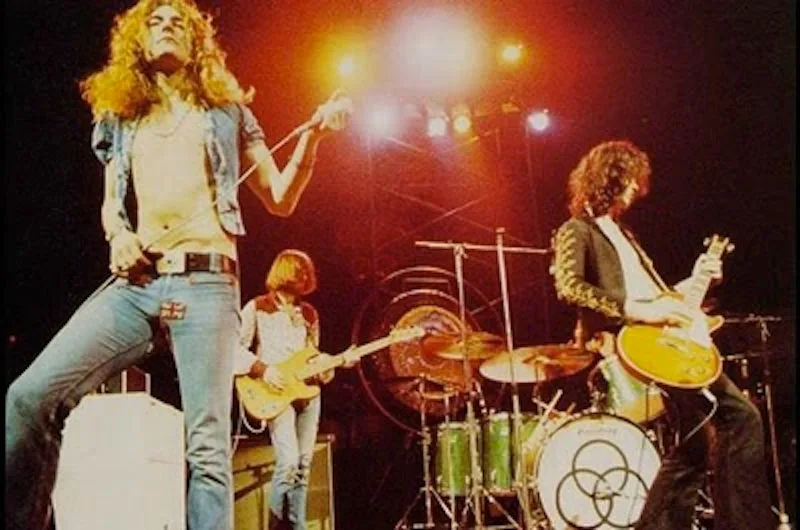
Rabat – With an extensive catalogue of hit songs from “Whole Lotta Love” and “Stairway to Heaven” to “Black Dog” and “Immigrant Song,” it is perhaps a surprise to hear that lead singer Robert Plant calls “Kashmir” one of his personal favourite tracks. With an unusually understated vocal part (for Led Zeppelin’s standards) and ambiguous lyrics, it’s an enormously spacious piece clocking in at over eight and a half minutes long and inspired – not by Northern India as the name suggests – but by the deserts of Morocco.
The sound of the desert
This is by no means the first Western rock song to be inspired by the desert: The Eagles and Lynyrd Skynyrd, to name a few, wrote extensively about the desert landscapes of the Southwestern US. But “Kashmir” is evocative of the desert landscape; inspired by its majesty whilst also retaining an element of mystery.
Desert rock
Bands like Kyuss and Queens of the Stone Age are labeled as desert rock, and although this partly stems from where the bands are from, it is also an identity based on musical features. The Killers for example are from Las Vegas and would not describe their music as desert rock, although they definitely write about their home town, which is in the desert. Musically desert rock music is heavily guitar based, favoring tones that are described as warm and dry – language to describe the desert – with repetitive drum rhythms that the more poetic analyst could attribute to the desert’s vast expansiveness. These groups will often incorporate elements of Mexican music such as the classical guitar and musical references to mariachi in their tracks which again, give a deliberate sense of geographical location.
Queens of the Stone Age -“‘First Is Giveth” – warm fuzz guitars, repetitive rhythms and classical guitars evoke the desert and particularly Mexico deliberately.
Deliberate North African references
For some musicians, the sounds of the desert are a much more obvious and deliberate musical influence. In 1999, The Police’s lead singer Sting featured the track “Desert Rose” on his “Brand New Day” album. Directly inspired by the Rai music he heard in clubs in Paris, Sting sings a duet with Cheb Mami, a giant in Tunisian Rai music, and the track features North African percussion instruments as well as the use of the harmonic minor scale which in the West. It all clearly evokes Arabic music.
The song itself is more of a musical interpretation of North African music, rather than a product of inspiration. This is evident in the slightly confusing music video where the singer drives through the Mojave desert in the US. The video culminates with the track live in a club in Las Vegas. The references to the desert in the lyrics are only passing – it is a song more focused on spirituality rather than physical landscape. The desert is a metaphor for Sting, which serves as a musical canvas to base the song off, rather than directly being inspired by the location.

Songs inspired by the desert
U2’s “Joshua Tree” does not hide its references. The album refers to both the tree which is native to the Mojave desert in the US, and to the national park in California. However, there are some of the less obvious desert references in the music. There is a common theme of expansiveness and emptiness expressed in the rolling repetitive drum rhythms and bass parts in tracks like “Where the Streets have no Name” as well as explicit references in the lyrics: “I’ll show you a place – High on the desert plain – Where the streets have no name.”

The confusion of ‘Kashmir’
During their 1973 concert tour, Led Zeppelin visited Morocco and the Sahara desert. During the long drives through the desert, guitarist Jimmy Page was inspired by the expansive scenery of endless desert and what through his eyes appeared exotic and mystical about the country, yet the track was confusingly named “Kashmir.” The lyrics explore the themes of meaning, mysticism, and finding answers to life’s questions, all with a musical backdrop inspired by the desert. The track does not try to emulate or write desert music (like Queens of the Stone Age) or music in regional styles (like Sting’s Rai influenced track).
“Oh, let the sun beat down upon my face – with stars to fill my dream.
I am a traveler of both time and space – to be where I have been.”
(and later)
“Oh, pilot of the storm who leaves no trace – like thoughts inside a dream.
Heed the path that led me to that place – with yellow desert stream.”
A desert-inspired sound
Musically, the track delivers an enormous sound that fits the expansive horizons of the Sahara.
This is achieved through the combination of three main parts: the drums provide a strong and regular rhythm to drive and underpin everything; the vocal and guitar parts float above to create an interplay of movement between all three; and the later-on string section heightens the track.
The guitar part is unique in itself as it rises and rises, only to finish by dropping down the octave to start again.When paired with the soaring strings later on in the track, it adds to the sense of grandiosity and size.
The guitar part also uses drones which are a musical link to North African and Middle Eastern music – without being exclusively from there. It’s evocative of a musical regionality, without being a parody or a pastiche. Lyrically, the theme is not the desert itself, but ideas of a physical and spiritual journey born out of the South of Morocco. The desert backdrop is clearly referenced:
“Oh, all I see turns to brown
As the sun burns the ground.
And my eyes fill with sand
As I scan this wasted land.
Tryin’ to find, tryin’ to find where I’ve been.”
Why Kashmir?
The harmonic minor scale is obviously inspired more by Arabic music than Indian music in the Western psyche, and the use of drones in the track is a common musical feature in many musical styles around the world, giving the track a little ambiguity.
The choice of song name refers to feelings of wanderlust and adventure from the perspectives of the band. “Kashmir” simply represents a far away place for them, although the physical geography and inspiration for the song is rooted in their experiences in Morocco in the early 70s.