Rabat – I confess that upon reading the term “autodidactic” next to the stunning works by Tallal and Hassan El Farouj, I wasn’t sure exactly what it meant in the art world. Coming from the Greek “Autós” (“self”), and “Didaktos” (“taught”) how did this word differ from the categories sometimes labelled as “Naive Art,” “Art Brut” or “Outsider Art?”
All of these terms are essentially synonymous, just coined at different times, in different places, and by different people. They all refer to artists who did not receive formal education and so taught themselves – although due to the connotations in English with the word “naive,” I think “autodidactic art” is a more positive term that gives the artist more credit for their achievements!
Villa des Art – Rabat
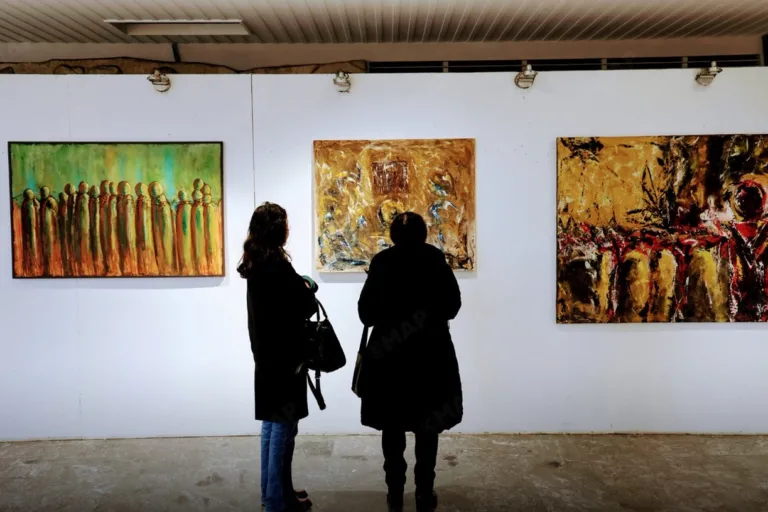
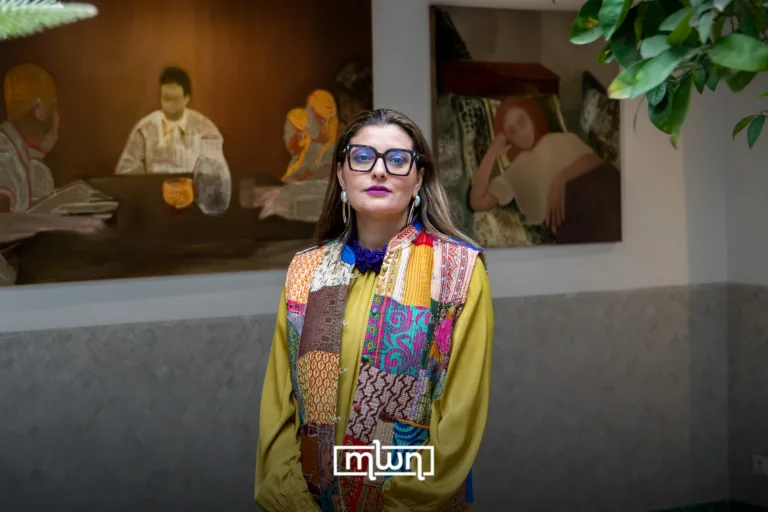
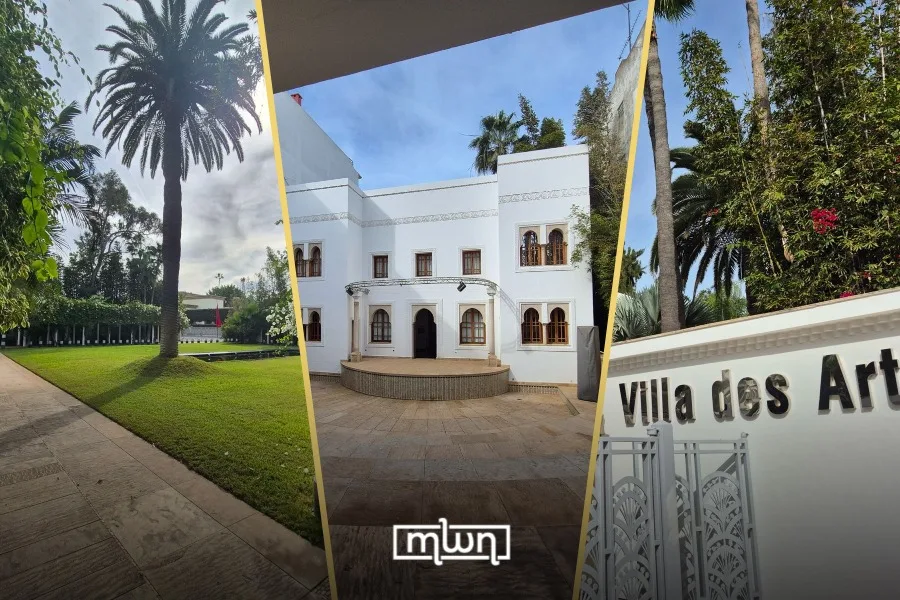
Rabat’s Villa des Arts is a beautiful site in its own right. It is a converted neocolonial mansion built in 1929, and inside the Art Deco exterior, the buildings host exciting works by contemporary Moroccan artists. Amongst the current pieces exhibited are paintings by Fatima Hassan El Farouj and Chaibia Tallal, two of Morocco’s autodidactic contemporary artists.
Fatima Hassan El Farouj (1945-2010)
Working in Rabat as a seamstress, Fatima was skilled at sewing, weaving, henna, and embroidery before she started painting. Introduced to painting by her husband who was an artist in his own right, her background in intricate, detailed work is evident in her works. Her use of intricate details weave stories of Moroccan daily life with symbolism in her pieces, which are most often full of vibrant colors. However in Villa des Art you can see one of her large canvases in black and white. The absence of color in this case draws the viewer in to investigate the details with more concentration; you have to work for it, but discovering the little details hidden in this composition is worth the effort!


Chaibia Talal (1929-2004)
A mother at 14 and a widow at 15, she worked as a maid and cleaned wool to support her son and his education. Inspired by a dream in which she was told to make art, Chaibia awoke and decided to teach herself to paint. Her son became an artist and introduced her works to Pierre Gaudibert, the director of the Museum of Modern Art Paris, in 1965, resulting in critical acclaim and exhibitions of her work at the Goethe-Instituit in Casablanca the following year.
Her style was often called “Outsider Art” as Chaibia freely followed her inspiration, with bold blocks of colors, most often depicting scenes of women in Moroccan rural life at festivals and gatherings, painted on wood and cardboard, and often with her fingers. Chaibia was not constrained by an artistic elite or style expectations established at the time, using the creation of art as a source of personal strength and confidence to help her as a single mother.
Her independence and unique style resulted in her being largely shunned in the Moroccan artworld in the 1960s, however over time her reputation has changed and her works have now been purchased by museums and galleries across the Gulf and North Africa, as well as being exhibited across Europe and the USA.

Some lesser-known self-taught artists
Frida Kahlo (1907-1954)
Despite some surrealist qualities, Frida rejected the artistic label of “Surrealism,” as it was based on dreams, and she claimed that her work was her reality. Full of hidden meaning, Mexican folklore, and emotional pain, her paintings document her turbulent relationships and introspection in her own unique self taught-style she developed during her convalescence from a bus accident aged 18.

Henri Rousseau (1844-1910)
Rousseau worked as a clerk in France, spending his free time – and later his retirement – teaching himself how to paint aged 40. Dismissed as naive and ridiculed by his contemporaries, his lack of artistic trappings in composition and depth is now what makes his work well renowned worldwide.

Jean-Michel Basquiat (1960-1988)
Dropping out of high school aged 17, Jean-Michel Basquiat began making graffiti art in New York city before becoming part of the city’s neo-expressionist movement. Basquiat may have not had any formal art education, but he studied art history from visiting the museums in New York City and took inspiration from the vibrant culture around him, resulting in his socially conscious artwork.

Max Ernst (1891-1976)
Ernst was no stranger to the classroom in other subjects, in fact he was a prolific student, well versed in philosophy, psychology, German history, psychiatry, and art history, but with no formal training in making art itself. Ernst joined the Dadaist movement in 1918, channeling his turmoil following the First World War, then became part of the Surrealist movement in the 1920s. His works draw influence from Asia and the Pacific as well as his European and US contemporaries.

Vincent Van Gogh (1853-1890)
No list of autodidactic artists could be complete without including Van Gogh – an artist so famous it is often forgotten that other than some help from his cousin Anton Mauve, Van Gogh was self-taught. He enrolled in the Academie Royale des Beaux Arts in Brussels but there is little evidence he attended. Mastering the fundamentals by copying prints and studying drawing manuals on his own, Van Gogh’s work went on to inspire the Fauve and German Expressionist movements despite only selling one painting during his short lifetime.

The value of autodidacts
It is perhaps due to the global popularity of these artists that audiences today can look at the amazing works of lesser-known artists on an international level such as Chiabia Talal and Fatima Hassan El Farouj. We can have an appreciation – not only for the aesthetic appeal of their works – but the talent and self determination required for their creation. They are a testament that inspiration is not only found and nurtured in formal artistic institutions.Villa des Arts in Rabat gives these artists an exhibition space for their work to carry on.