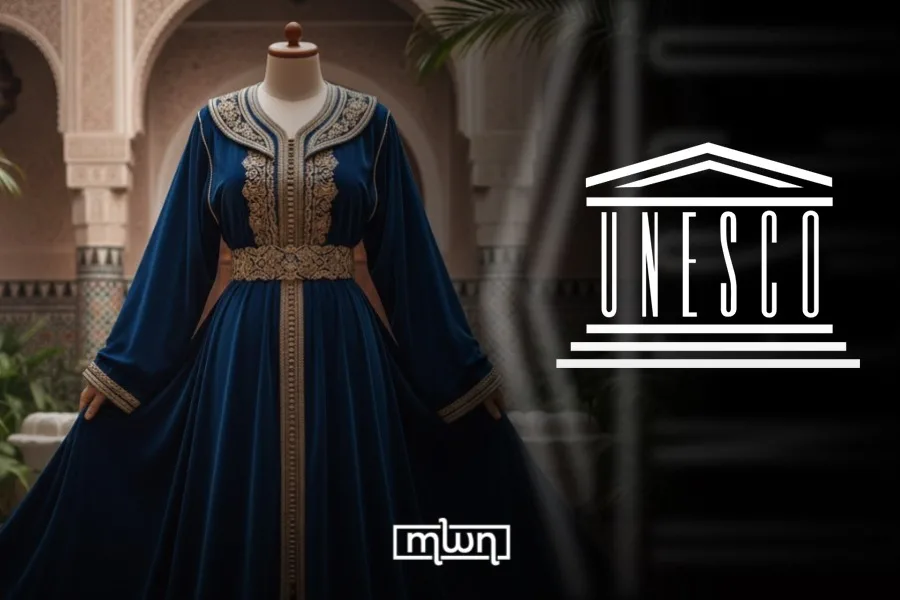
Fez — Morocco is entering the decisive phase of its effort to inscribe the Moroccan caftan on UNESCO’s Representative List of the Intangible Cultural Heritage of Humanity, as the UN agency’s Intergovernmental Committee prepares to hold its 20th session in New Delhi in December.
If approved, the garment would join 15 Moroccan items already recognized as “living heritage,” from the cultural space of Jemaa El-Fna and the Tan-Tan Moussem to Gnawa music, Tbourida, Malhun poetry, and metal engraving.
UNESCO committee set to examine Moroccan caftan file
Submitted under the title “Moroccan Caftan: Art, Traditions and Skills,” the nomination was prepared by the Ministry of Youth, Culture and Communication in coordination with Morocco’s permanent delegation to UNESCO.
It is scheduled to be examined during the 20th session of the Intergovernmental Committee for the Safeguarding of the Intangible Cultural Heritage, which will run from December 8 to 13 at New Delhi’s Red Fort, itself a UNESCO World Heritage site.
UNESCO’s file presents the caftan as a long, finely-worked tunic worn by people of different ages and genders for weddings, religious festivities, and life-cycle rituals.
The garment is described as the result of centuries of evolving dress practices in Morocco, shaped by Arab, Amazigh, and Jewish influences, and sustained by a dense network of master weavers, tailors, embroiderers, sfifa-makers, button-makers, and apprentices whose skills vary from city to city.
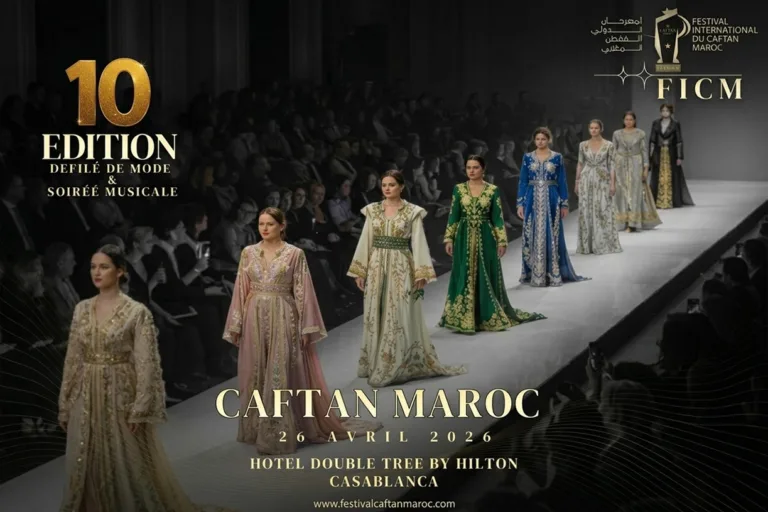
The nomination also emphasizes the caftan’s contemporary reach: it notes how Moroccan designers have carried the garment onto international runways while staying anchored in traditional techniques, and how new audiences abroad increasingly associate the caftan with Moroccan identity and craftsmanship.
Defending heritage amid regional disputes
Morocco’s push to have the caftan formally inscribed comes against a backdrop of recurring cultural disputes with neighboring Algeria over garments, music, and cuisine.
In recent years, Algerian institutions and media have sought to present the caftan as part of their own heritage, even as Moroccan historians, designers, and cultural specialists point to the garment’s terminology, archival traces, and artisanal ecosystem as evidence of a specifically Moroccan lineage.
Those experts argue that this dynamic differs from elements that are genuinely shared across borders. Couscous traditions, for example, were jointly inscribed in 2020 by Morocco, Algeria, Tunisia, and Mauritania as a multinational file, reflecting a regional culinary practice with deeply intertwined histories.
By contrast, the caftan file currently involves only Morocco as the submitting state, underscoring Rabat’s intention to have the garment recognized as a national expression rather than a shared one.
For Moroccan diplomats and cultural officials, a positive decision in New Delhi would do more than settle a symbolic debate.
It would strengthen the country’s ability to defend its designers and artisans when the caftan is copied, mislabelled, or claimed elsewhere, and would provide an additional reference point in international discussions about cultural appropriation and heritage branding in the Maghreb.
Legal tools and future nominations
The caftan file is only one pillar in a broader architecture Morocco is building to protect its heritage. In July 2025, the Minister of Youth, Culture and Communication signed a memorandum of understanding in Geneva with the Director General of the World Intellectual Property Organization (WIPO), aimed at strengthening cooperation on copyright, related rights, and the legal safeguarding of Moroccan cultural heritage.
A central feature of the agreement is the international promotion of “Label Maroc” (“Morocco Label”), a certification managed by national IP authorities that is designed to protect emblematic Moroccan creations such as the caftan and traditional zellige against misuse or misrepresentation.
The partnership also provides training and technical support to Moroccan institutions like the Moroccan Copyright Office, allowing them to deploy new tools — from resale rights to digital rights management — in defense of creators and craftspeople.
Within UNESCO’s own framework, Morocco has steadily expanded its intangible heritage portfolio since 2008, when the cultural space of Jemaa El-Fna and the Tan-Tan Moussem became its first entries on the Representative List.
One element every two years
Subsequent inscriptions have covered everything from Gnawa music and the Sefrou Cherry Festival to argan-related know-how, Tbourida, Malhun, and arts associated with engraving on metals, bringing the total to around 15 recognized elements by 2024.
Because the Intergovernmental Committee can only examine a fixed number of national files each cycle, the system effectively limits how quickly any single country can add new elements — in practice, often translating into one major national inscription every couple of years.
Moroccan authorities have therefore begun to map out a multi-year roadmap: with the caftan file now in its final stage, attention is already turning to crafts like the zellige of Fez and Tetouan, for which a dedicated nomination project was officially launched in Sale in mid-November.
From caftan to zellige and beyond
That zellige initiative, unveiled during a study day and paired with an exhibition titled “Moroccan Zellige: A Historical Heritage and a Living Tradition,” aims to document the craft’s history from early examples in Aghmat to the great monuments of Fez and Tetouan, while ensuring that its geometric techniques and workshop practices are transmitted to new generations.
For now, however, all eyes are on New Delhi and the upcoming session of UNESCO’s Intergovernmental Committee.
Diplomacy and protection of cultural heritage
The Moroccan caftan will be considered alongside dozens of other living traditions from around the world — a reminder that questions of dress, identity, and craftsmanship can carry diplomatic weight, and that Morocco intends to answer them with a mix of cultural diplomacy, legal preparation, and long-term planning for its heritage.