Fez — The documentary “HANDI’CAP sur l’Atlas” (“HANDI’CAP on Top of the Atlas”) has had its first public screening at the Renaissance cinema in Rabat.
The 52-minute film follows a group of students from Collège Saint-Exupéry in Rabat as they climb Mount Toubkal alongside two of their peers with disabilities.
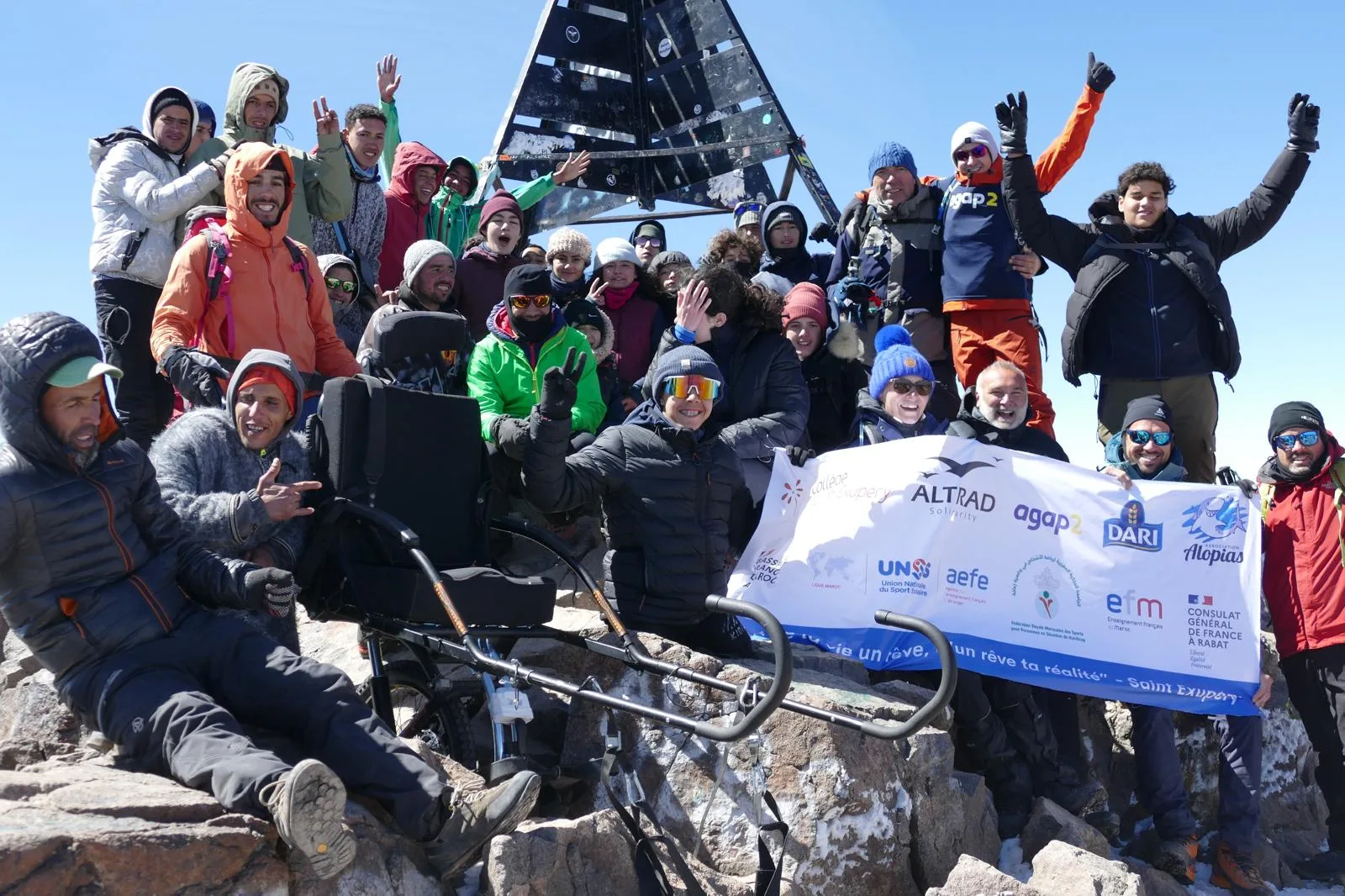
The ascent took place on May 13 and led the team to the summit of North Africa’s highest peak, at 4,167 meters. The group reached the top after around seven hours of effort on the second day of walking.
A collective adventure to 4,167 meters
At the heart of the film are Abdellah and Malak, both 16. Abdellah is a swimmer from the Royal Moroccan Federation of Sports for People with Disabilities and has both legs amputated. He made the climb in a joëlette, a special all-terrain chair adapted for mountain trails.
Malak is a blind student at Lycée Descartes and a former pupil of Saint-Exupéry. The film shows her progressing step-by-step, guided by her teammates and by sound, touch, and voice.
Fifteen students from the school’s sports association and the Club Engagement formed the rest of the rope team. Some of these students also live with invisible disabilities. The expedition is supervised by explorer and speaker Arnaud Chassery and his team, who bring technical experience and a culture of teamwork.
Inclusion, solidarity, and pushing limits
“HANDI’CAP sur l’Atlas” is less about performance than about what it takes to move forward together. The camera captures moments of fatigue, doubt, and tension, but also bursts of laughter, shared songs, and the small gestures that keep the group going.
The climb facilitates discussions about inclusion in very concrete terms. Every decision on the path is made with the whole team in mind. The joëlette requires several pairs of hands. Malak’s progress depends on clear, calm instructions. The stronger hikers slow down to keep the group together.
By the time they reach the summit, the achievement is collective. The film underlines this, showing faces marked by effort and emotion rather than focusing only on the landscape.
Two firsts on the roof of North Africa
The project is marked by two unprecedented feats. Abdellah is the first young person to reach the summit of Toubkal in a joëlette. Malak becomes the first young blind woman to stand at the top.
The documentary treats these “firsts” not as isolated exploits, but as the result of planning, training, and mutual trust. It also shows how technical tools, like the adapted chair, can open up spaces that seemed out of reach.
For the students of Saint-Exupéry, the ascent is a lesson in what inclusion looks like when it is lived, not just discussed. For Abdellah and Malak, it is a powerful affirmation of their place in the group and in the mountains.
A different way to look at disability
By focusing on the climb rather than on labels, “HANDI’CAP sur l’Atlas” helps shift the way disability is seen. The film gives space to abilities, strategies, and adaptation. It shows that the challenge lies less in the bodies themselves than in the way environments are designed and teams are organized.
The screening at the Renaissance cinema is a first step in bringing this story to a wider audience. The project, supported by the French Embassy in Rabat and carried by the school community, positions sport and nature as tools for education and social change.
From the first steps on the trail to the final group photo on the summit, “HANDI’CAP sur l’Atlas” offers a simple message: when paths are opened and support is shared, the highest peaks can become places where everyone has a place.