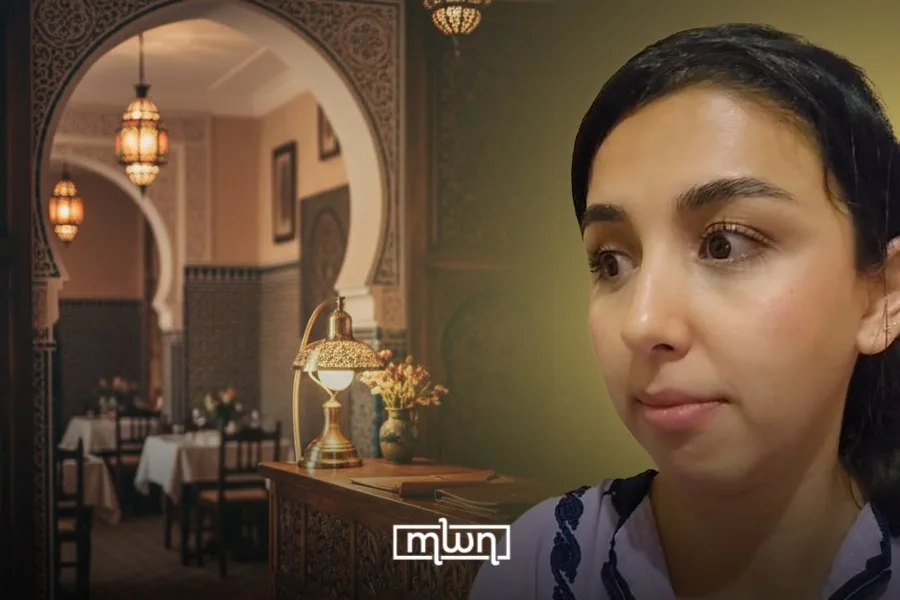
Fez — A short video shared by Moroccan content creator, @just.zmagriya, has sparked fresh debate about “foreign privilege” in the country’s restaurants and cafes. The clip reenacts a restaurant that refused a reservation made in Darija before accepting the same reservation in French minutes later.
In the video, the creator first calls the restaurant speaking Moroccan Arabic, asking to book a table for two that evening. The employee replies that the restaurant is fully booked and suggests she try again the next day.
A few minutes later, she calls again. This time she speaks French and asks for a five-person reservation for that same evening. On the other end of the line, the employee hesitates only long enough to ask one question: “Are you French?” After she answers “yes,” he accepts the booking and offers her a table without mentioning any lack of availability.
The creator has since clarified that the video is a reenactment, not a live recording. She says it faithfully reproduces an exchange she experienced in real life. That nuance has not slowed the clip’s spread online, nor the conversations it has set off.
A familiar feeling, a new flashpoint
The scene struck a nerve because it felt familiar to many viewers. In comment sections, users recounted similar situations in cafes, hotels, and beach clubs. Some described being turned away with vague excuses, only to see foreign visitors welcomed moments later. Others spoke about changes in tone or attitude depending on the language they used.
The term that quickly resurfaced was “The European Complex”— the idea that foreign customers, and especially those perceived as European, are treated as more valuable than locals. For some Moroccans, the video was a vivid illustration of that bias at work.
Others urged caution, arguing that one clip cannot stand as proof for an entire sector. They pointed out that restaurants do sometimes keep tables aside for larger bookings or regular clients. They also noted that reenacted videos can blur the line between testimony and performance.
Yet even among those who questioned the specific case, many agreed on one point: The fact that the video resonated so widely suggests a deeper discomfort with how class, language, and perceived origin intersect in daily life.
Language as a filter
One part of the clip drew particular attention: the moment when the employee asks whether the caller is French. For critics, that brief exchange said more than any long speech could. It suggested that foreign status itself could open doors that remained closed to locals only minutes earlier.
The use of French also raised questions. In some spaces, it functions less as a neutral working language and more as a social marker. Speaking French fluently can signal status, education, or foreign ties. For many viewers, the video showed how language can act as a filter, determining who is seen as “desirable” clientele.
This dynamic is not new. Discussions about “code-switching” in Morocco — shifting between Darija, French, Amazigh, or English depending on context — have long touched on questions of class and access. The clip condensed the debate into a single, simple scene.
Hospitality, image, and hierarchy
Morocco’s reputation as a welcoming country is central to its tourism strategy – and Moroccans take pride in their hospitality.. The idea that locals might receive worse treatment than foreign visitors therefore hits a sensitive point.
Some industry voices, who weighed in on the debate, stressed that most restaurants and hotels depend on both local and international guests. They argued that clear reservation rules, transparent pricing, and equal treatment are in the sector’s own interest.
At the same time, others linked the issue to wider economic pressures. In cities where luxury venues rely heavily on tourists and expatriates, staff can feel pushed to prioritize higher-spending clientele. That tension can sometimes translate into visible differences in how customers are handled.
The video has provided a simple lens through which to view those pressures. It shows how hierarchy can appear in a pause, a question, or a change in tone.
What viewers are asking for
Beyond the initial shock or outrage, many comments converged on similar demands. People called for:
Clear reservation policies, communicated in advance and applied equally, regardless of language or nationality.
Basic training on non-discrimination and customer care for front-of-house staff.
More space for feedback and complaints when clients feel unfairly treated.
Several users also highlighted the role of content creators in documenting everyday experiences. They argued that such clips, even when staged, can help make invisible habits visible and open space for accountability.
A debate that goes beyond one restaurant
Online, attention has already shifted from the specific venue to the wider pattern it is seen to represent.
The debate speaks to deeper questions about how Moroccans relate to foreign visitors, to their own languages, and to themselves. It touches on pride and insecurity, on economic realities and social reflexes.
In that sense, the viral clip is about more than a cancelled reservation. It is about who gets to feel welcome, and on what terms. And it suggests that in Morocco’s hospitality scene, as in many other spaces, true inclusion will depend not only on smiling slogans, but on what happens in small, unseen moments — including a brief phone call on an ordinary day.