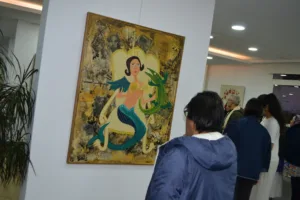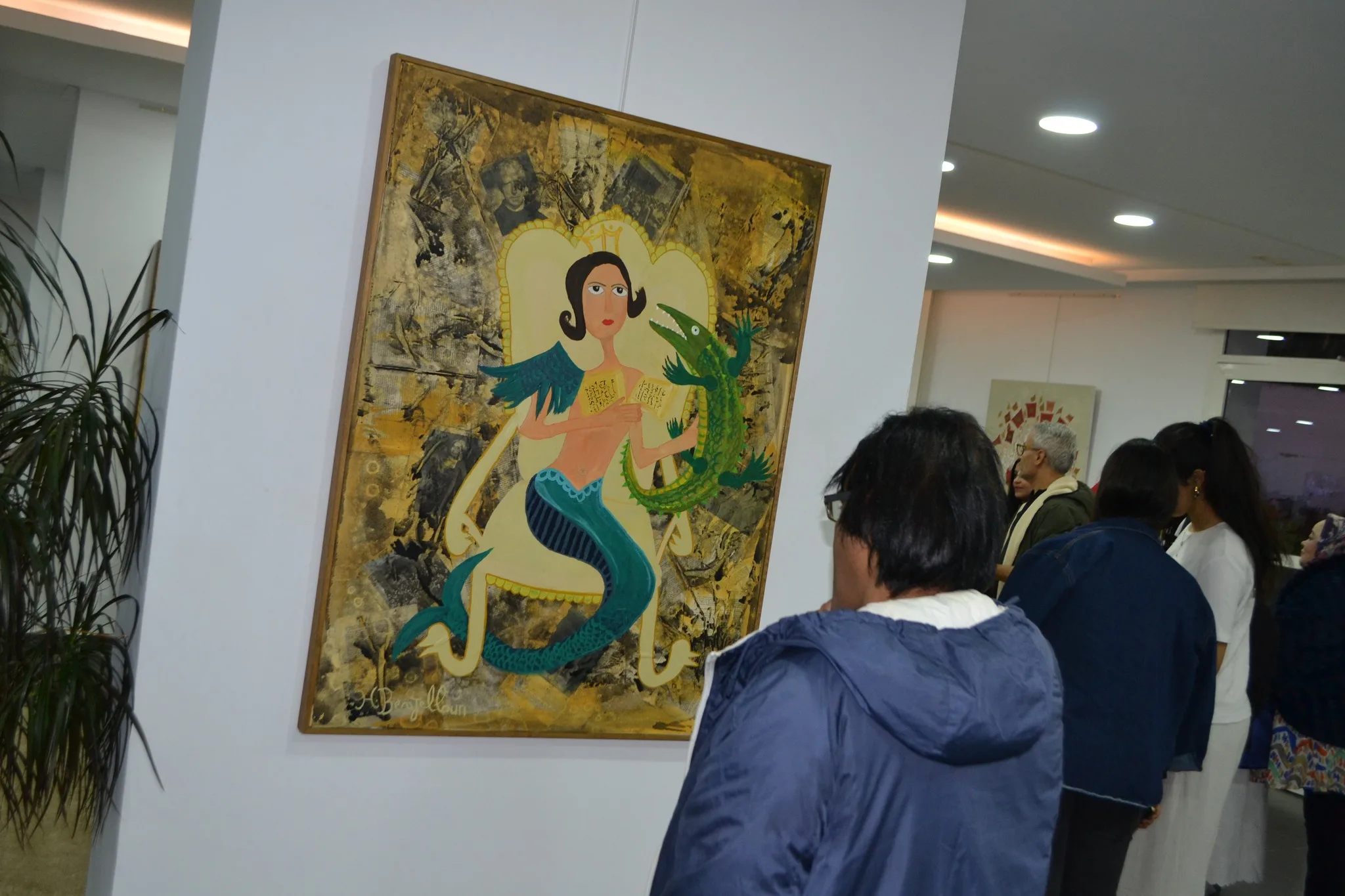
Fez — The Iklyle Cultural Center has hosted “Amphibious Worlds,” a solo exhibition by Moroccan visual artist Houda Benjelloun, held as part of the 50th anniversary of the Green March. The show brought together a series of canvases centered on hybrid figures and imagined universes, where human and animal elements fuse and overlap.
Two of the works are dedicated directly to the Green March, under the title “The Epic of the Free Moroccans.” They foreground a distinctly Moroccan visual language, dominated by earth-inspired tones and grounded, tactile textures.
Surrealist language for hidden dimensions
Speaking at the closing of the exhibition, Benjelloun explained that “Amphibious Worlds” builds on a surrealist approach that she has been developing throughout most of her work. Each piece, she noted, “refers to another,” forming a coherent ensemble rooted in imagination and dream.

She described the marine, aquatic, and terrestrial creatures in her paintings as coexisting to illustrate different levels of the imaginary, while placing strong emphasis on chromatic diversity. Color becomes a way to signal shifts between one inner state and another, rather than a purely decorative layer.
A mirror of the collective unconscious
For Benjelloun, “Amphibious Worlds” is conceived as an inward journey as much as a visual spectacle. She presents the project as “an invitation to contemplate our hidden and mysterious worlds […] a mirror of the collective unconscious, where myths intertwine with the concerns of the present,” and insists that visual art remains “a space of freedom where colors breathe.”

Her hybrids — part human, part animal, part symbol — function as guides through this submerged territory, pointing toward emotions and stories that resist straightforward narration.
Open images, open interpretations
Poet and novelist Hassan El Madadi sees the exhibition as more than an exercise in style. He argues that Benjelloun’s practice goes beyond simple aesthetic research, and that she turns her canvases into open supports, inviting viewers to construct their own readings.

Rather than closing the works with a single, fixed message, the artist leaves room for multiple interpretations. The result is a viewing experience where meaning is not imposed from above, but built gradually in the encounter between painting and public.
A rising voice in Moroccan contemporary art
Born in Rabat in 1990, Houda Benjelloun has emerged as a notable figure on the Moroccan contemporary scene. Her work combines technical control with a sustained exploration of the imaginary, often positioning itself on the threshold between the real and the fantastical.

Her paintings invite audiences to reflect on that border and to consider their own inner landscapes. With “Amphibious Worlds” in Tetouan, she extends that exploration into a series of hybrid, dreamlike spaces that ask what might surface if we allow our hidden worlds — and our colors — to breathe.