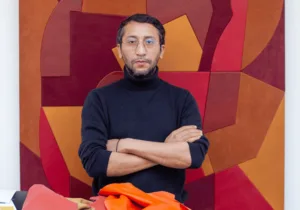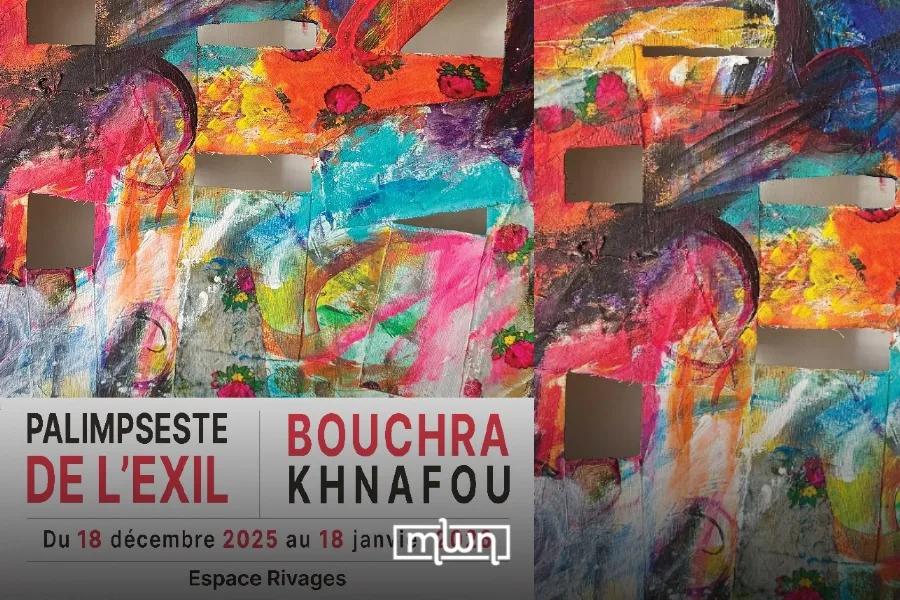
Fez — The Hassan II Foundation for Moroccans Residing Abroad is hosting “Palimpseste de l’exil,” (Palimpsest of Exile), a solo exhibition by Morocco-born, Qatar-based artist Bouchra Khnafou, from December 18 to January 18 at Espace Rivages.
The show brings together recent works that explore contrast, memory, and the experience of living away from home.
A Moroccan artist shaped by fine arts and the Gulf
Khnafou graduated from the École Supérieure des Beaux-Arts de Casablanca in the early 2000s and now teaches visual arts within Qatar’s Ministry of Education.
She is also the founder and former president of the Forum Ahmed Cherkaoui association in Morocco and has taken part in numerous exhibitions in Morocco, the Gulf and Europe, including shows in Bejaâd, Marrakech, Rabat, Doha, Manama and Mannheim.
Speaking about her training in Casablanca, she recalls years marked by limited means but intense work. “The strength of a creator does not lie in material resources,” she says, “but in patience, sincerity and the ability to turn limited means into tools of creativity.”
Mass and void, fabric and collage
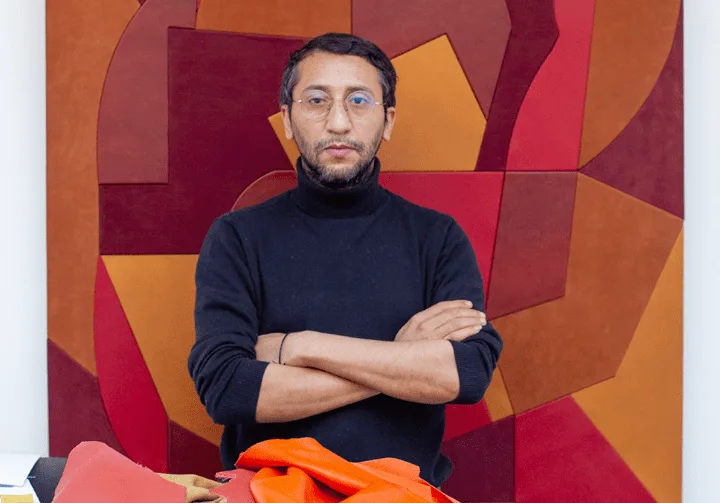
The works presented in “Palimpseste de l’exil” are built around contrast: vivid versus muted colours, full zones versus cut-out openings, and layers of collage that leave parts of the surface deliberately bare.
The Hassan II Foundation describes her approach as an “art of contrasts” where mass and emptiness structure the canvas in a visual rhythm that keeps a fragile balance.
Khnafou works with paper, fabric and recycled materials, treating each as a visual language rather than a neutral support. “Each material has its own nature, texture and color, and its own way of harmonizing with other elements,” she explains. “Thanks to this diversity, materials become part of the meaning, not just tools that build a form.”
She also embraces strong oppositions in color. “I dare to bring opposites together,” she says. “For me, contrast is the engine of life: light cannot be separated from shadow, calm from noise. By placing a vibrant colour next to a softer one, I create a subtle tension that gives life to the canvas.”
The red flower and the space left open
Many of her paintings feature a small red flower, a recurring sign that links different pieces in the show. Khnafou reads it as a discreet emblem of identity.
Leaving Morocco for Qatar, she says, gave that symbol a new weight: “The red flower became a sign of this duality, a discreet but powerful mark that carries the idea of identity that follows me everywhere… Its red recalls the warmth of Morocco, while its simple form fits with the calm aesthetic I discovered in Qatar.”
Equally striking are the cut-outs and empty spaces. For the artist, these openings are not gaps but presences of another kind. “In a visual artwork, emptiness is not an absence,” she notes. “When I leave openings or white spaces, I add another layer of meaning. The void becomes a window linking the work to the world around it… It lets the painting breathe.”
Exile as a new way of seeing
The title “Palimpseste de l’exil” points to layers of experience and memory, rewritten but never erased.
Living abroad, Khnafou says, has changed the way she looks at Morocco and at her own practice. “Distance did not break my link with Morocco; on the contrary, it made it more present,” she explains. Colors, light and symbols from home have gradually reappeared in her work, filtered through life in Doha and through exchanges with Arab and international artists.
She describes the Qatari scene as a source of energy, nourished by workshops, group shows and constant dialogue. “This cultural and artistic exchange has broadened my perspectives without cutting me off from my roots or my personal style,” she says.
A return to the place of origin
For Khnafou, exposing her work at Espace Rivages carries a special meaning. The space is dedicated to Moroccan artists living abroad; the foundation sees it as a place where they can reconnect with the country of their early work.
The artist shares that view. “More than a simple presentation of my work, this exhibition is a symbolic return to my roots,” she says. “It is a bridge that reconnects me to the memory of a place, to the Morocco that saw the birth of my beginnings and my first inspiration.”
“Palimpseste de l’exil” runs at Espace Rivages, headquarters of the Hassan II Foundation in Rabat, from December 18 to January 18. For Khnafou, this is both a homecoming and a new layer added to a long, evolving dialogue between distance, identity and the painted surface.