Fez — Today, it is hard to imagine a Moroccan home, cafe, or market stall without a pot of atay close by. Mint tea is offered to guests, poured for family, shared in negotiations, and served to tourists as a first introduction to the country.
Yet this “national drink” is a relatively recent arrival, woven into Moroccan life over just a few centuries.
From diplomatic gift to daily habit
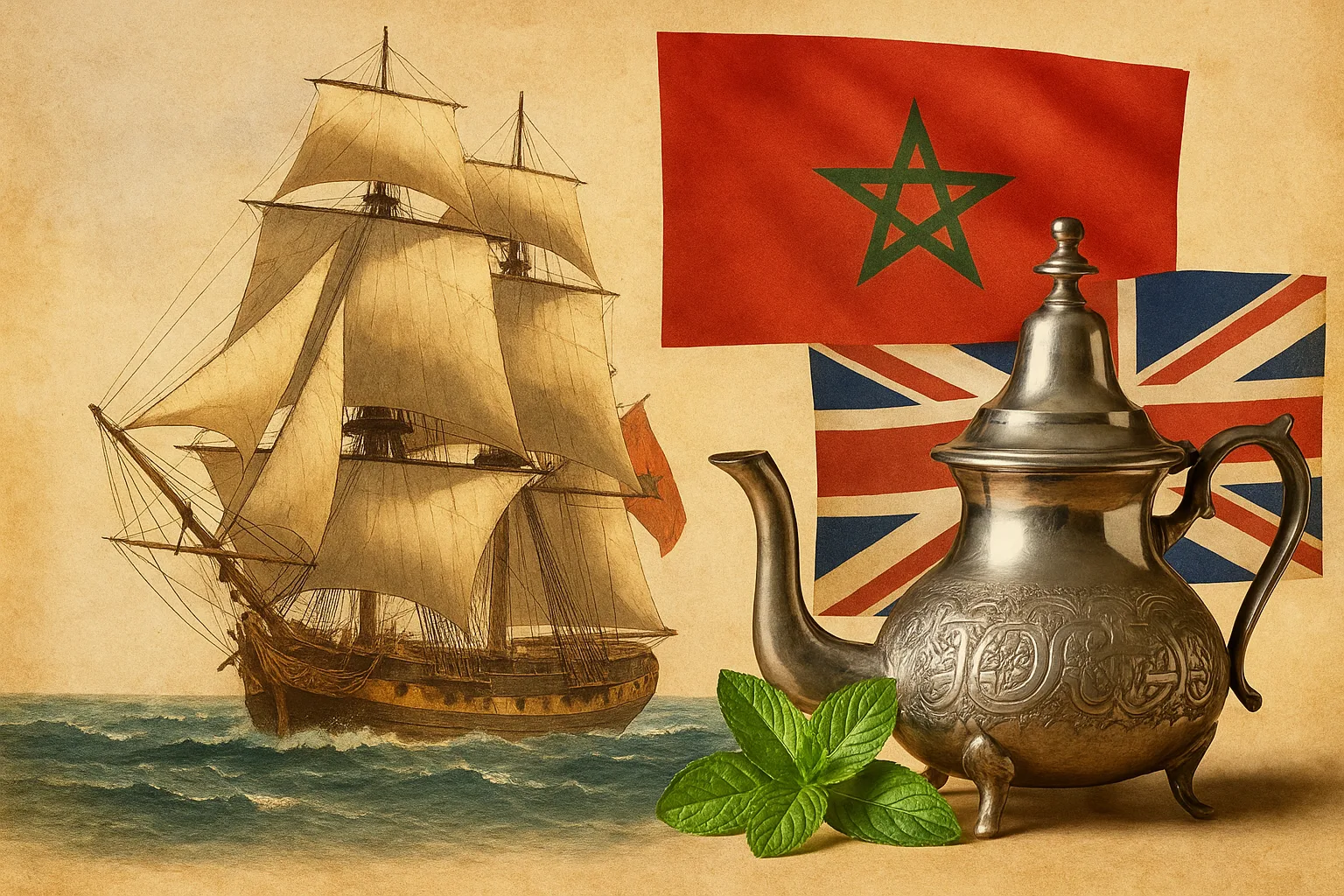
Historians generally trace the first appearance of tea in Morocco to the 18th century, during the reign of Sultan Moulay Ismail. One popular account says that Queen Anne of Great Britain sent chests of Chinese green tea to the sultan as a diplomatic gesture, in thanks for the release of English prisoners.
At that time, tea was rare and expensive, more a court curiosity than a common drink. It took another major event for it to spread. During the Crimean War in the 1850s, British merchants found themselves with surplus tea after Baltic ports were blocked. Looking for new markets, they began offloading Chinese green tea, especially gunpowder tea, in ports like Tangier and Essaouira.
From there, merchants — including many Jewish traders based in Essaouira — carried tea and sugar into the Moroccan interior. What began as a luxury for urban elites slowly filtered outwards, helped by diplomatic fashions, trade agreements, and the desire of local notables to signal refinement and modernity.
By the late 19th century, tea imports had multiplied several times over. In cities, mastering the tea ceremony became a marker of status and savoir-faire. The court even had an official “mūl atay”, or a “master of tea,” responsible for preparing and serving it.
Tea reached rural Morocco a little later, often amid difficult periods of the country’s history. During the famines of the 1880s, it functioned as an emergency calorie source and an appetite suppressant, and also as a way for newly arrived rural families in cities to adopt urban habits.
Gunpowder tea, sugar, and mint
The tea that took root in Morocco was not black tea but Chinese green gunpowder, whose tightly rolled leaves travel well and can be brewed more than once.
Moroccans combined it with ingredients they already knew and loved. Mint had long been used in infusions and traditional remedies. Sugar, imported through European trade, became more available during the 19th century.
The result was something distinct from the teas of China or Britain: a strong green tea base, generous sugar, and a handful of fresh spearmint, sometimes joined by herbs like wormwood or verbena in winter.
Even the objects around the tea were shaped by global connections. The iconic “berrad,” the rounded, spouted metal teapot associated with Moroccan tea, is closely related to a model created in 19th-century England, later adapted and reimagined by Moroccan artisans. Trays, engraved glasses, sugar tongs, and kettles have since become a whole craft ecosystem in cities like Fez.
A ceremony and a social code
Over time, atay became much more than a way to drink hot liquid. It settled at the heart of Moroccan social life. In many homes, the act of preparing and pouring tea is ceremonial, especially when guests are present.
Traditionally, the person making tea washes the leaves, brews and sweetens the pot, then pours from a height so the liquid foams in small glasses. The tea is often served three times in succession, with each glass slightly different as the leaves continue to infuse.
Serving tea has also become a clear sign of welcome and respect. Hosts will offer it at the beginning of a visit, during business discussions, and even in shops to encourage a relaxed, trusting atmosphere. For many Moroccans, especially in communities where alcohol is absent, mint tea plays the role that wine or cocktails might occupy elsewhere, creating a shared space for conversation and connection.
In this way, tea operates as a social code. To refuse it entirely can be read as distancing oneself. To accept and linger over several glasses is to signal interest in the relationship, whether personal, professional, or political.
From daily habit to national symbol
As atay spread across classes, regions and generations, it took on a symbolic weight that went beyond its ingredients. Guides, hotels and official communications now regularly present mint tea as a signature of the “Moroccan art of living” and as the ultimate expression of hospitality.
The ritual also intersects with wider heritage debates. Morocco is already associated with the Mediterranean diet on UNESCO’s list of intangible cultural heritage, and mint tea is often cited as a visible, aromatic part of that lifestyle.
Some campaigns have even called for Moroccan mint tea itself — with its gestures, objects and social meanings — to be recognised on UNESCO’s lists, arguing that it encapsulates hospitality, conviviality and intergenerational transmission.
Whether or not that formal recognition comes, the status of tea within Morocco is clear: It appears in advertising, cinema, music, tourism, and diaspora narratives as a shortcut to “home”. A silver tray and teapot can evoke as much national identity as a flag or a football shirt.
A tradition still evolving
Despite its strong symbolic role, Moroccan tea culture is not frozen. Young Moroccans experiment with less sugar, different herbs, or iced versions in summer. Cafes in big cities serve atay alongside espresso and matcha. Brands export pre-mixed “Moroccan mint” blends around the world, sometimes simplifying a ritual that, at home, remains precise and time-consuming.
What does not change is the central logic: tea is meant to be shared. The history of tea in Morocco runs from diplomatic gifts and global trade all the way to neighbourhood living rooms and street-side stalls. Along that path, a foreign leaf became a local symbol of hospitality, of everyday elegance, and of a certain way of sitting together and taking time.
In the end, a pot of atay tells a double story. It speaks of routes that connect Morocco to China, Britain and the wider Mediterranean. And it anchors a very specific idea of Moroccan life, in which identity is poured, again and again, into small glasses, and refilled as long as the conversation lasts.