Fez — The 2025 edition of the Digital Arts Festival (FAN) came to a close on November 30 at the Mohammed VI Polytechnic University (UM6P), after seven days that turned the Benguerir and Khouribga campuses into open labs for digital art.
Under the theme “Art and Artificial Intelligence: Convergences and Ruptures,” the festival explored how emerging technologies are reshaping creation, performance, and the way audiences experience art.
Initiated in 2024 by coding school 1337 and carried this year by CANCoop in collaboration with the Institute ofAdvanced Studies (IAS) and Open Mind Art & Culture (OMAC), the 2025 edition unfolded across UM6P spaces and public sites in both cities, with support from the French Institute of Morocco and tech partner Epson.
A closing that mirrored a full week of experimentation
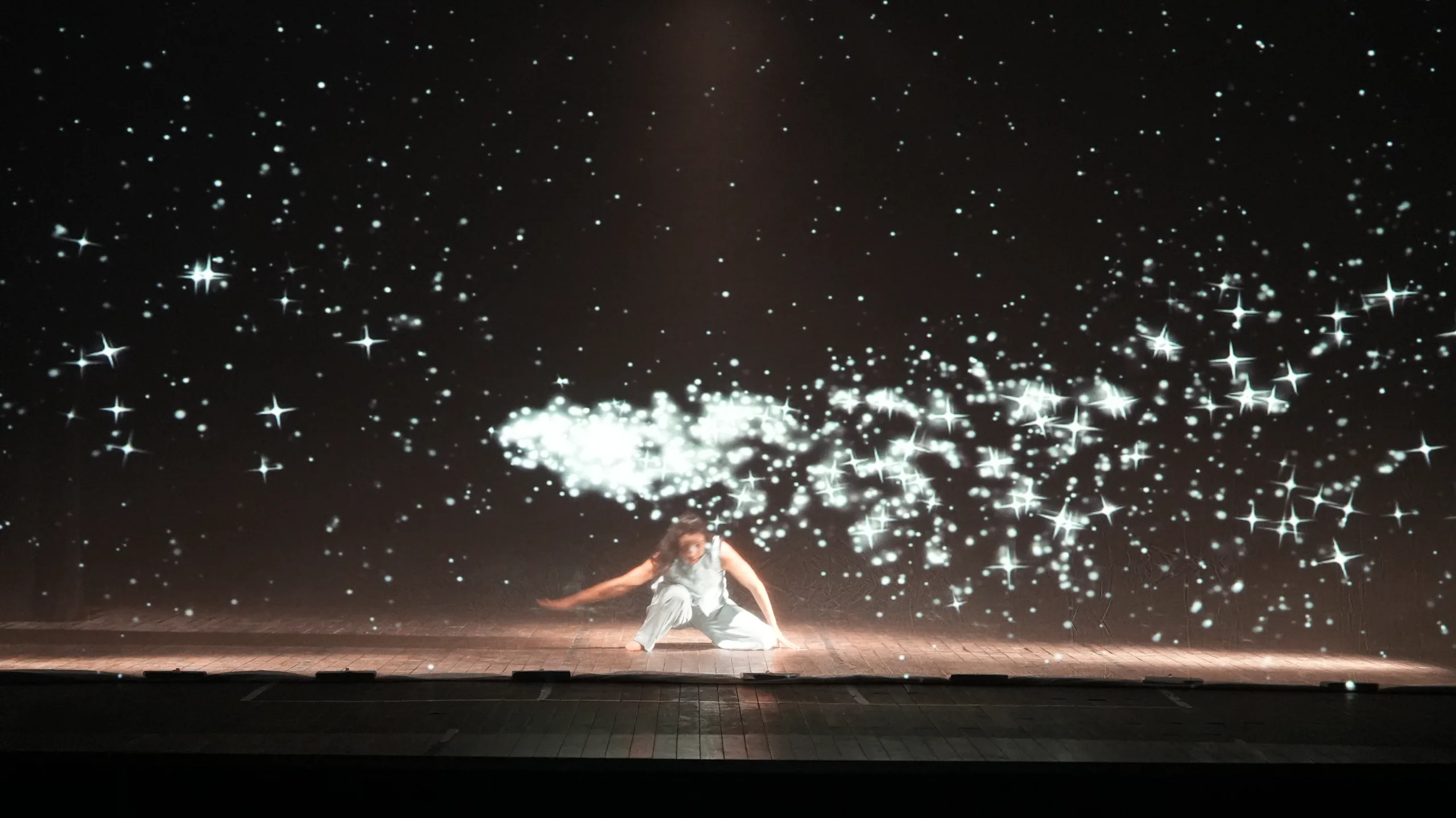
From November 24 to 30, visitors discovered interactive and immersive works ranging from augmented dance performances to sculptural installations and experimental video pieces. Artists from Morocco, France, Japan, Tunisia and Spain were present, some showing finished works, others developing pieces on site in residency and working closely with students.
By the time the festival closed, the tone was clear: FAN has become less a simple exhibition than a meeting point where programmers, artists, and students share the same tools and questions. The closing days brought back many of the most striking works and wrapped up the conversations started in workshops and talks, turning the end of the event into a synthesis rather than a curtain drop.
AI, magic, and monumental façades
The opening set the tempo for the rest of the festival with “AI DREAM,” a show by French artist MOULLA and his Augmented Magic team. The performance mixed augmented reality, stage illusion and visual art to explore what human–machine collaboration can look like in real time.
During the week, the façades of UM6P’s Benguerir campus and Khouribga’s Al Moujahidine square became giant projection surfaces. The mapping piece “FOZEMACHINE” by Fred Chemmama, a pioneer of interactive video mapping, turned these walls into a moving visual environment where light, movement and public presence responded to one another. The installation was one of the recurring sights of the festival and remained a reference point as the event drew to a close.
Other highlight works included “ARCHITECTURE LUMIÈRE” (“Light Architecture”) by architect and artist Zineb Sekkat and the pieces “COSMIC DRIFT” and “PULSE OF THE GAME” by Moroccan artists Ahmed Khilad and El Mehdi Alislami, both students at 1337. Together, these projects showed how digital art can inhabit public space and build a shared language between code, architecture and emotion.
Young Moroccan talents at the center
One of the key messages of FAN 2025 was the place given to young Moroccan creators. Students from 1337 and other Moroccan institutions presented interactive installations, experimental videos and augmented sculptures that tackled themes of technology, emotion and identity.
Among the works that marked this edition, “Millstones of Ibn Battuta,” a virtual reality simulation by El Mehdi Alislami, invited viewers to travel through imagined landscapes inspired by the famous traveller. The immersive installation “What is identity,” created by students from six Moroccan higher education institutions, used digital tools to ask questions about self, belonging and movement.
In the final days, these student-led projects became a focal point for visitors and guests, illustrating how a new generation uses technology as a language rather than a simple tool. For the organisers, this is one of the festival’s main achievements: giving visibility to emerging voices and turning the campus into a production space, not just a display.
A space for debate, not only spectacle
Beyond the visual impact, the festival placed strong emphasis on reflection. Conferences and round tables ran throughout the week, and their closing sessions brought together artists, researchers and students around questions raised by AI and creative technologies.
Participants discussed robotic art with Japanese artist Naoyuki Tanaka, live creation in public space with Reda Boudina and Zineb Sekkat, and the narrative and philosophical dimensions of artificial intelligence with author and media artist Yann Minh. As the festival ended, these conversations underlined a central idea: digital art is not only about tools, but about how society wants to use them and what stories it chooses to tell.
UM6P, 1337, IAS, and OMAC: a shared platform
The FAN fits into UM6P’s broader strategy to connect science, technology, entrepreneurship, and the humanities. With campuses in Ben Guerir, Rabat, Khouribga, and Laâyoune, the university positions itself as a research and impact-driven institution with Africa at the heart of its model. For UM6P, the festival is a way to make digital culture part of that mission, turning knowledge into a lever for transformation.
Coding school 1337, which launched the festival in 2024, continues to treat it as an extension of its project-based teaching. With free, open-access campuses in Khouribga, Ben Guerir, Tétouan, and Rabat, and membership in the international 42 network, the school sees digital arts as a natural extension of code and problem solving. FAN is one of the spaces where that vision becomes visible.
The IAS brings an additional layer by hosting international residencies and encouraging high-level, multidisciplinary research. Within the festival, IAS welcomed several artists in residence, making FAN a place where artistic and scientific approaches meet around questions of transition and knowledge.
OMAC, UM6P’s culture and art structure, tied these strands together by programming events, talks, screenings and workshops, and by linking the festival with its Education & STEAM activities for local public schools. Through these channels, the closing of FAN 2025 also marked the end of a long sequence of outreach and campus programming around digital culture.
Partners and next steps
Tech partner Epson once again supported the festival with projection tools and training. In October, the company ran an intensive workshop on Pro AV and video mapping for around thirty students from six Moroccan institutions, many of whom then presented immersive installations during FAN.
The French Institute of Morocco backed the festival as part of its mission to foster cultural and knowledge exchange between France and Morocco, adding an international dimension to the line-up of artists and speakers.
As the lights went down on the 2025 edition, organizers framed the closing not as an end, but as a starting point for the next steps. With a second edition now complete, the Festival des Arts Numériques has confirmed its place as a recurring platform where Moroccan campuses, cities and public spaces become sites for testing how art and technology can move together — and how a new generation can write that dialogue in its own language.