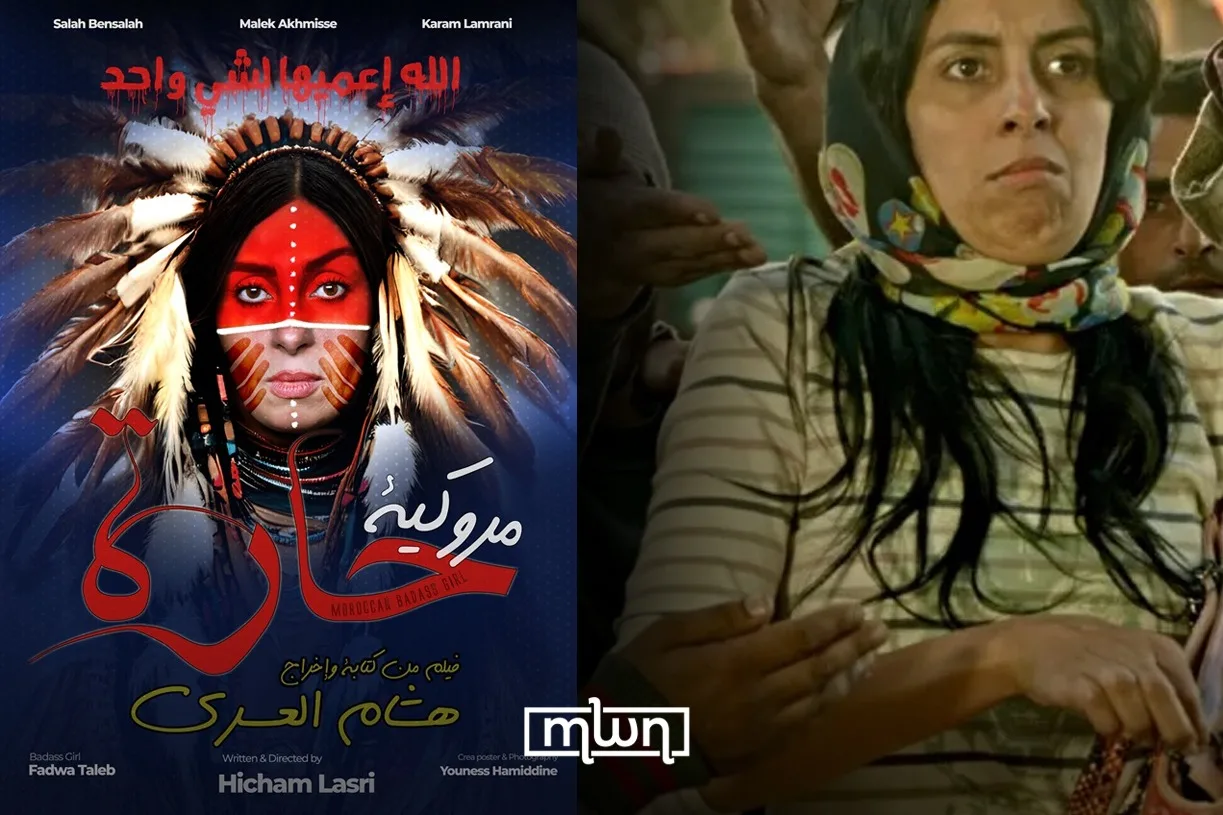
Fez — With “Moroccan Badass Girl,” filmmaker Hicham Lasri turns his camera toward a figure that has long haunted his films from the edges: the young woman who refuses to obey the script written for her.
Speaking to Variety, Hicham Lasri described both “Moroccan Badass Girl” and his other project “Happy Lovers,” as black comedies centered on antiheroes in the Arab world, “a bit in the vein of the Coen brothers.”
After six feature films rooted in the 1980s “Years of Lead” under King Hassan II, he sees this new work as a break with his own past. “Moroccan Badass Girl” is his first film fully set in present-day Casablanca and, as he put it, his “first real comedy” — a hectic, fast-paced ride where the city itself becomes a character and the camera follows a woman moving through its tension, noise and contradictions.
He told Variety that part of his motivation was to show “how women feel in Casablanca in the street,” and to play with absurdity and dark humor rather than straightforward social drama. The result is a film that keeps his trademark edge but channels it into a sharper, more contemporary language — one that asks Moroccan audiences to laugh, wince and recognize themselves at the same time.
Plot Summary: Khadija’s Worst Day
“Moroccan Badass Girl” follows Khadija, known as “Cathy,” played by Fadoua Taleb, a 30-year-old Moroccan woman crushed by the violence of her daily life — at home, at work, and in a wider society marked by patriarchy and exploitation. On the day of her 30th birthday, after yet another round of humiliation and pressure, she moves through Casablanca reliving memories of how her family and bosses have treated her and how life has kept cornering her. Even so, she refuses to surrender her dreams or accept her status as a victim, pushing back in her own sharp, stubborn way.
The film uses black comedy, sarcasm, and elements of the absurd to tell what is essentially the worst day of Cathy’s life. In the middle of this, strange events hit Casablanca and the dead begin to come back to life, turning the city into a surreal mirror of a society that waits for miracles instead of working for change. Through Cathy’s anger, confusion, and resilience, the story points to a world where many people dream of success, comfort, or fame without effort — and quietly asks what it would take for them, like her, to stop waiting and start acting.
Hicham Lasri’s cinema in context
Born in Casablanca in 1977, Hicham Lasri came to cinema after working as a writer and journalist. His films — including “The End”, “They Are the Dogs”, “The Sea Is Behind”, “Starve Your Dog,” and “Jahiliya” — have screened widely on the international festival circuit and helped define a new, restless wave of Moroccan cinema.
His style is easy to recognize. He mixes black-and-white and color, jumps in time, plays with handheld cameras and stylized framing, and often lets scenes drift into the absurd. Under that surface, his films keep returning to the same pressure points: state violence, broken promises of the 1990s and 2000s, the weight of memory, and the way ordinary people carry all of that in their bodies.
Women are present in his earlier work, but usually in relation to male protagonists. “Moroccan Badass Girl” is a shift: the chaos of the city and the country seen through the eyes of someone who lives at the intersection of youth and gender, not only at the edge of police files or political history.
Women, rage, and the Moroccan city
In today’s Morocco, debates around harassment, economic precarity, social media pressure, and changing family models all run through the lives of young women. A “badass girl” in this context could be many things at once: a student, a worker, a rapper, a daughter, someone living in shantytowns or in new apartments on the city’s outskirts.
If the film follows Lasri’s usual logic, the “badass” label will not be simple praise. His characters are often fragile under their bravado. They joke, perform, and act tough, but the camera catches their doubts and contradictions. A Moroccan girl claiming that word may find that her resistance comes with a cost — at home, online, at work — and the film will probably sit inside that tension rather than resolve it neatly.
Between fantasy and social critique
One of Lasri’s signatures is his ability to jump between realism and cartoon-like exaggeration. He stages scenes that almost feel like comic panels, then cuts back to quiet, documentary-style moments in the same neighborhood. “Moroccan Badass Girl” has the perfect title for that split: half superhero, half ordinary person.
That mix allows him to do two things at once. On one level, he can give viewers a fun, sharp, almost punk energy around a girl who refuses to behave. On another, he can dig into the structures that make that refusal necessary and dangerous: unemployment, patriarchy, empty political promises, and the feeling of being stuck on the edge of change that never quite arrives.
In a media landscape where young Moroccan women are often flattened into influencers, victims, or success stories, a Lasri character with flaws, anger, and agency would mark a different kind of representation — closer to the contradictions of real life.
Why it matters now
Moroccan cinema is in a period of expansion, with more films on platforms, more festivals, and more international attention. At the same time, questions about censorship, funding, and the space given to risky stories remain constant.
Within that context, “Moroccan Badass Girl” looks like a statement. It signals that one of the country’s most distinctive directors wants to tackle gender head-on, without softening his approach. It also suggests that the “new Morocco” he has been dissecting for more than a decade cannot be understood if women remain side characters.