Fez — A new cultural space dedicated entirely to Moroccan carpets has opened in the heart of Marrakech’s historic Laksour district.
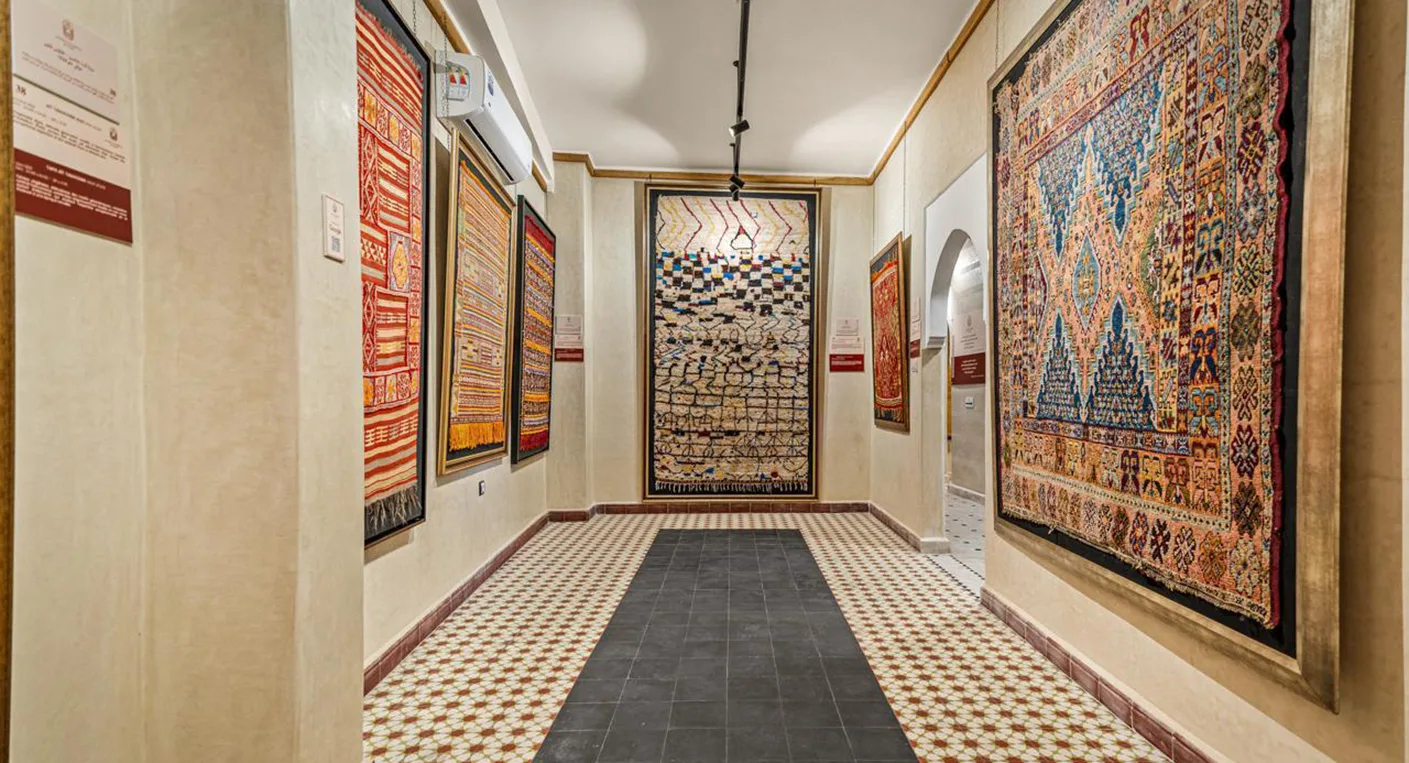
La Maison Culturelle du Tapis (The Cultural House of the Carpet) housed in a purpose-built riad designed in strict accordance with traditional Moroccan architecture, positions itself not as a commercial showroom but as a museum-like experience devoted to the symbolic, historical, and artistic dimensions of the Moroccan carpet.
Conceived as a 45-minute journey, the visit unfolds through a carefully curated scenography in which each room represents a distinct region of Morocco, from the High Atlas and Middle Atlas to Rabat and the Haouz.
The approach is deliberately didactic and immersive, offering visitors a structured narrative that contextualizes each carpet within its geographic, cultural, and social origins.
A private collection shaped by history
At the core of the Maison Culturelle du Tapis is a private collection assembled over more than five decades. The carpets on display were selected for their historical value, symbolic richness, and technical complexity.
The oldest piece dates back to the 1850s, while others stand out for their rare dimensions or unconventional materials.
Visitors encounter silk carpets, black wool weavings, goat-hair rugs, square carpets, and kilims made with wool, silk, and silver threads. Some of the pieces were woven by men, challenging common assumptions about gendered craftsmanship.

The exhibition route is complemented by a Modern Room and a Masterpiece Room, the latter conceived as a sanctuary for exceptional collector’s items.
Beyond carpets, the museum also presents related objects such as babouches, cushions, saddle bags, and weaving tools, including spindles, wool combs, and weft beaters, as well as reference books devoted to carpet traditions.
Honoring the women behind the weavings
The project was initiated by Nasser Ksikes, a fourth-generation member of a family of carpet merchants and collectors.
For Ksikes, the museum represents both a personal legacy and an act of cultural preservation. He describes the space as a tribute to the women weavers whose stories and identities are encoded in the motifs they create, often without recognition.
This emphasis on the human dimension of weaving is reinforced by a projection room showing a rare French documentary filmed in the 1940s.
The historical footage is paired with lithographs by Jean Besancenot, whose work documented Moroccan urban and rural costumes across Amazigh, Arab, and Jewish communities. Together, these elements provide visual context for the social environments in which the carpets were produced.
From contemplation to participation
La Maison Culturelle du Tapis is conceived as a living space rather than a static museum. Visitors are invited to take part in immersive weaving workshops, during which they can learn basic techniques and create a small handmade carpet to take home.
The experience extends to a boutique offering carefully selected Berber craft objects and paintings depicting women weavers.

The visit concludes on a panoramic terrace overlooking the rooftops of the medina, where guests can enjoy Moroccan tea, coffee, or fresh juices accompanied by traditional pastries.
By combining exhibition, education, and sensory experience, La Maison Culturelle du Tapis establishes itself as a new cultural address in Marrakech, reaffirming the carpet’s place as a central expression of Moroccan heritage and creativity.