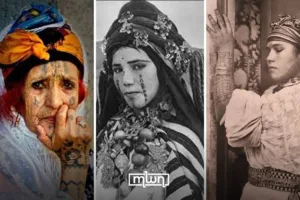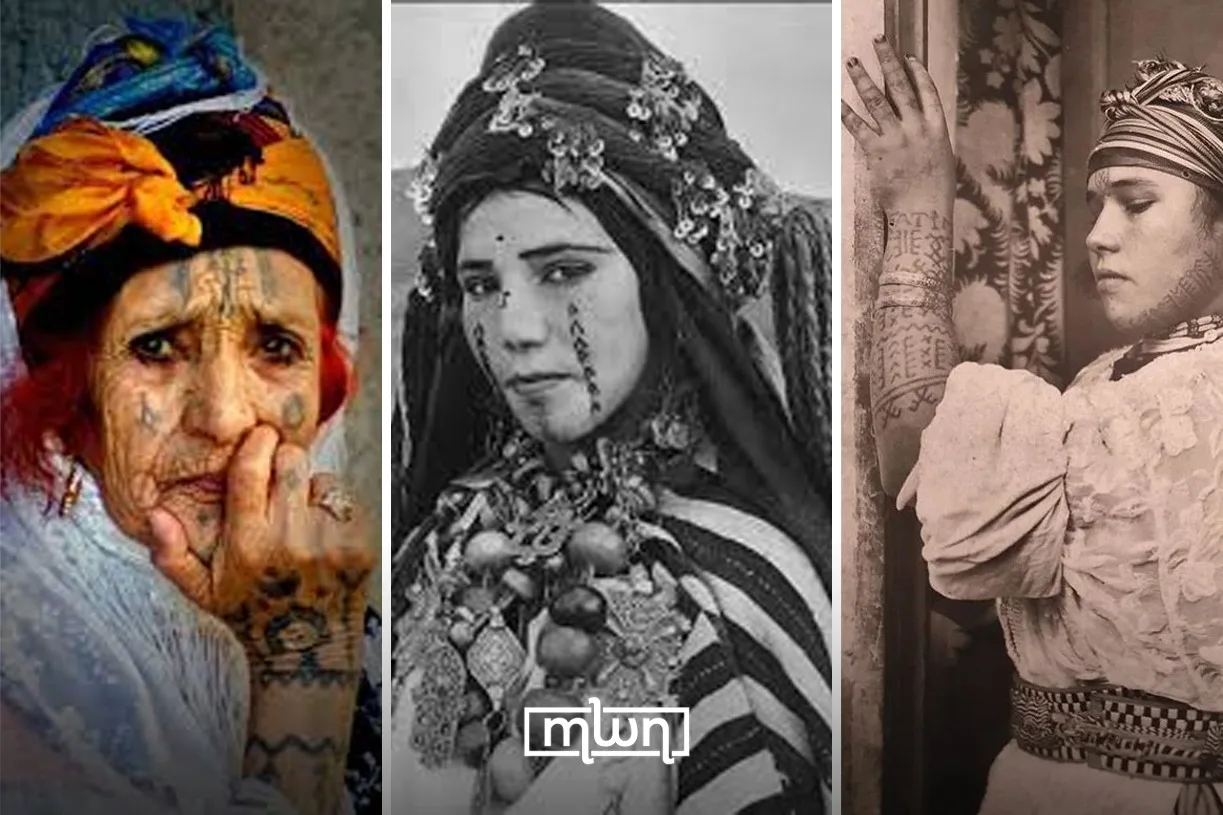
Marrakech — Once widespread across Amazigh communities in Morocco and North Africa, the tradition of women receiving symbolic tattoos is now at a critical cultural crossroads. While it is celebrated by artists and cultural activists, the practice is fading rapidly among younger generations.
For centuries, Amazigh women’s tattoos were embraced and celebrated as rich semiotic tools, each motif holding layers of meaning.
Lines, dots, triangles and circles, often placed on chins, cheeks, hands or forearms, symbolized tribal belonging, beauty, fertility, protection, and social milestones such as puberty, marriageability or motherhood.
Anthropological studies describe these designs as markers of identity and womanhood, integral to cultural ceremonies and rites of passage.
The act of receiving a tattoo was itself a communal ritual affirming a young girl’s transition into adulthood and a woman’s role in her community.
Despite their deep roots, facial and body tattoos have declined sharply over recent decades. In many rural Amazigh regions, particularly Morocco’s High and Middle Atlas mountains, only elderly women still carry these marks.
Experts and local elders attribute this decline primarily to changing religious interpretations and modern social norms.
A more conservative turn in religious attitudes has led many to view tattoos as un-Islamic or taboo, prompting some women to avoid the practice entirely or even seek to remove existing tattoos out of fear of posthumous judgment.
Modern beauty trends and urbanization also erode the appeal of traditional tattoos, with younger Amazigh women increasingly opting for contemporary aesthetics over ancestral ink.
Yet in the midst of decline, there are efforts to revive and reinterpret Amazigh tattoo heritage.
Tattoo artists, such as Tunisian Manel Mahdouani, are deliberately incorporating traditional Amazigh motifs into contemporary tattoo art, presenting them as cultural identity expressions rather than archaic customs.
These efforts aim to reconnect younger generations with their heritage.
Visual artists and cultural commentators are documenting the meanings of ancient symbols, using digital media and design to keep the tradition alive in memory and artistic practice even if the physical tattoos themselves wane.
Today’s Amazigh women face a complex negotiation between preserving ancestral customs and adapting to evolving social values.
For elders who proudly bear these inked legacies, the tattoos are living history, visual texts that tell tribal stories, reflect beauty ideals, and signify personal journeys.
For many younger Amazigh women, however, these designs have become symbols of a disappearing world, cherished in memory, revived in art, but seldom worn on skin.
As the last living bearers of this tradition age, the future of Amazigh women’s tattoos is increasingly about cultural preservation through documentation and reinterpretation, rather than continuation in their original form.