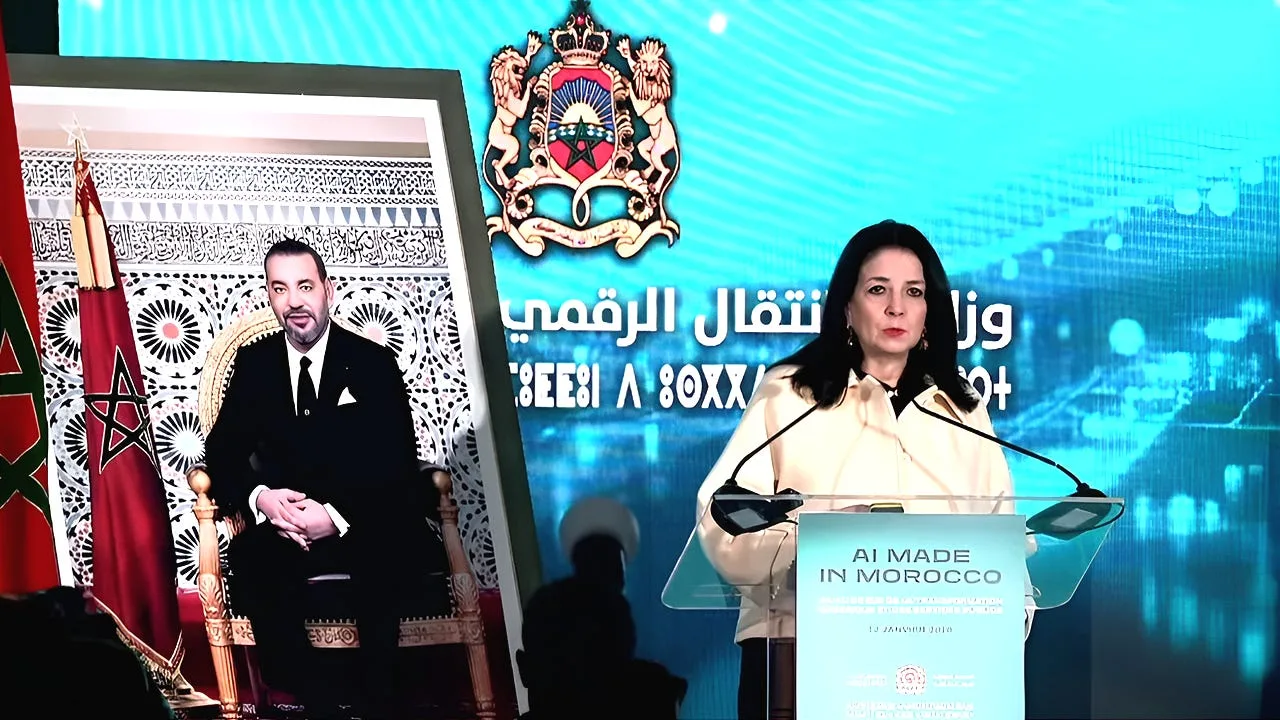
Fez — Rabat hosted on Monday the strategic forum “AI Made in Morocco: Artificial Intelligence at the Heart of Digital Transformation and Public Services,” marking a new milestone in the country’s drive to develop a sovereign, nationally anchored approach to artificial intelligence.
The event builds on the momentum of the National AI Conference held in July 2025, and it brought together government officials, institutional stakeholders, private-sector operators, and representatives from academia and research.
Together, the event’s participants examined how AI can be mobilized as a tool for public-sector modernization, economic competitiveness, and technological autonomy.
Artificial intelligence as a sovereignty lever
Morocco’s strategy positions AI as a central pillar of sovereignty and decision-making capacity. Amal El Fallah Seghrouchni, Minister of Digital Transition and Administrative Reform, described artificial intelligence as a determinant of economic, institutional, and geopolitical influence, while warning against excessive technological dependence.
The approach promoted by Rabat emphasizes national control over data, algorithms, and infrastructure, with the stated objective of preserving regulatory authority, innovation capacity, and strategic autonomy in a rapidly evolving global landscape.
Jazari Institutes anchor the national strategy
A key highlight of the forum was the structuring of the national network of AI centers of excellence known as the Jazari Institutes. Designed as a distributed, territorially rooted system, the network aims to strengthen Morocco’s capabilities in training, applied research, and technological innovation as part of the “Morocco Digital 2030” strategy.
The official launch of “Jazari Root,” the federating core of the network, marked a significant step in operationalizing this architecture. The centers are intended to function as regional platforms serving public institutions, citizens, and the national economy, while supporting the deployment of AI solutions aligned with Moroccan priorities.
Strategic partnerships and applied research
The forum also saw the launch of a joint artificial intelligence research and development laboratory between the ministry and Mistral AI, under a memorandum of understanding. The lab is dedicated to co-developing technological solutions, building prototypes, and upskilling national talent, with a particular focus on modernizing public services through applied AI.
This partnership reflects Morocco’s preference for selective, capacity-building collaborations that reinforce domestic expertise rather than outsourcing critical technological functions.
South-South cooperation and global governance
Internationally, Morocco continues to advocate for more equitable global governance of artificial intelligence. Omar Hilale, Morocco’s Permanent Representative to the United Nations, highlighted the kingdom’s call for AI frameworks centered on development, capacity-building, and knowledge sharing.
The Moroccan position emphasizes South-South cooperation and the co-construction of AI solutions adapted to the realities of developing countries, in line with the broader diplomatic vision championed by King Mohammed VI.
As “AI Made in Morocco” signals a shift from ambition to implementation, the kingdom is positioning artificial intelligence as both a strategic asset and a public good. This approach is designed to serve national sovereignty, inclusive development, and a more balanced global digital order.