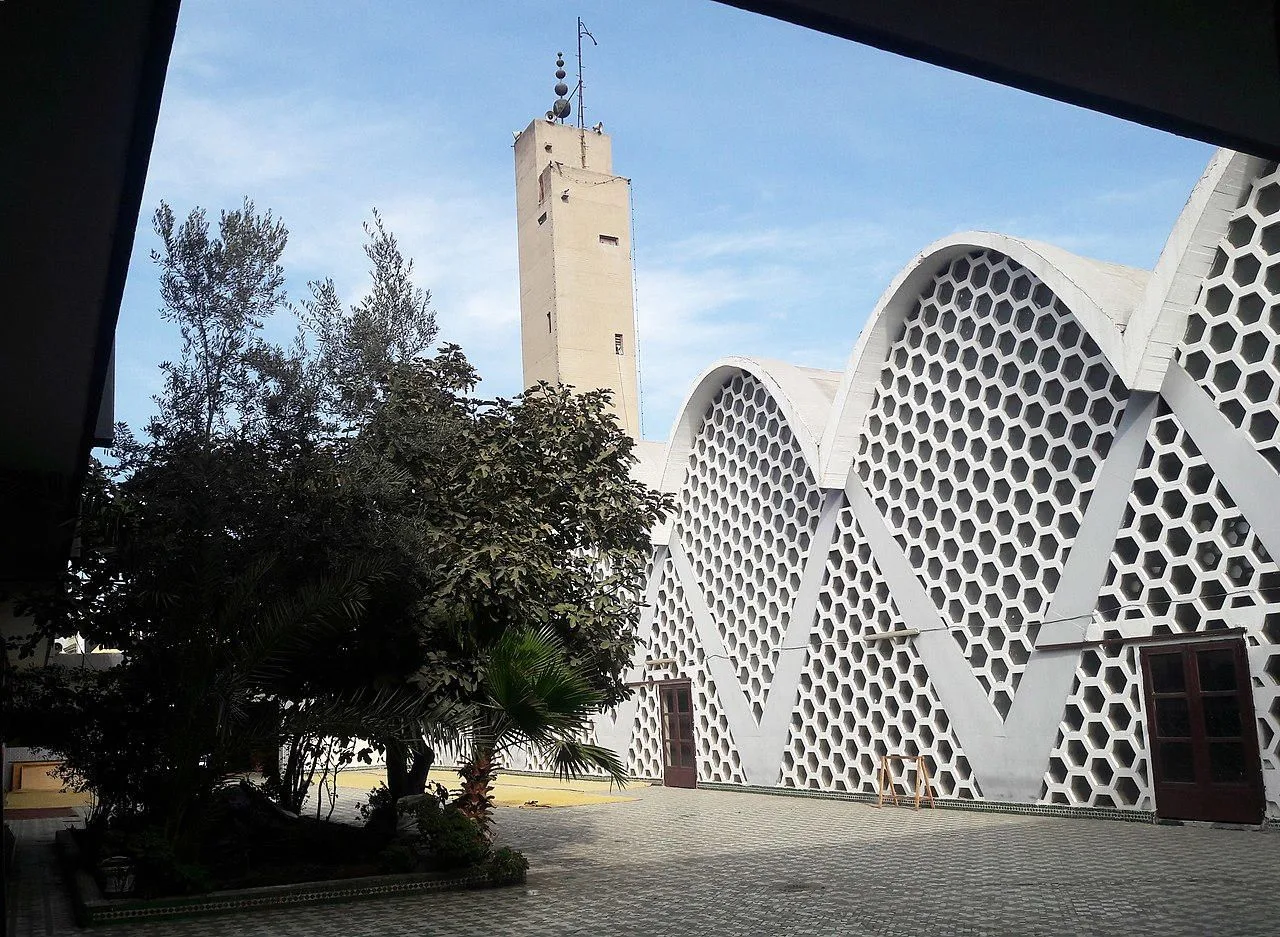
Fez — The Assunna Mosque, also known as As-Sunna Mosque, is one of Casablanca’s most recognizable religious landmarks, reflecting the city’s modernist identity while remaining rooted in Morocco’s Islamic tradition.
Located in the heart of Casablanca, the mosque was designed Jean-François Zevaco and completed in 1966 during a period of intense urban growth.
As Morocco’s economic capital expanded rapidly after independence, the city required religious spaces that could serve large congregations while fitting into a modern urban landscape. Assunna Mosque emerged as a response to that need, combining scale, accessibility, and architectural restraint.
A mosque shaped by the post-independence era
Unlike older mosques built around dense medinas, Assunna Mosque was designed for a contemporary city. Its wide prayer hall, clear circulation, and open surroundings reflect Casablanca’s post-independence planning ideals. The mosque was conceived not only as a place of worship, but also as a public religious anchor in a fast-moving metropolis.
Its name, “As-Sunna,” refers to the traditions of the Prophet Muhammad, signaling an emphasis on orthodox Sunni practice.
Over the decades, the mosque has become closely associated with major religious gatherings, especially Friday prayers and Ramadan nights, when worshippers fill its interior and surrounding spaces.
Architectural simplicity with Moroccan identity
What makes Assunna Mosque unique is its deliberate simplicity. Unlike more ornate historic mosques, it favors clean geometric forms, balanced proportions, and minimal decoration. Traditional Moroccan elements — such as zellige patterns, carved plaster, and a square minaret — are present, but used sparingly.
This restrained aesthetic gives the mosque a timeless quality. It feels neither old-fashioned nor overtly experimental, allowing it to blend seamlessly into Casablanca’s architectural fabric while remaining immediately recognizable as a sacred space.
Natural light plays a central role in the interior, enhancing the sense of calm and focus. The design prioritizes clarity and function, reinforcing the mosque’s role as a place for collective prayer rather than visual spectacle.
A living center of religious life
Beyond architecture, Assunna Mosque holds social and spiritual importance. It regularly hosts sermons, Quranic lessons, and religious guidance that attract worshippers from across the city. During religious holidays, it becomes a focal point for communal prayer, reinforcing its place in Casablanca’s collective memory.
For many residents, the mosque represents continuity in a city known for constant change. It stands as a reminder that faith and community remain central, even as the skyline evolves.
Today, Assunna Mosque continues to embody Casablanca’s unique balance between tradition and modernity. Its quiet presence in the city’s core reflects Morocco’s broader approach to religious architecture: respectful of heritage, responsive to the present, and firmly anchored in communal life.