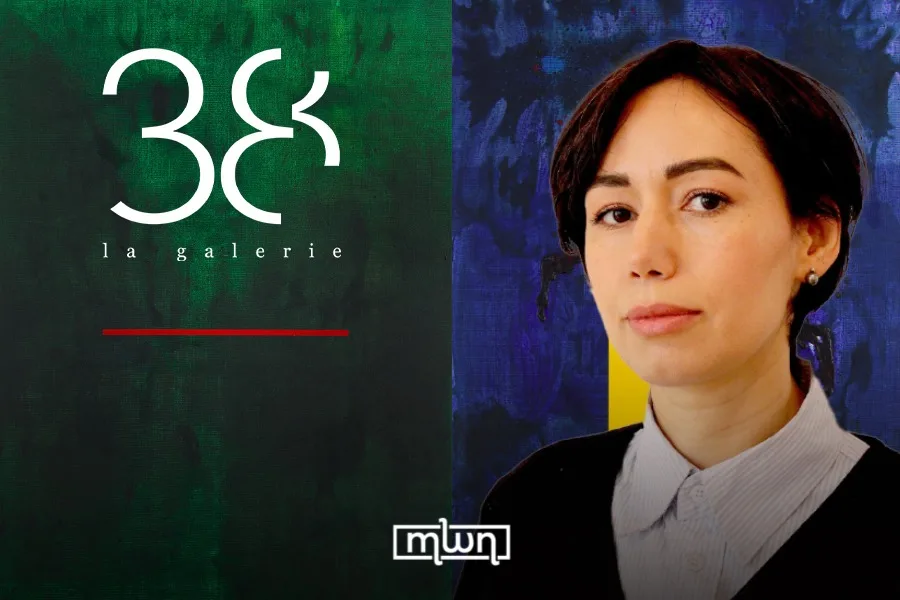
Fez — Gallery 38 Casablanca is set to host “Topography of Oblivion,” a solo exhibition by Moroccan-French visual artist Nissrine Seffar, opening on January 22 and running through February 21.
The exhibition brings together paintings, sculptures, videos, and installations developed over several years of research, all structured around a single, persistent question: how memory becomes inscribed in matter.
Rather than approaching memory as an abstract concept, Seffar anchors it in physical substances such as sand, salt, water, and earth, treating landscapes as silent witnesses to collective history.
Landscapes as living archives
At the core of “Topography of Oblivion” is a dialogue between two territories that appear radically different: the North Sea and the Moroccan desert. In Seffar’s work, however, both spaces function in similar ways. Their soils act as living archives, accumulating traces through successive layers shaped by wind, erosion, and time.
Sand and salt emerge as materials of memory, carrying fragments of past events like contemporary fossils. These substances link distant geographies while collapsing the distance between past and present, suggesting that landscapes retain what human narratives often erase.
A practice rooted in imprint and process
The exhibition features works from the series “Topography of Oblivion” and “Cerebral Traces,” which exemplify Seffar’s method. Canvases are first shaped on site, immersed in seawater or placed directly on the ground to physically register particles, climate, and invisible traces of place.
Back in the studio, these raw imprints are reworked through successive layers, following a process akin to printmaking or engraving. The resulting surfaces reveal a visual depth that evokes geological stratification and emotional memory, turning each work into a record of territorial experience.
Geometric forms appear throughout the paintings, drawn directly from the landscapes themselves. Horizon lines, shoreline contours, and ground structures are sometimes reduced to near-abstract coordinates, functioning as topographical readings of what the land retains and what time deposits.
Extending memory beyond painting
Sculptures, videos, and installations extend this investigation into other materials and gestures. Assemblages of mineral and organic elements, repetitive and attentive actions, and capsules of sand and light create what Seffar describes as a sensitive cartography.
Among the works are marble slabs engraved with the Arabic word “ʿilm,” a term that unites meanings of knowledge, sign, territory, and trace. Language, matter, and memory intersect throughout the exhibition, reinforcing the idea that history is both material and embodied.
An artist shaped by sites of history
Nissrine Seffar is a Moroccan-French visual artist whose practice spans painting, installation, video performance, drawing, and in situ material sampling. For more than two decades, her work has explored the relationships between collective memory, organic matter, and the imprint of territories marked by trauma.
She works from historically charged sites including Guernica, Rivesaltes, Oradour-sur-Glane, Monte Cassino, the North Sea, and the Moroccan Sahara. Her artistic gesture often functions as an act of care, repair, or mourning, forming what she describes as a plastic archaeology of memory.
Seffar’s work has been shown internationally and is held in public collections in France. In 2020, she received the Occitanie Médicis Prize, awarded in partnership with the French Academy in Rome, which led to a residency at the Villa Médicis.
By positioning landscapes as witnesses rather than backdrops, “Topography of Oblivion” invites viewers to reconsider how history persists beyond written records. In doing so, the exhibition situates Casablanca within a broader reflection on memory, transmission, and the enduring traces left by human experience across territories.