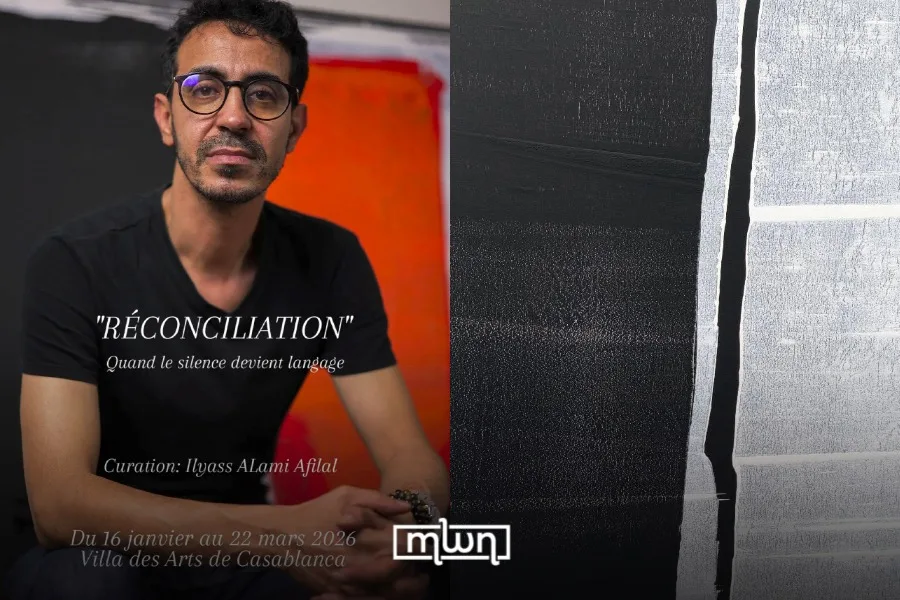
Fez — The Villa des Arts in Casablanca is hosting “Reconciliation,” a new exhibition by Moroccan artist Nabil Bahya, which is opening today, signaling a decisive moment in his artistic trajectory.
Described as both a formal and existential inflection, “Reconciliation” reveals a recent phase in Bahya’s work that places gesture, transparency, and color at its core.
Stripped of overt symbolism and freed from narrative structures, the paintings invite viewers into a space of intimacy where the act of painting itself becomes an inner exploration.
A quieter language of gesture and color
In this new body of work, Bahya adopts a markedly restrained approach. The pictorial material lightens, giving way to layers of transparency and delicate chromatic harmonies. Color no longer asserts itself; instead, it hints.
Soft, sometimes diaphanous tones create a visual atmosphere that privileges calm, vulnerability, and emotional sincerity.
The gesture remains free yet controlled, never violent, reflecting what the artist describes as a desire for confession and peace. By imposing a strict economy of means, Bahya probes interiority and invites the viewer to slow down, disconnect from visual noise, and engage with a more contemplative form of perception.
Continuity through transformation
While the shift is evident to those familiar with his earlier work, “Reconciliation” does not represent a rupture divorced from Bahya’s past. Rather, it unfolds as a natural evolution rooted in a long-standing inquiry into gesture and intention, developed since his training at the École supérieure des beaux-arts of Casablanca.
This measured transformation consolidates his pictorial identity while opening new creative perspectives. By moving toward emotional truth, Bahya seeks to go beyond the visible and touch what he considers essential.
An exhibition shaped by remembrance
“Reconciliation” also carries the weight of homage. The exhibition was conceived in close collaboration with the late Ilyass Alami Afilal, founder of the Salon Marocain des Artistes Contemporains Émergents and a key supporter of young contemporary artists in Morocco. His sudden death earlier this year, as the project was taking shape, lends the exhibition a deeply resonant dimension.
Additionally, the loss of Hassan Ouriaghli, president of the Al Mada Foundation and a central figure behind the Villa des Arts de Casablanca, further reinforces this sense of quiet tribute. Together, these absences transform “Reconciliation” into a discreet yet powerful homage to two figures who shaped Morocco’s contemporary art landscape.
In its sobriety and emotional depth, the exhibition reflects not only an artist’s inward turn, but also a collective moment of reflection, the enduring role of the Villa des Arts as a space for creation, memory, and transmission.