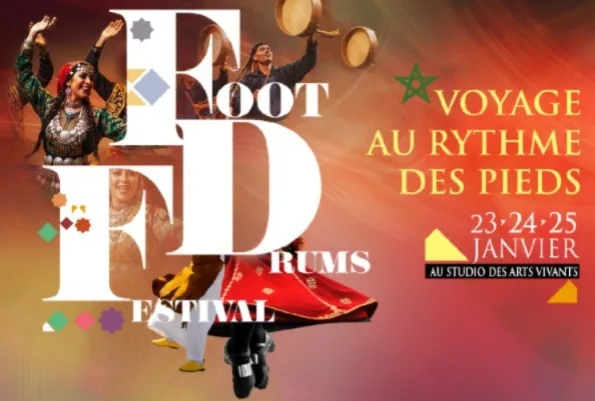
Fez — The Studio des Arts Vivants is set to become the epicenter of an original artistic celebration from January 23 to 25, as the Festival Foot & Drums brings together dance, rhythm, and reflection from across cultures.
Conceived as more than a stage event, Foot & Drums positions the movement of the foot as a shared language that transcends borders. Across performances, workshops, and scholarly exchanges, the festival explores how percussive footwork carries memory, identity, and contemporary creativity in diverse traditions around the world.
Footwork as a universal language
At the heart of the festival lies a simple yet powerful idea: the foot as an instrument. From ritual dances to contemporary choreography, rhythm produced by the body’s contact with the ground becomes a means of storytelling and transmission. The programming reflects this philosophy by weaving together practices from different cultural spheres, each revealing how rhythm is learned, inherited, and reinvented.
By emphasizing pedagogy and dialogue alongside performance, Foot & Drums situates rhythm within a broader cultural ecosystem, linking the stage to living heritage and creative research.
An international study day
The intellectual centerpiece of the festival takes place on Saturday, January 24, with an international study day moderated by Zohra Makach, professor-researcher and artistic director of FITUA. Scholars and practitioners from various backgrounds will examine the symbolism and aesthetics of foot-driven rhythms.
The opening session features Géraldine Nalini Margnac, who analyzes the aesthetic stakes of foot rhythms in the staging of beauty through her expertise in Indian Bharatanatyam. She is followed by Pedro Ordóñez Eslava, whose work frames the foot in contemporary flamenco as both a combative tool and a medium for critical thought.
Heritage, identity, and modernity
A second session shifts the focus to questions of identity and transmission in the modern world. Anthropologist Lahoucine Bouyaakoubi addresses the challenges of passing on Ahwach, a collective Amazigh art form that unites song and dance in the preservation of living culture.
The discussions conclude with Mario de la Torre-Espinosa, who offers a cross-disciplinary analysis of flamenco footwork resonating within contemporary dance, referencing figures such as Luz Arcas and Marcos Morau.
Bridging performance and reflection
By refusing to separate live performance from academic inquiry, Foot & Drums affirms an approach that values both spectacle and understanding. The festival highlights rhythm as a site where tradition meets experimentation, and where embodied knowledge continues to evolve.
In doing so, Casablanca once again positions itself as a crossroads for artistic exchange, offering a platform where global rhythms converse through the shared language of the foot and the enduring pulse of movement.