Marrakech – Over the past decade, the Joy Awards have emerged as one of the most prominent of these gatherings, and in their 2026 edition, the ceremony went well beyond the traditional format of an awards show, positioning itself as a fully realized live musical production capable of rivaling major international stages.
Aligned with Saudi Arabia’s accelerated growth in the entertainment sector, the Joy Awards have gradually transformed from a regional celebration into a cross-disciplinary live spectacle that brings together music, cinema, television, and pop culture.
Held annually in Riyadh, the event now functions less as a sequence of award announcements and more as a carefully curated broadcast experience, built on live performances, strong visual storytelling, and deliberate cultural intersections.
That ambition was particularly evident in the 2026 edition. Musical segments were not treated as brief interludes designed to fill time between awards, but rather as interconnected chapters within a clear musical narrative.
The program unfolded with a sense of continuity, where each performance built on the previous one, creating a cohesive flow rarely seen in conventional televised ceremonies.
Global stars appeared alongside Arab artists not as a statement of comparison or spectacle, but as a reflection of a broader confidence in the region’s creative output.
Orchestral arrangements were woven into contemporary pop structures, rhythms blended organically, and transitions between performances were carefully calibrated.
The result felt closer to a live concert with a strong narrative arc than to a standard television recording.
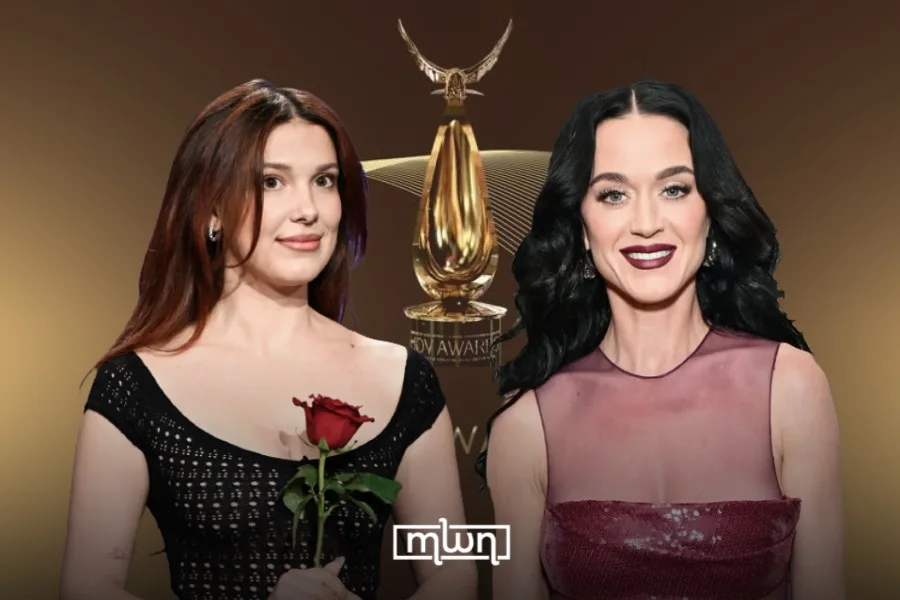
The evening opened decisively with an energetic performance by Katy Perry, who set the tone from the outset by launching into her renowned track “Dark Horse.” Her appearance immediately framed the ceremony as a concert-driven experience rather than a traditional awards show.
Combining live vocals, choreography, and advanced stage design, Perry’s performance moved across shifting theatrical spaces, culminating in a fireworks display that lit up the Riyadh skyline.
Later in the evening, she returned to the stage to present the award for Favorite Female Artist to Egyptian singer Angham, briefly reflecting on music’s ability to transcend borders, a theme that echoed throughout the night.
One of the evening’s more unexpected moments came from American pianist Jud Coffey, who made a playful, unscripted entrance that added a sense of spontaneity to the tightly produced show.
Coffey presented a new classical interpretation of the Gulf song “Rida Allah wa Radaynaak” by Talal Salama, reimagining the piece through a piano-driven arrangement while preserving its emotional core.
The ceremony’s emphasis on musical dialogue rather than contrast was further reinforced through collaborations.
Guitar virtuoso Marcin joined Angham on stage for a medley of her most iconic songs, introducing a Latin-inflected segment that brought a contemporary edge to her repertoire.
The collaboration highlighted technical precision while offering a fresh sonic perspective on familiar material.
Another standout moment came with the arrival of British pop star Robbie Williams, who performed a selection of his well-known hits, including “Feel,” before the show took an unexpected turn.
Saudi artist Ayed joined Williams on stage, first performing his own song “Takhayal Law,” before the two artists came together for a bilingual Arabic-English rendition of “Angels.”
The performance was notable for its balance, with neither artist overshadowing the other, instead sharing the stage in a carefully calibrated exchange.
The program continued to move fluidly across genres. Operatic quartet Il Divo delivered a powerful rendition of “I Will Always Love You,” reinterpreting the iconic ballad through a classical lens.
In a seamless visual and musical transition, disco legend Liz Mitchell of Boney M brought the audience back to the golden era of dance music. She later shared the stage with Il Divo for joint performances of classics such as “Daddy Cool” and “Rasputin,” blending opera and disco in a way that felt intentional rather than novelty-driven.
Beyond music, Joy Awards 2026 reinforced its cross-industry identity through appearances by major international screen stars. Lee Jung-jae and Lee Byung-hun, the stars of Netflix’s Squid Game, took to the stage to present one of the awards, briefly acknowledging the growing global presence of Arab film and television.
Lee Jung-jae presented the award for Favorite Egyptian Series to “Ashghal Shaqqa Geddan,” drawing lighthearted reactions when he stumbled over the Arabic title.
The ceremony also welcomed Stranger Things star Millie Bobby Brown, who received the Personality of the Year award and spoke about the importance of self-belief, as well as Academy Award winner Forest Whitaker, who was honored with a Lifetime Achievement Award.
Bollywood icon Shah Rukh Khan was also in attendance, presenting an award to singer Assala, with social media quickly circulating clips capturing his courteous gesture as he assisted her down the stage steps.
What ultimately distinguished this edition of the Joy Awards was not simply the presence of high-profile international names, but the way they were integrated into the overall production.
The harmony between live performances and orchestral elements, the precision of visual transitions, and the carefully controlled pacing transformed the ceremony into a globally legible musical platform.