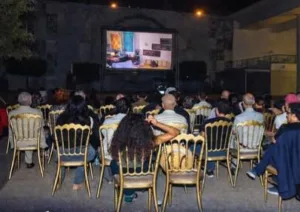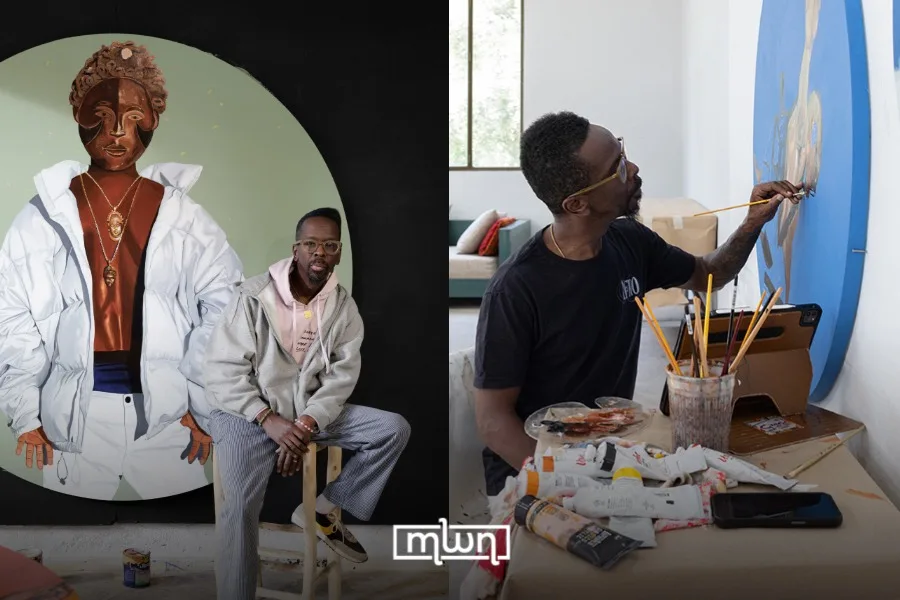
Fez — “Icarus,” a solo exhibition by American interdisciplinary artist Fahamu Pecou, is currently on view at the Residents’ Gallery of the Montresso Art Foundation in Marrakech, where it has been running since December 26, 2025 and will continue through March 21.
A breath of eternity runs through the works presented in the exhibition, which reclaims the myth of Icarus and strips it of its moralizing conclusion. Rather than a narrative of excess and punishment, Pecou proposes a radical alternative: what if Icarus never fell?
From ancient Greece to the Kingdom of Kongo
In “Icarus,” the viewer departs from Ancient Greece and enters an anachronistic rebirth rooted in the Kingdom of Kongo. Under Pecou’s hand, Icarus becomes a metaphor for the Black condition — a vessel of collective memory that challenges the laws of social gravity and reclaims elevation as a right rather than a transgression.
Based in Atlanta for many years, Pecou is a leading figure in the contemporary Black American art scene. His work is deeply political, functioning both as an act of resistance and as a heightened consciousness of African American culture.
Knowledge, rather than material wealth, stands at the core of his practice, with the artist framing the pursuit of origins as his true treasure, following the intellectual path traced by Toni Morrison.
Wings as symbols of transmission and flight
Across paintings and works on paper, wings emerge as central motifs. They operate simultaneously as allegories of creativity and flight, and as bridges between the physical and spiritual worlds.
Pecou draws connections that move fluidly across time and culture — from Michael Jordan to Nkisi figures, from hip-hop culture to Kongo cosmology. Through this visual language, he studies the circulation and transformation of artistic, cultural, and ancestral practices across the Black Atlantic. His iconography renders visible the metamorphoses that occur as cultural forms migrate, adapt, and endure.
The exhibition introduces what theorists describe as new “Afrotropes,” revealing cultural relics and contemporary reflections essential to the construction of a transcultural Black community.
A storyteller grounded in research and performance
Pecou’s approach places storytelling at the center of his work. As both artist and performer, he constructs a dense network of signs and symbols that connect places and temporalities, giving form and identity to the African diaspora. Time condenses under his brushes and pencils, plunging into a reconfigured visual space that produces new cultural artifacts.
At the heart of “Icarus” lies the act of transmission. Through self-figuration, Pecou sacralizes Icarus not as a figure of punished hubris, but as a myth in which Black bodies fly without being burned — in a space where the sun does not consume and where elevation is accessible to all.
Morocco as a site of renewal
The exhibition is closely tied to Pecou’s work in Morocco, particularly at Jardin Rouge, where he developed much of the project. From this setting, the artist reveals what the exhibition describes as a connected cosmogram of worlds, inviting viewers to imagine a cycle in which what appears to be an ending is, in fact, only a beginning.
Born in 1975, Fahamu Pecou lives and works in Atlanta. He holds a PhD in interdisciplinary studies and is the founder and executive director of the African Diaspora Art Museum of Atlanta. His work is held in major international collections, including the Seattle Art Museum, the Smithsonian National Museum of African American History and Culture, the Montresso Art Foundation in Morocco, and the Mumok Museum in Vienna.