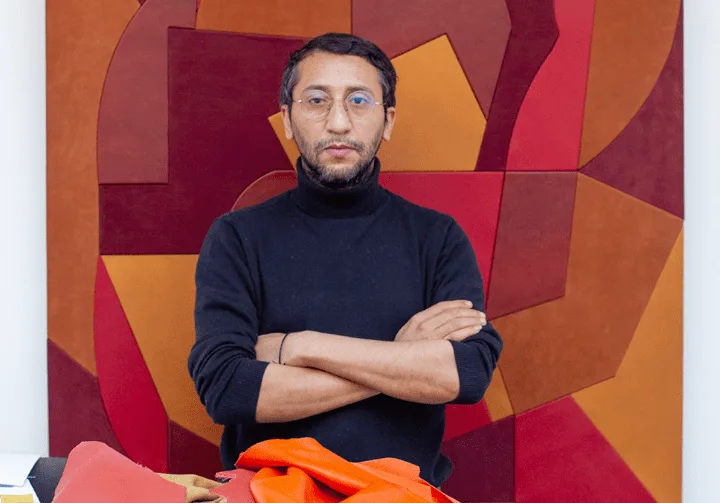
Fez — The TGCC Foundation for art and culture is presenting “Making the hand legible,” a solo exhibition by Moroccan artist Hassan Mannana, from January 29 to March 7 at Artorium, Casablanca. The exhibition offers an immersive exploration of the human body, approached not as a fixed form but as a surface inscribed with histories, memories, and lived experience.
Mannana, who often describes his practice as that of a “conceptual anthropologist,” invites viewers to reconsider how the body is perceived and interpreted. In “Making the hand legible,” skin, muscles, and anatomical structures become visual languages, charged with meaning rather than reduced to biological function.
The body as a readable surface
At the heart of the exhibition lies an inquiry into legibility: what it means to read the body, and what the body itself reveals when treated as an archive. Mannana’s works suggest that flesh carries traces of personal and collective histories, shaped by pressure, labor, care, and violence.
Drawing on both scientific knowledge and artistic intuition, the artist creates a dialogue between anatomy and emotion. The body is neither idealized nor abstracted away. Instead, it appears fragmented, layered, and sometimes hybrid, reflecting the complexity of human experience in a rapidly changing world.
Between material and metaphor
The exhibition brings together sculptural works crafted from contemporary materials such as copper, leather, and wood. These elements are not chosen for aesthetics alone; they echo notions of resistance, vulnerability, and transformation. Copper evokes conductivity and circulation, leather suggests protection and exposure, while wood carries associations of growth and decay.
Rather than representing the body in a literal sense, Mannana uses these materials to turn it into a metaphor. The resulting forms blur the boundaries between organic and constructed, suggesting bodies shaped as much by their environments as by their internal structures.
Humanity in a dematerialized world
“Making the hand legible” also raises broader questions about what remains of the human body in an increasingly dematerialized, digital reality. As daily life shifts toward screens and data, Mannana’s work insists on the persistence of flesh, touch, and physical presence.
By foregrounding the hand — a symbol of labor, creation, and connection — the exhibition emphasizes embodied knowledge and manual experience. The hand becomes both subject and tool, reminding viewers that meaning is often produced through contact and gesture.
An exhibition rooted in reflection
Through this body of work, Mannana positions the human form as a site of ongoing negotiation between fragility and resilience. The exhibition does not offer definitive answers, but instead opens space for reflection, asking viewers to reconsider how they inhabit their own bodies and how those bodies are shaped by the world around them.
As part of the TGCC Foundation’s cultural programming, “Making the hand legible” contributes to a growing conversation within Morocco’s contemporary art scene about identity, materiality, and the place of the human in an era defined by rapid transformation.