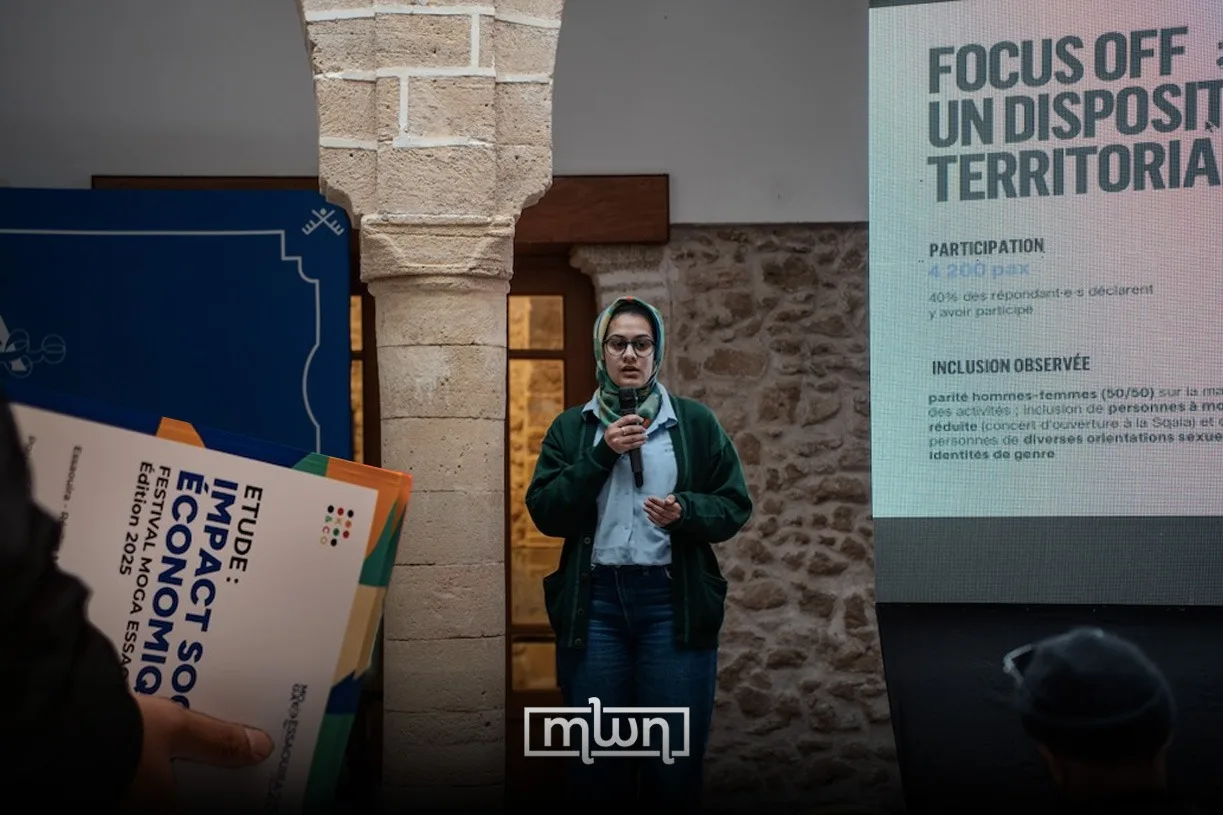
Marrakech – Today, at La Scène café in Rabat, MOGA Festival has unveiled the results of its socio-economic impact study for the 2025 edition, revealing just how deeply the festival now resonates beyond the dancefloor.
Conducted by K&Co and finalized this January, the study measures the economic, tourism, social, and branding effects of MOGA on the city of Essaouira, carefully distinguishing between the ticketed MOGA IN experience and the open access MOGA OFF program.
MAD 51.5 million injected into the Moroccan economy
According to the study, the 2025 edition of MOGA Festival generated an estimated MAD 51 505 472 million in direct economic impact, channeled into the local and national economy through accommodation, transport, food, drinks, services, and cultural productions.
The festival welcomed 15,000 participants in total; 10,800 attending MOGA IN and 4,200 engaging in MOGA OFF.
Each participant spent an average of MAD 10,187, which turned each individual experience into a collective economic engine.
The biggest spending categories tell a familiar festival story, but at a destination scale:
- Accommodation: MAD 3,410
- Transport: MAD 1,062
- On-site food: MAD 709
- On-site beverages: MAD 1,290
Behind the scenes, the impact translated into work. The festival generated 1,404 direct jobs, largely involving Moroccan artists, cultural professionals, and service providers; proof that the creative economy is not just aesthetic, but structural.
Tourism that lasts longer than the beat
One of the most telling indicators? People actually stayed in Essaouira after the festival lights dimmed.
More than 35% of participants extended their stay, with an average prolongation of 2.6 extra days, multiplying the benefits for local businesses.
Accommodation choices reflect Esaaouira’s flexible hospitality ecosystem:
- Airbnb: 49%
- Booking platforms: 21.1%
- No prior reservation: 20.3%
Villas, apartments, riads, and hotels all shared the spotlight, further evidence that MOGA’s audience integrates into the city.
A young, global, culture-driven crowd
The audience profile confirms MOGA’s international pull while remaining deeply rooted at home:
- Moroccan participants: 62.9%
- Internationals: 37.1% – mainly from France (34.4%), the US (21.7%), and the UK (15,2%)
The average age? 30 years old. The most represented group: 26-30 year olds, a demographic that travels, spends, and shares, turning festivals into global campaigns.
Satisfaction levels were equally telling: 92% of participants reported being satisfied, with an average score of 4.41/5. In lifestyle terms, that’s loyalty in the making!
MOGA OFF
If MOGA IN is the heartbeat, MOGA OFF is the bloodstream.
In 2025, MOGA OFF program activated 37 locations across Essaouira, hosting 38 activities spanning music, culture, sport, wellness, sustainability, solidarity economy, and heritage.
The study identifies this model as a territorial lever, redistributing flows of people and spending throughout the city.
Participants spent an average of MAD 1,500 per day in town during the OFF period, with 87% declaring a daily budget between MAD 1,000-3,000.
Restaurants, cafes, concept stores, and wellness spaces all benefited. A total of 62% of partner hotspots were in food & beverage, followed by shopping and well-being.
In policy terms, the study positions MOGA OFF as a financeable culture impact program; a rare case where nightlife, urban life, and development align.
MOGA, movement, momentum
Born in Essaouira and now exported to Spain and Portugal, MOGA has evolved into a cultural platform with measurable returns, a hybrid between lifestyle, tourism strategy, and creative industry policy.
MOGA is no longer just about who plays, but about what stays behind.
In 2025, what stayed behind were jobs, nights booked, meals served, brands discovered, and a city reimagined.