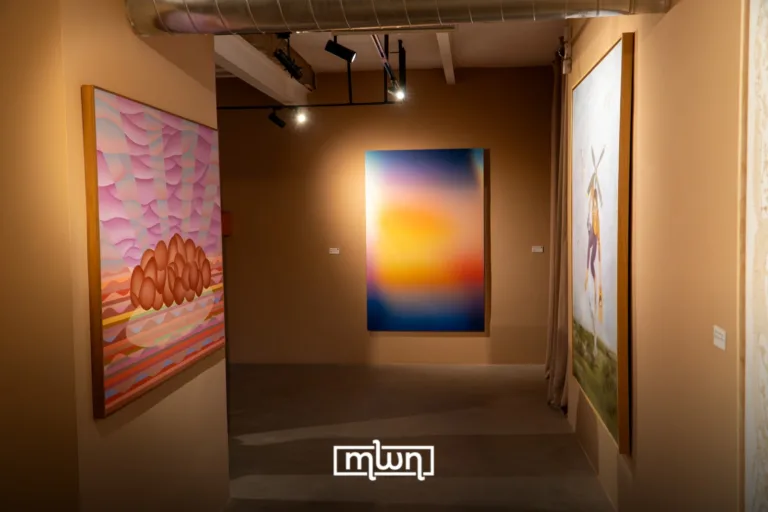
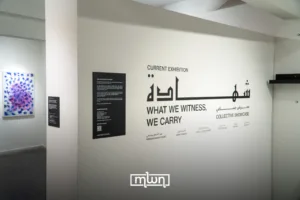
Marrakech — The exhibition “What We Witness, We Carry” brings together six North African artists whose works explore memory, territory, and resistance through deeply personal and collective lenses.
Presented as part of the 1-54 Contemporary African Art Fair’s Marrakech program, the exhibition positions artistic witnessing as both a poetic gesture and a political act.
Featuring works by Saif Fradj (Tunisia), Zineb Bouchra (Morocco), Adem Yahiaoui (Algeria), Ibouyen (Morocco), Abdellah Oujdi Yousfi (Morocco), and Abdellah Aboulhamd (Morocco), the show spans photography, painting, drawing, and installation.
Across these mediums, the artists transform fragments of lived experience into visual testimonies that confront what is often erased or silenced.
The exhibition reflects on themes such as ecological destruction, restricted freedoms, intergenerational trauma, and ancestral persistence.
From images of an oasis damaged by extractive practices to intimate family archives revealed for the first time, the works trace how territory is shaped not only by borders, but by memory, culture, and emotional inheritance.
Speaking to Morocco World News at the opening, curator Abdellah Aboulhamd described What We Witness, We Carry as a collective project grounded in shared regional experience and dialogue across the Arab world.
A co-founder of Leblassa Art Space and the Yassalam Artist Collective, Aboulhamd emphasized the collaborative nature of the exhibition.
“It’s an artist collective gathering artists from all over the Arab world, from North Africa, the Levant, and the Gulf,” he said.
“Today we are at the opening of our latest exhibition as part of 1-54 Art Fair, titled What We Witness, We Carry, showcasing works from six different artists from Morocco, Algeria, and Tunisia.”
Aboulhamd explained that the exhibition’s central concept of territory extends beyond physical geography.
“The whole exhibition is about territory and how we define it, not only as borders, but as something cultural, ancestral, and emotional,” he noted.
“It’s about what territory means in one’s life, and how those invisible boundaries shape who we are.”
Through images of children flying kites during lockdowns, dream symbols erased and reimagined, earthquake debris suspended in space, and ancient rock carvings treated as both archive and home, the exhibition reveals how artists reclaim narratives that dominant systems seek to obscure.
Fragmentation becomes form, and memory becomes material.
By making the hidden visible, the artists affirm agency over their histories and environments, insisting that bearing witness is itself an act of resistance.