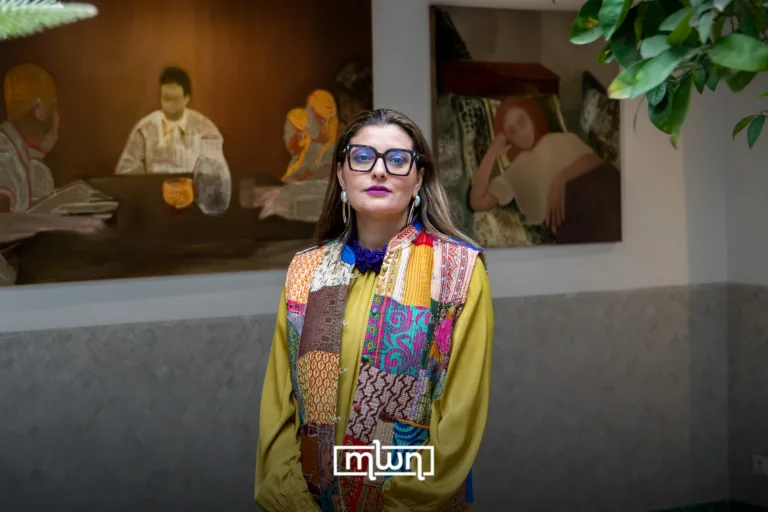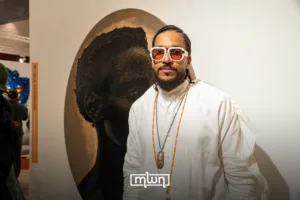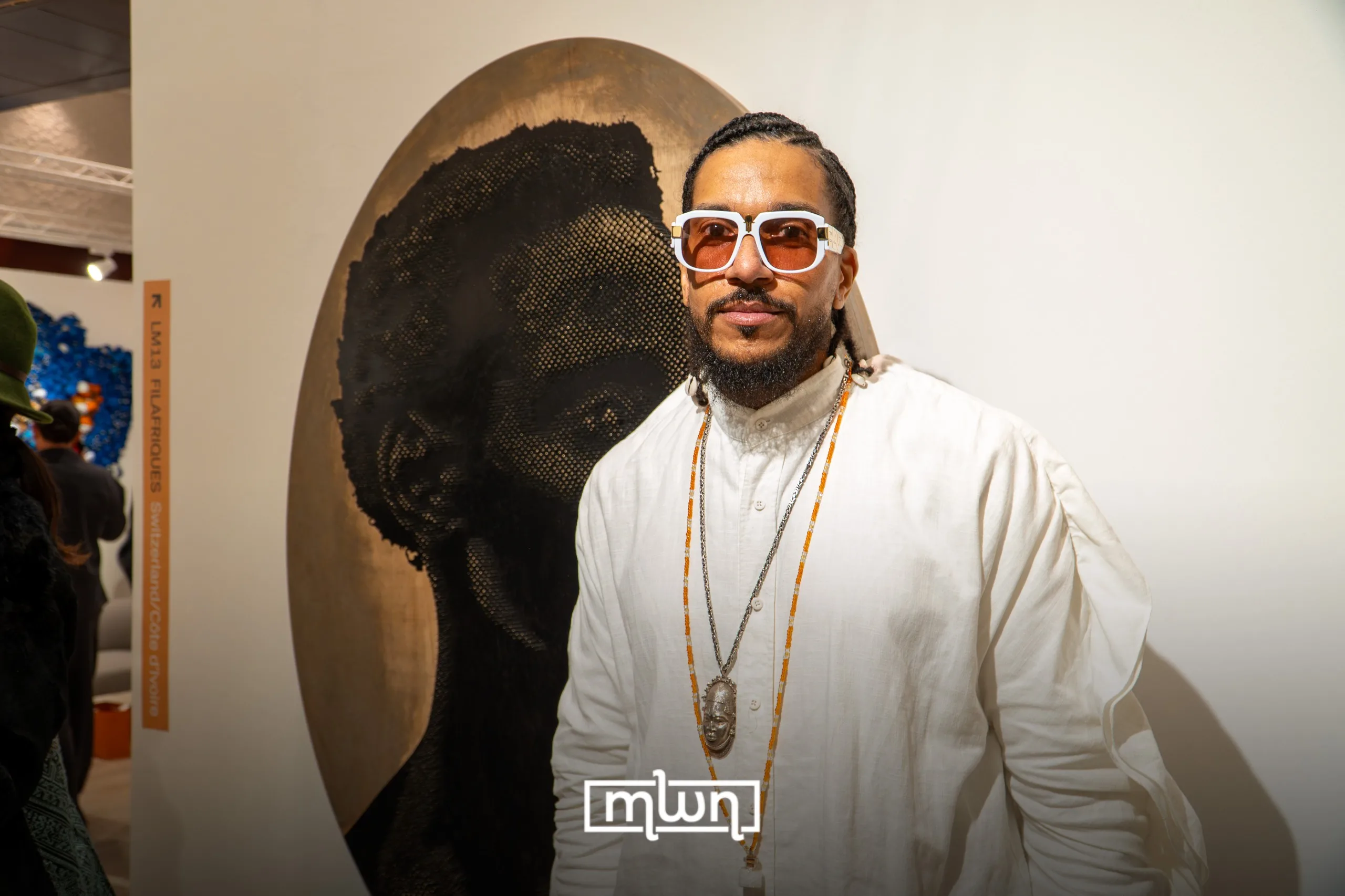
Marrakech – Paris-born visual artist Alexis Peskine made his debut at 1-54 Marrakech during the February 5-8 art fair, bringing his exploration of Afro-descendant experiences to Morocco for the first time after participating in 1-54 London and New York editions.
The accomplished artist, whose mother is Afro-Brazilian from Salvador Bahia’s Cosme de Farias neighborhood and father is French-Russian, attended the VIP cocktail event on February 6 at La Mamounia. The gathering assembled collectors, curators, and cultural tastemakers celebrating contemporary African creativity.
“I grew up in Paris, I was born and raised in Paris, but my family is from Brazil,” Peskine explained during his interview with Morocco World News (MWN). “My main source of inspiration is us, black people, Afro-descendants, African people, my work is an homage to our ancestors, as well as an homage to what we are doing today as a people.”
Peskine aims to visit all 54 African countries before turning 54, having traveled to 33 nations. The Howard University graduate received prestigious recognition, including a Fulbright scholarship and Hennessy Black Masters Art Competition award.
His artistic focus has transformed over recent years. “For a long time, my work was about resistance. But as the world has become increasingly violent, especially over the past few years, my focus has shifted toward healing and spirituality,” he revealed.
The artist found particular inspiration during his time in Morocco. “I also came here for an art residency at Montresor, and I was deeply influenced by Hassan Hajjaj’s [a Moroccan-British visual artist celebrated for his vibrant fusion of North African heritage and global pop culture] film Brothahood, which explores the shared spiritual and rhythmic roots of Gnawa and Capoeira,” Peskine noted.
His research unveiled striking parallels between Moroccan and Brazilian spiritual traditions. “I thought it was really interesting to talk about the parallels between Gnawa and Candomblé, which is the Afro-Brazilian spirituality,” he explained. “Both Gnawa and Candomblé got mixed with religions.”
Both traditions emerged from complex cultural fusion processes. “Gnawa draws on a blend of Islam with Amazigh Berber and sub-Saharan African traditions and spiritual practices. Our own spirituality, in turn, is shaped by influences from Yoruba and Congolese cultures, communities originating in the Benin region, and elements of Catholicism,” Peskine detailed.
The artist identified specific spiritual connections between the traditions. “I learned about Gnawa’s lila [the all-night ritual ceremony], where different entities represent specific energies, such as water. Each energy is associated with particular colors, and we have something very similar in Brazil with the Orishas,” he observed.
Peskine’s signature technique involves hammering nails into wood stained with coffee and mud, applying gold leaf to create large-scale composite portraits. “The nails talk about pain and suffering, and destruction, but they also talk about construction, because you use the nail to construct things,” he explained about his “acupeinture” method.
Read also: IZZA Marrakech Pioneers Art-Forward Hospitality Model During 1-54 Art Fair
Major institutions, including Harvard Art Fogg Museum, New Britain Museum of American Art, and Museum of Contemporary Photography have acquired Peskine’s works. His pieces channel energy reminiscent of spiritually charged Minkisi power figures from the Congo Basin.
His artistic mission extends beyond individual expression. “My work is a desire for abundance, for people of African descent,” Peskine declared, advancing his goal of celebrating global African heritage through visual storytelling.
The collaborative project he referenced originated in Switzerland in partnership with Galerie Philafrique. He explained that the work involved consulting “healers, including European healers,” through whom he discovered connections to “the same source” shared by healing traditions found across Africa, Asia, and the Americas.
Brazil is home to the largest population of Afro-descendants outside Africa, situating Peskine’s heritage within one of the world’s most significant diaspora landscapes.
“Our traditions are very anchored in Africa and African spirituality, because so many Africans were deported to Brazil,” he explained, adding that it is “very important to talk about that,” especially given how often these practices have been marginalized or shamed.
He noted that centuries of alienation have sometimes led communities to internalize this stigma, to the point where “we ourselves end up shaming our own ways.”
The 1-54 Art Fair serves as the foremost international platform for contemporary art from Africa and its diaspora, named for the continent’s 54 nations and bridging regional traditions with global art discourse beyond mere marketplace functions.