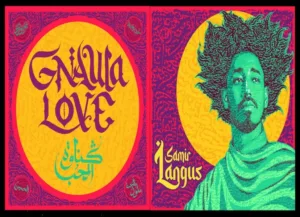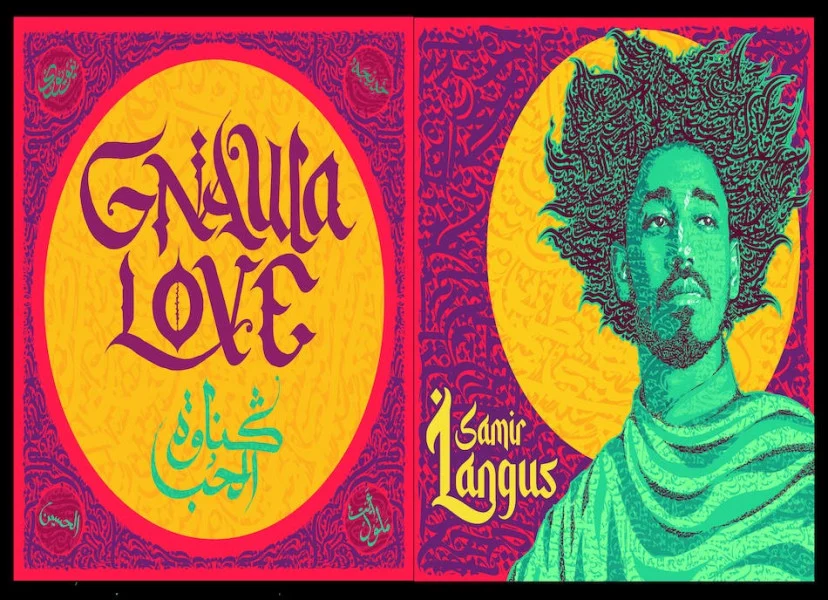
Casablanca – On February 13, New York–based Moroccan singer Samir LanGus released his new album “Gnawa Love,” a project that positions ancestral Moroccan sound at the center of a contemporary, globally connected music landscape.
Composed of 11 tracks, the album moves between trance-inducing ritual rhythms and modern arrangements shaped by jazz, funk, and world music influences, presenting tradition as a living voice.
The album features cross-cultural collaborations. Maâlem Hamid El Kasri appears on the track “Trance,” while Trinidadian trumpeter Etienne Charles contributed through a solo on “Habibi.”
The Grammy-nominated artist consistently uses his social platforms to express his deep love for Gnawa. Reflecting on one of the album’s songs, LanGus wrote, “On this Valentine’s Day, my heart belongs to Gnawa.”
“‘To Leyla’ isn’t just a song! It’s my love letter to Gnawa. The rhythm that raised me. The spirit that moves me. The tradition that lives in my heart. Forever in rhythm. Forever in trance. Forever in love.”
Through “Gnawa Love,” LanGus turns his personal love for the music genre into a journey everyone can feel, honoring tradition while carrying it forward.
Born in Aït Melloul, LanGus grew up immersed in the Gnawa tradition and trained under several maâlems, including renowned Maâlem Hamid El Kasri.
Under his guidance, he mastered the sintir (guembri) – the three-stringed lute central to Gnawa music – as well as the krakebs, the metallic castanets that define its percussive drive.
After relocating to New York nearly a decade ago, the artist began widening his musical landscape.
Brass arrangements, synthesizers, layered vocals, and improvisational passages gradually entered his compositions, enriching the hypnotic foundation of Gnawa without compromising its ceremonial essence.
Read also: The Origins and History of Gnawa Music in Morocco