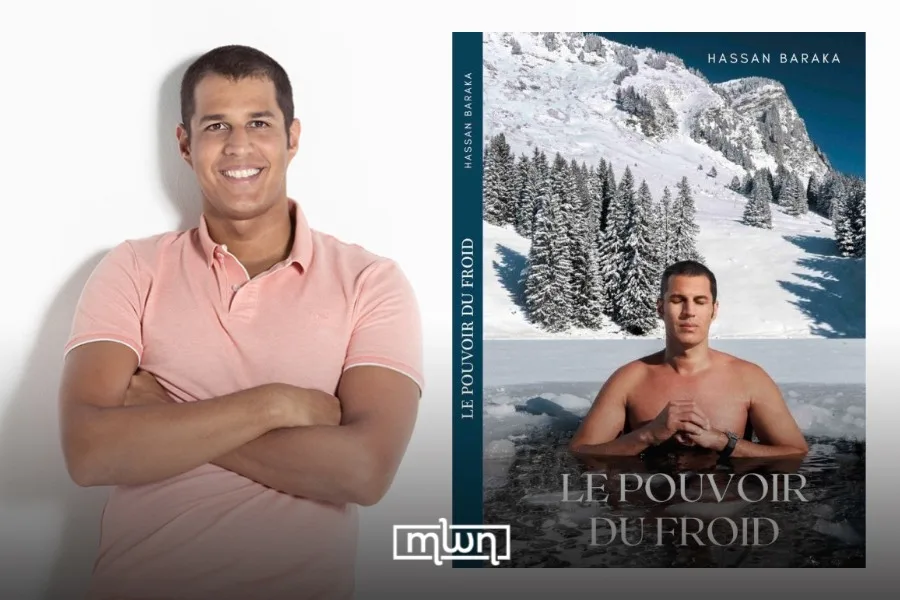
Fez — Moroccan extreme swimmer Hassan Baraka has released his third book, “Le Pouvoir du Froid” (“The Power of Cold”), offering readers an inside look at the physical and psychological impact of ice swimming.
Known for pushing human limits in hostile environments, Baraka has built a reputation through a series of high-profile endurance challenges. From swims in Arctic waters at temperatures as low as minus one degree Celsius to crossings of the English Channel and long-distance challenges in the Balearic Islands, the athlete has positioned himself as one of Morocco’s leading figures in extreme sports.
With this latest publication, Baraka shifts from performance to reflection. Rather than simply recounting feats, he analyzes what prolonged exposure to extreme cold reveals about the human mind and body.
Cold as a revealer
In “Le Pouvoir du Froid,” Baraka describes cold not merely as an environmental condition but as a catalyst for self-discovery. Immersion in icy water strips away distraction and forces immediate presence, he argues.
The cold imposes discipline. It requires controlled breathing, mental focus, and precise timing. According to Baraka, this confrontation with discomfort produces clarity. Fear becomes visible, while limits grow more tangible. It is in that tension that transformation begins, the swimmer writes.
The book blends personal narrative with scientific research. Baraka highlights studies suggesting that controlled exposure to cold can stimulate endorphin production, improve blood circulation through alternating vasoconstriction and vasodilation, and activate Brain-Derived Neurotrophic Factor (BDNF), a protein linked to brain plasticity. Some research also associates cold exposure with immune system stimulation and potential neuroprotective effects.
However, Baraka cautions against treating cold immersion as a miracle solution. Preparation and gradual adaptation are essential. Without training and awareness of physical limits, extreme cold can be dangerous.
Beyond sport
As the book progresses, the narrative moves into more introspective territory. Baraka reflects on the relationship between mental endurance and physical boundaries. The mind may feel limitless, he suggests, but the body demands respect.
The key lies in adjustment. Exposure time, breathing rhythm, and psychological preparation must align. The goal is not to become someone else, but to uncover what already exists beneath fear and resistance.
Through “Le Pouvoir du Froid,” Baraka proposes more than an athletic memoir. He presents a philosophy centered on voluntary discomfort as a path to growth. Stepping outside one’s comfort zone, he argues, sharpens awareness and strengthens resilience.
In transforming freezing water into a space of reflection, Hassan Baraka invites readers to reconsider their relationship with discomfort. The cold, in his account, is not an adversary. It is a mirror.