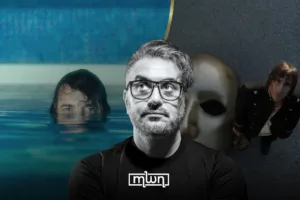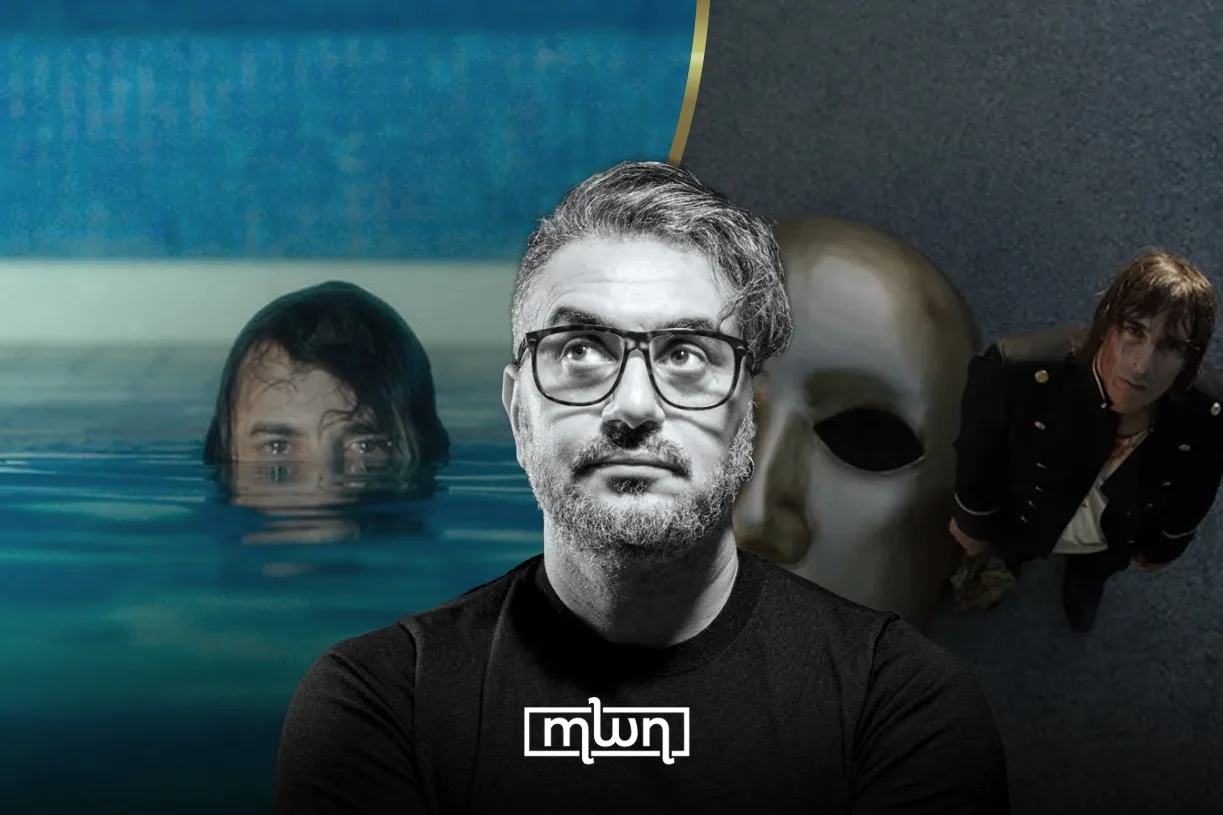
Fez — With “Thank You Satan,” released in Arabic as ‘المطرود من رحمة الله’ (“The One Expelled from God’s Mercy”), Moroccan filmmaker Hicham Lasri delivers one of his most provocative works to date.
The film, structured as a black comedy, centers on a French protagonist who gradually adopts the logic of radical violence, forcing audiences to confront uncomfortable truths about identity, fear, and the mechanisms that manufacture extremism.
Lasri, known for uncompromising films such as “Headbang Lullaby,” “Jahilya,” and “Starve Your Dog,” has long resisted conventional narrative cinema. His latest project continues that trajectory while sharpening its political edge.
The film stars French actor Thomas Scimeca in the lead role, alongside Alyzée Costes, Nadia Kounda, and Aboubakr Bensaihi. The cast also includes Julie Gayet, Henri Liebman, Hassan Badida, and Salah Ben Salah.
Produced by La Prod and Moon A Deal Films, the project carries strong Franco-Moroccan collaboration, further echoing the film’s thematic focus on identity across borders.
Ahead of its nationwide cinema release, the film has been presented as part of a Ramadan Cultural Tour, featuring excerpts, debates, and open conversations with Lasri.
Screenings and discussions have taken place in Rabat and Casablanca, including events at Café La Scène and the American Arts Center.
In an in-depth conversation with Morocco World News (MWN), Lasri reflected extensively on his cinematic philosophy, his visual language, and the global anxieties that shaped the film.
Cinema beyond narrative
Lasri rejects the idea that cinema is primarily about plot.
“For me, cinema can be a script, it can be a story, it can be many things,” he told MWN. “But for me, it is above all a sensory vector. There are things that are beyond comprehension.”
This definition underpins his entire approach. Rather than constructing films around straightforward storytelling, Lasri aims to transcend narrative itself.
“My dream has always been to go beyond the narrative,” he said. “To transcend the narrative in order to bring different universes each time.”
The filmmaker insists that cinema must use its own tools rather than mimic other art forms. “The idea is to use the tools of cinema not to make theater or radio or literature,” he explained, “but to bring something more ambiguous and complex and to share it.”
That ambition has often led critics to label his work dense or difficult, but Lasri is unapologetic.
“When people say it’s dense or complicated or incomprehensible,” he said, “that simply means they are not at the level. Or they don’t make enough effort to enter the work, the way you enter a painting or a novel or architecture.”
For Lasri, difficulty is not a flaw; it is a demand for engagement.
Framing madness through surreal aesthetics
In “Thank You Satan,” Lasri deploys his signature dreamlike imagery to portray psychological unraveling.
“This film was made in reaction to the violence of the world,” he said. “It takes into consideration the rise of terrorism, the fragility of the artist, the Salman Rushdie affair, Charlie Hebdo, all those events that disturbed us and made us question our identities,” adding that “We became designated culprits without choosing it.”
The film’s central character — a French man surrounded by Moroccans — gradually adopts what Lasri describes as “the reflexes of a terrorist.” The premise is not designed to sensationalize violence, but to expose its mechanics.
“I wanted to make a film from the point of view of a French man who is ready to kill someone for a simple reason,” Lasri said. “And to show how we build a mechanism that allows him to understand that we are all capable of crossing to the other side.”
“Violence does not belong to a religion or a society,” Lasri stated bluntly. “It belongs to the human being. Period.”
The aesthetic approach mirrors the protagonist’s descent. “Our approach was to use my aesthetic and oneiric language to depict madness,” he explained. “To show someone losing control, becoming extreme, without forgetting irony and sociology.”
The importance of the image
Lasri places enormous importance on visual composition. “Each frame must carry an inner force,” he said. “Every frame in the film must be a story in itself.”
He avoids traditional shot-reverse-shot structures. “My approach is never to film dialogues,” he noted. “It is to film situations. To avoid classic back-and-forth. To make the situation more claustrophobic, more poetic, more dreamlike.”
The role of sound is crucial. “More than half of cinema is sound,” he told MWN. “Not just music or dialogue. It’s how you create a mental sound space that makes the film stranger, more touching, more disturbing.”
The goal is not to resolve narrative tensions but to open them. “The idea is not to solve narrative problems,” he said. “It is to open aesthetic, narrative, and sensory doors to different universes.”
Titles as ‘contracts’
The film’s dual title reflects this layered approach.
“For me, every title is a program,” Lasri explained. “It’s like a contract. Here is the program of the film.”
The English title “Thank You Satan” carries international resonance and deliberate provocation. In his vision behind the name, Lasri referenced the French singer Léo Ferré and the cultural echo of “Sympathy for the Devil.”
“It has meaning because it’s English,” he said. “It gives an international dimension. It sounds wrong, in bad taste. Putting the devil in a title is already a statement.”
By contrast, the Arabic title “المطرود من رحمة الله” is drawn directly from Qur’anic language. “We wanted something that comes directly from the Qur’an,” Lasri said. “Something more hyperbolic, less frontal, but understood.”
For him, titles frame interpretation before a single image appears.
Cinema as a lie detector
Lasri’s ethical position is equally uncompromising.
“The camera is a lie detector,” he told MWN. “Cinema works with artifice, but that does not mean we should not seek truth.”
Each project, he said, is also a moral challenge. “Every film is a narrative challenge, an aesthetic challenge, but also an ethical challenge. I question myself: do I have the right to show certain things? How far can I go without becoming pornographic? How far can I denounce without self-flagellation?”
In a Moroccan film industry he describes as “locked and complicated,” Lasri refuses to dilute his voice. “What interests me is to be myself,” he said. “To affirm myself. Not to simplify. Not to dilute my approach. To remain punk.”
He believes cinema must question the status quo. “We need to question society,” he insisted. “We need to question what seems obvious. We must not fall into the traps of politicians or corrupt journalists.”
Reclaiming narrative space
A central ambition of “Thank You Satan” is reclaiming narrative agency.
“It’s about seizing our story and twisting it,” Lasri said. “Not letting others speak for us.”
He described the film as a protest of the distorted mirror of how Muslims and Moroccans are portrayed in global media. “We refuse the clichés stuck to our backs,” he said. “We refuse the target painted on us.”
By centering a French character who exploits existing fears, Lasri reframes the discourse around radical violence. “It’s about investing a narrative space,” he explained. “About showing that we are also affected, that we are also afraid.”
The influence of Philip K. Dick
Lasri’s fascination with destabilized realities finds inspiration in science fiction writer Philip K. Dick.
“My favorite novel is ‘Ubik,’” he said. “I read it when I was very young. It continues to accompany me.”
He admires how Dick questioned the nature of reality. “He was one of the first to question the real,” Lasri said. “We live in a post-truth era. It’s dangerous to accept reality as given. That is intellectual laziness.”
Drawing parallels to contemporary politics, Lasri noted how narratives are manufactured and imposed. For him, cinema offers a counter-space.
“Cinema is a mental space of reflection,” he said. “For two hours, you leave yourself and discover other universes. Those two hours must be used in the most intelligent and inspiring way possible.”
A cinema that endures
Lasri distinguishes sharply between ephemeral content and lasting art.
“What remains is not content,” he argued. “It’s not consumable things made for television or TikTok. A film can be seen 100 years later and still offer a powerful mental space.”
He compares cinema to literature. “A well-written book can be eternal,” he said. “A well-made, authentic film can also be eternal.”
With “Thank You Satan,” Lasri once again refuses comfort. He chooses provocation over reassurance, ambiguity over simplification, and ethical tension over easy applause.
In doing so, he positions cinema not as entertainment alone, but as an art form capable of exposing violence without exploiting it, and of challenging narratives before they calcify into dogma.
For Lasri, that mission remains urgent.
“We need to deactivate the mechanisms of violence,” he said. “But to do that, we must first reflect on it.”
And reflection, in his cinema, is never passive.