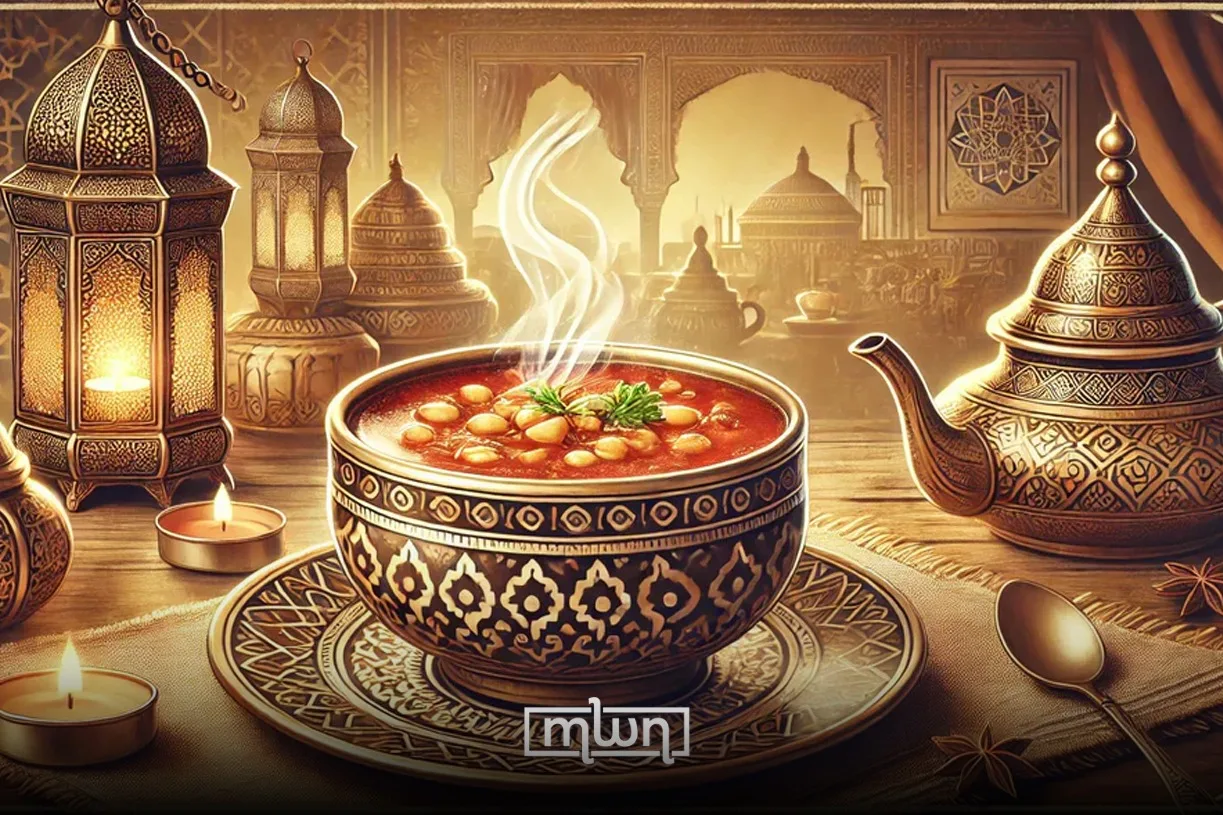
Fez — Few dishes are as deeply woven into Morocco’s culinary and cultural identity as harira. Served daily during Ramadan and cherished year-round, the soup is far more than a comfort food.
According to Moroccan chef and culinary historian Lahcen Lahouari, harira may be as much as 2,200 years old, with roots anchored in Amazigh culture. He considers it “the oldest historically documented Moroccan dish.”
Lahouari argues that harira predates the Arab-Islamic period and traces back to pre-Islamic North Africa.
He links its origins to Amazigh dietary traditions based on grains, legumes, herbs, and occasional meat.
In his research, he suggests that even Roman military commanders stationed in North Africa recommended similar nourishing soups to their soldiers and gladiators for strength and endurance.
The idea of a protein-rich, grain-based broth was consistent with both Amazigh foodways and Roman military nutrition.
Medieval references and Ibn Battuta
Other historians trace harira’s origins to the Marinid era. A frequently cited reference appears in “Tuhfat al-Nuzzar fi Ghara’ib al-Amsar wa ‘Aja’ib al-Asfar” (A Gift to Those Who Contemplate the Wonders of Cities and the Marvels of Traveling), the famous travel chronicle of Ibn Battuta.
While visiting India in the 14th century, Ibn Battuta noted that locals broke their fast with a dish called “kushari,” describing it as similar to harira in Morocco. The comparison suggests that harira was already well established in Moroccan culinary identity at the time.
Poetic references further anchor the dish in Moroccan cultural memory. The Moroccan judge and poet Abdelmaamoun Al-Balaghi praised both harira and couscous in verse, writing:
“I love harira and couscous,
And their love in my heart is firm.”
Such literary mentions signal that harira was not merely sustenance, but part of social and emotional life.
Almoravid and Almohad accounts
Historical texts from the Almoravid and Almohad periods also reference harira. The historian Al-Nuwayri recounts that Ibn Tumart, founder of the Almohad state, prepared harira daily for his soldiers after Prince Ali ibn Yusuf cut off their food supplies.
Medical scholar Ibn Zuhr used the term “harira” in his writings, indicating that the dish was recognized by name in scholarly discourse.
Later, during the era of Sultan Moulay Ismail, Abd al-Qadir ibn al-Arabi al-Manbahi al-Madghari ibn Shakrun al-Maknasi referred to it in his didactic poem “Al-Arjouza al-Shakrouniya.” He described it as a nourishing broth, emphasizing the importance of cutting meat finely and adding coriander for both flavor and health.
These references reveal continuity across dynasties, linking harira to daily sustenance, military resilience, and domestic cooking alike.
Colonial-era documentation
Harira also appears in the 1885 publication “Le Maroc Moderne” (Modern Morocco), released during the reign of Sultan Hassan I. The text notes variations in the soup’s color and texture, observing that recipes differed across regions.
European travelers and writers similarly described harira in their accounts, often remarking on its thick consistency and layered flavors. Their observations confirm that by the late 19th century, harira had become emblematic of Moroccan cuisine.
Today, harira remains central to Ramadan evenings, family ftour gatherings, and communal rituals. Yet its history stretches far beyond religious practice. It embodies agricultural heritage, Amazigh identity, dynastic continuity, and cross-cultural exchange.
Whether its precise origin lies 2,200 years in the past or in the medieval courts of Morocco, harira stands as a living culinary archive.
Each bowl carries echoes of empire, poetry, and survival, reminding Moroccans that food can preserve memory long after history fades from the page.