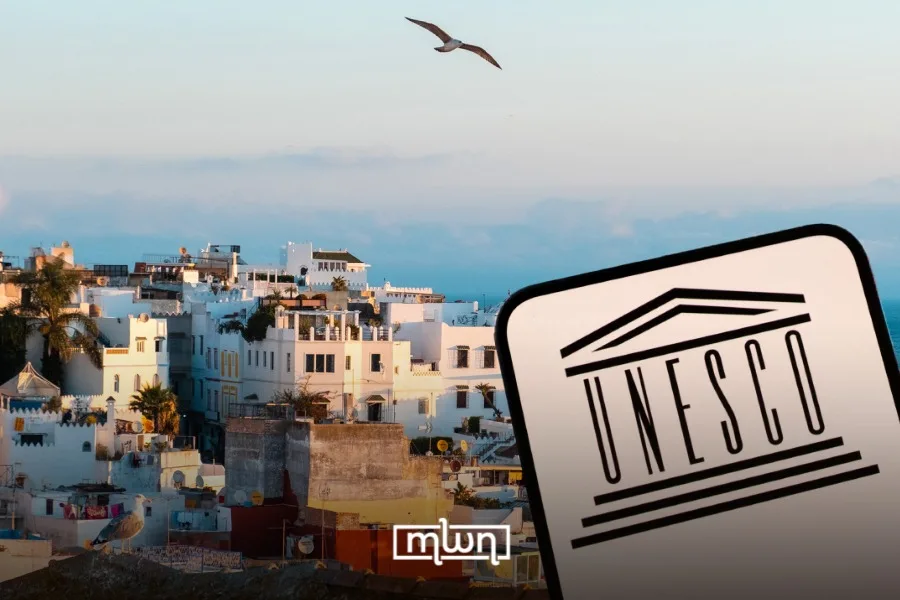
Fez — Tangier has relaunched its effort to secure inscription on UNESCO’s World Heritage List, reviving a project first initiated in 2017 to recognize the city’s rich urban and historical heritage.
Local institutions and civil society groups recently convened a coordination meeting to restart the process, aiming to update and strengthen the city’s nomination dossier in line with international requirements.
The meeting was organized by the “Observatoire pour la protection de l’environnement et des monuments historiques de Tanger” (Observatory for the Protection of the Environment and Historical Monuments of Tangier), with participation from the regional directorate of culture in the Tanger-Tetouan-Al Hoceïma region, the regional tourism delegation, and other relevant institutions.
The renewed effort focuses on aligning the proposal with the strict standards set by UNESCO’s World Heritage Centre. Among the key priorities discussed were updating the city’s heritage data, defining the exact boundaries of the proposed site, and developing a long-term management plan designed to safeguard the historic landscape.
Organizers also plan to hold a specialized training session in coordination with UNESCO to support the teams responsible for preparing the final nomination file.
Preparing Tangier’s heritage dossier
The UNESCO World Heritage designation requires countries to demonstrate what the organization describes as an “outstanding universal value,” meaning the site must hold cultural or natural significance that transcends national boundaries.
In Tangier’s case, the candidacy centers on the city’s historic urban landscape. The approach builds on work already undertaken in previous years, including an international workshop organized in 2016 with the UNESCO World Heritage Center. That meeting explored the possibility of listing Tangier’s historic urban fabric under UNESCO’s “Historic Urban Landscape” framework.
Before a site can be formally nominated to UNESCO, it must first appear on the country’s national tentative list. This preliminary stage identifies properties that the state may later propose for World Heritage inscription.
If the process moves forward, Tangier’s nomination will therefore pass through several stages of evaluation and revision before it can be submitted for international review.
A broader vision toward 2030
The renewed push for UNESCO recognition also comes at a strategic moment for Morocco. Local stakeholders emphasize the importance of raising Tangier’s international visibility ahead of 2030, as the country prepares to host major global events, including the FIFA World Cup.
Supporters of the project argue that World Heritage status could become a powerful tool for preserving the city’s architectural and historical legacy while strengthening its tourism appeal.
Tangier already holds a form of recognition within UNESCO’s cultural programs. The city is part of the UNESCO Creative Cities Network in the field of literature, a distinction awarded to cities that promote dynamic cultural policies and literary heritage.
However, inscription on the World Heritage List would represent a different level of recognition, focusing specifically on the universal historical and urban value of the city itself.
While the UNESCO evaluation process can take several years, the renewed coordination among local institutions signals a fresh chapter in Tangier’s ambition to see its historic landscape recognized among the world’s most significant cultural sites.