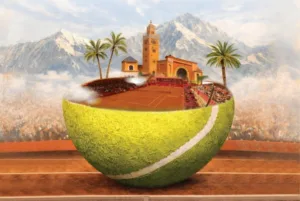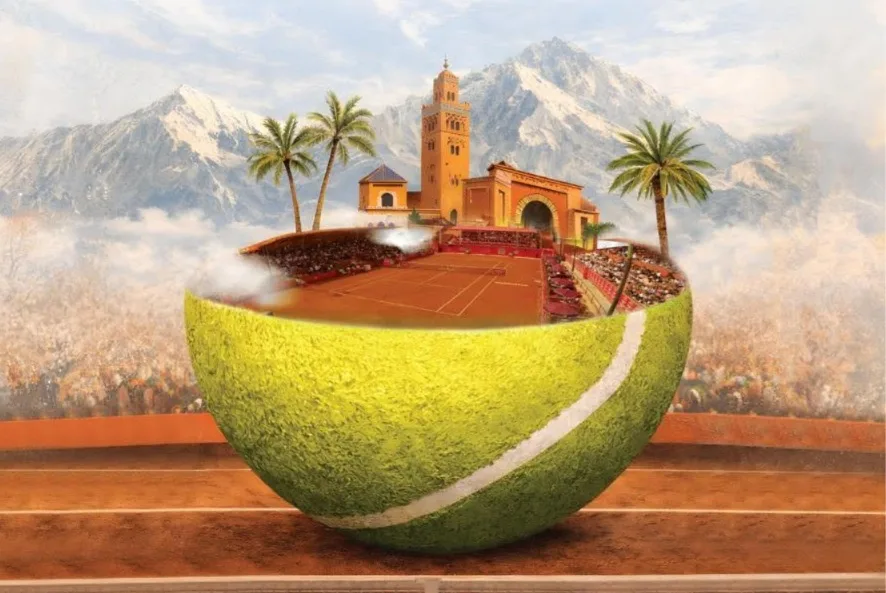
Rabat – The Grand Prix Hassan II, the ATP Tour’s only stop in Africa, returns to Marrakech from March 30 to April 5, for a 40th edition.
The setting is the Royal Tennis Club de Marrakech, a venue that has become synonymous with the best of Moroccan sport and hospitality.
Over the years, it has welcomed the world’s finest players, offered some of the most atmospheric tennis on the tour, and quietly built a reputation that far outweighs the tournament’s modest size on the ATP calendar.
This year, the occasion calls for something bigger.
The organizers are describing this edition as a fusion between heritage and innovation, and for once, that language is backed by real decisions.
No one embodies this moment better than Hicham Arazi. Morocco’s most celebrated player of the modern era, Arazi spent years competing at the highest levels of the sport before transitioning into leadership.
He now serves simultaneously as Tournament Director of the Grand Prix Hassan II and captain of Morocco’s Davis Cup team, two roles that place him at the precise intersection of the tournament’s past and its future.
His presence at the helm of this 40th edition is not incidental. It is the whole story in miniature: a champion who lived through the tournament’s greatest years, now steering it toward its next chapter, with a generation of Moroccan talent ready to follow in his footsteps.
For all the strategic ambition behind this edition, its most crowd-pleasing decision may be the simplest one.
Entry to the Grand Prix Hassan II will be completely free throughout the entire event.
No tickets, no barriers, just tennis, in one of the world’s most beautiful cities, open to anyone who wants to show up.
Marrakech, already one of the world’s great cultural destinations, is being positioned this year as a serious node on the international sporting map.
But the move that will define this edition is simpler and more radical than any hospitality upgrade: every single wild card in the draw will be awarded to a Moroccan player.
It is an unprecedented commitment in the tournament’s history, and a direct answer to a question the Moroccan tennis community has been asking for years: when does homegrown talent get its chance on the biggest stage?
The answer, this year, is now.
Wild cards are among the most powerful tools a tournament possesses.
They bypass the qualification process entirely, placing a player directly into the main draw alongside the world’s best.
By reserving all of them for Moroccan athletes, the tournament is doing something that goes beyond symbolism.
It is creating real, concrete ATP-level opportunities for a generation of players who have been developing in the shadows of international tennis for years.
It is a strong signal, one that acknowledges the depth of talent emerging from Morocco and sends a message to young players across the country: the door is open, and it is wide open.
Since its founding, the Grand Prix Hassan II has held a singular place on the ATP Tour.
It is not merely Morocco’s tournament, it is Africa’s tournament, the only proof that the world’s most prestigious men’s tennis circuit has a presence on the continent. That responsibility has been carried with pride for four decades.