Fez — STM School in Fez marked Laylat Al Qadr with an evening that blended spirituality, performance, and cultural transmission, positioning students as young carriers of tradition.
The night unfolded as a carefully paced program where children from different grades stepped forward in groups, each presenting multiple numbers that ranged from devotional singing to traditional Moroccan repertoire, creating a flow that felt both celebratory and purposeful.
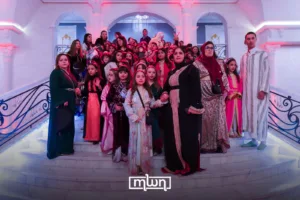
Families filled the room early, greeting one another with the familiar warmth of Ramadan gatherings.

As the program built momentum, the atmosphere shifted into something closer to a community ceremony, where applause and emotion were tied to more than artistic ability. For many parents, it was the simple pride of seeing their children stand confidently on stage, sing in unison, and hold the attention of a full audience.
A Moroccan ceremonial opening
The evening began with a distinctly Moroccan ritual tone. Before the curtain reveal, children were brought to the stage accompanied by zaghrata (ululation) and “salat w salam ala rassoul Allah,” echoing how Moroccan families traditionally elevate major moments like weddings and births.

The choice set the emotional register from the start, turning what was supposed to be a school show into a communal celebration rooted in shared codes.
Throughout the night, that same Fassi atmosphere carried into the details. Classic Moroccan sweets like kaab ghzal and tea circulated in the background, reinforcing the sense that the gathering belonged to Ramadan’s hospitality culture as much as it belonged to the school calendar.
Students at the center of the story
Multiple student groups from different grades performed successive sets, with short musical interludes allowing the program to move smoothly.
The variety of ages created a layered effect: younger children brought tenderness and spontaneity, while older students offered stronger control and stage discipline. The night’s structure gave each group its moment, turning the stage into a shared space rather than a competition.

Educational director Younous Kaabouch spoke of the night’s purpose in explicitly educational terms. “The purpose of this event is to introduce the students to their religion, traditions, and customs in their country,” he told Morocco World News (MWN). STM School aims to offer “meaningful art, which is an educational art,” the director added, describing it as a way of introducing children to “the true art, which feeds the soul.”

Kaabouch also emphasized that the program is designed as skill-building, not spectacle. He described it as a moment to sharpen students’ abilities, strengthen their motivation, and connect performance to wider learning. In his view, the artistic material is part of a broader educational ecosystem that helps students focus and excel across their studies.
Andalusian tarab and Issawa energy on stage
The program’s musical texture expanded through live interludes by guest performers who brought recognized Moroccan genres into the night’s rhythm. The Othmani Group contributed Andalusian tarab and additional traditional Moroccan numbers that matched Laylat Al Qadr’s spiritual tone, offering calmer passages that felt reflective and anchored.

Later, the Tadlaoui Youness band shifted the energy dramatically with Issawa music, lighting up the stage with faster tempos and a strong percussive drive that visibly lifted the room.
The contrast between Andalusian refinement and Issawa intensity created a dynamic arc across the evening, keeping the audience engaged while showcasing the breadth of Moroccan musical heritage.
Confidence, family pride, and community
STM School cofounder Hajar Habchaoui presented the night as a deliberate space for student development. “This event mainly aims to boost their self-confidence and learn how to take the stage,” she told MWN, describing the gathering as both a celebration of students and a moment for parents to come together around Laylat Al Qadr and Morocco’s cultural heritage.
Several school managers echoed the same theme, focusing on the scale of the turnout and the teamwork behind it.

STM School manager Noura Lachkar told MWN she was overwhelmed by the audience size in the second year, thanking Samir Bennis, Amine Bennis, and the school teams for their coordination and effort.

Another school manager, Ghitta Mouhib, stressed the event’s progress, saying, “Every year we are impressed and every year it is better than the year before,” while also thanking the administrative and educational teams, as well as Hajar Habchaoui, Adiba, Oumayma, and Younous.
STM combines a STEM-centered academic model with arts and student development, with the Fez-based institution aiming to build both performance confidence and classroom excellence among its students.
Its Laylat Al Qadr program reflects that philosophy in action, using stage experience as a structured tool for focus, discipline, and communication.