Fez — Morocco is moving to defend one of its most recognizable crafts after reports emerged that it had formally raised objections with UNESCO over an Algerian nomination file linked to zellige.
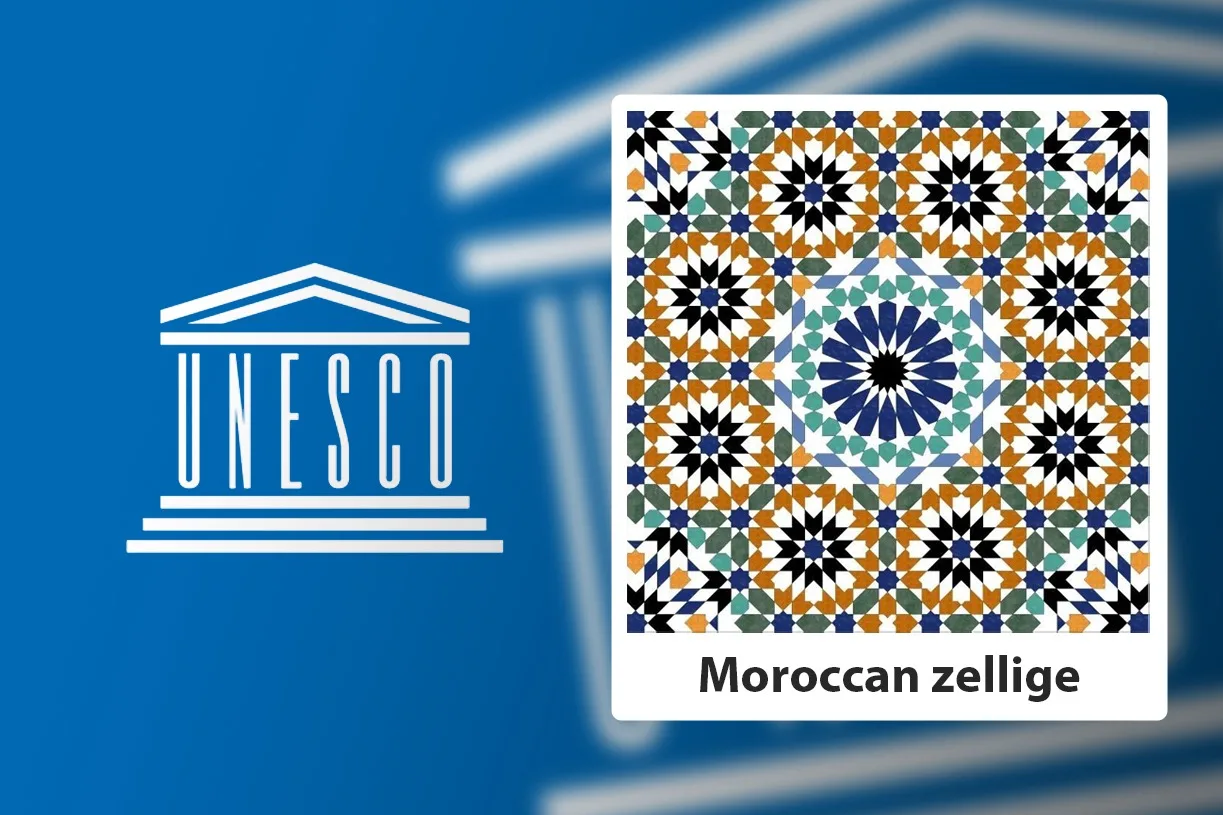
While UNESCO has not publicly announced any complaint or decision, its own records show that Algeria currently has a 2026 nomination under process titled “L’art d’ornementation architectonique en zellidje, céramique émaillée: savoirs et savoir-faire associés” (The art of architectural ornamentation in zellidj, glazed ceramic: associated knowledge and know-how).
The issue has quickly drawn attention in Morocco because zellige is not simply some decorative tilework to Moroccans, but one of the country’s most rooted artistic languages.
It appears in mosques, madrasas, fountains, palaces, and homes, especially in cities such as Fez and Tetouan.
In November 2025, Morocco’s Ministry of Youth, Culture, and Communication officially launched its own project to inscribe “the art of zellige of Fez and Tetouan” on UNESCO’s Representative List of the Intangible Cultural Heritage of Humanity. The ministry described the craft as a Moroccan intangible heritage passed from master artisans to apprentices across generations.
Why the dispute matters
What is at stake is not just a name in an archive. Heritage files shape international recognition. They influence how crafts are described, taught, and remembered.
For Morocco, that makes zellige a serious issue. The ministry’s 2025 announcement said the inscription effort was meant to preserve the craft, strengthen its place in national memory, and ensure its transmission to future generations. It also said the art has adorned Moroccan architecture for centuries and reflects Morocco’s contribution to human heritage.
Moroccan officials have also spent the past year building stronger legal tools around heritage protection.
In July 2025, Morocco signed a memorandum of understanding with the World Intellectual Property Organization, and the government said zellige was among the heritage elements already registered through WIPO-related mechanisms for stronger legal safeguarding. The same government statement drew a clear distinction between UNESCO recognition and WIPO protection, noting that UNESCO offers international recognition while WIPO can support legal action in cases of theft or misappropriation.
That wider context helps explain why the current dispute has stirred such strong reactions. UNESCO’s public database confirms that Algeria’s file is indeed under process for the 2026 cycle, but it does not, at least publicly, explain how any objection from Morocco is being handled or whether the nomination will be modified, contested, or maintained.
A craft larger than politics
Zellige has long carried more than aesthetic value in Morocco. The ministry’s launch event in Salé stressed that the craft is a vibrant expression of identity, memory, and centuries of Moroccan skilled labor, not just ornament. It also cited historical traces of Moroccan zellige stretching back before the Almoravid period, with scholars at the event pointing to early examples in Fez and broader traditions in Tetouan.
For that reason, the dispute is likely to resonate far beyond cultural institutions. In Morocco, zellige is part of how people recognize the country itself. It lives in architecture, craftsmanship, and daily visual memory. Any challenge involving its attribution will almost certainly be read as more than a technical heritage matter.
Whether UNESCO intervenes publicly or not, the episode shows how cultural heritage has become a front line of regional diplomacy.
In the case of zellige, the debate is not only about tiles. It is about who gets to name a tradition, frame its history, and claim its place in the story of North Africa.