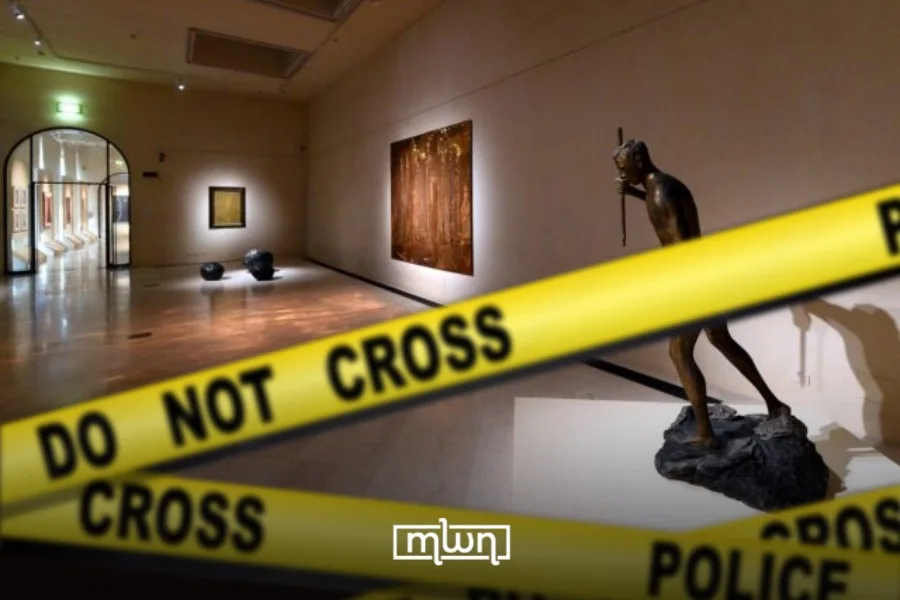
Fez — Thieves stole three paintings by Renoir, Cézanne, and Matisse from the Fondazione Magnani-Rocca near Parma in northern Italy during the night of March 22-23, according to police and multiple wire reports published Monday, March 30. The stolen works are Renoir’s “Les Poissons,” Cézanne’s “Still Life with Cherries,” and Matisse’s “Odalisque on the Terrace.”
The museum, also known as the “Villa of Masterpieces,” sits in Mamiano di Traversetolo, around 20 kilometers from Parma, and houses one of Italy’s best-known private art collections. Its permanent collection includes works by major European masters such as Monet, Renoir, Cézanne, Rubens, Van Dyck, Goya, and Dürer, according to the foundation’s official site.
Reports say the break-in was fast and highly targeted. Police said the thieves forced open the entrance door, while local media accounts cited by AP and Reuters said the group was able to seize the paintings in less than three minutes before fleeing across the museum gardens. Authorities suspect a structured and organized gang, with Italy’s specialist art investigators now involved in the case.
Some coverage has placed the value of the stolen works at more than €9 million, though Reuters noted that this figure had not been officially confirmed by the Carabinieri. Other reports suggest the haul could be worth roughly $10 million, underlining the scale of the loss even as precise valuations remain unsettled.
A museum theft during a major exhibition season
The heist comes at a delicate moment for the foundation, which is currently hosting “Il Simbolismo in Italia” (“Symbolism in Italy”), a major exhibition running from March 14 to June 28, 2026. That means the theft has struck not only one of Italy’s most prominent private collections, but also a museum in the middle of a high-profile cultural season.
As of Monday, the museum had not posted a public statement on its website about the theft, according to AP, and it was not immediately reachable because it was closed that day. That left much of the public picture in the hands of police reporting and media reconstruction.
A familiar pattern in European art crime
The theft in Parma also fits into a broader pattern of high-value cultural crimes in Europe. AP linked the incident to a recent string of major museum thefts, including a widely reported October robbery at the Louvre in Paris in which jewels and other items worth €88 million were stolen.
For now, the Parma case raises a familiar but unsettling question: how works that survived generations, wars, and borders can still disappear in minutes. The paintings’ fame may make resale difficult, but that same visibility does not lessen the blow to public heritage or the urgency of recovering them.