Safi – Every few years the fitness world anoints a new obsession, from the spin studio to the CrossFit box to the marathon major, and for several seasons now that crown has belonged, almost unarguably, to Hyrox.
What began in 2017 as a single race in a German exhibition hall, staged for a few hundred devotees, has swelled into one of the fastest-growing mass-participation sports on the planet.
More than 650,000 people raced it last season, and close to a million are expected for this one, across five continents and counting.
Part of its seduction is its ruthlessness, and part is its sameness.
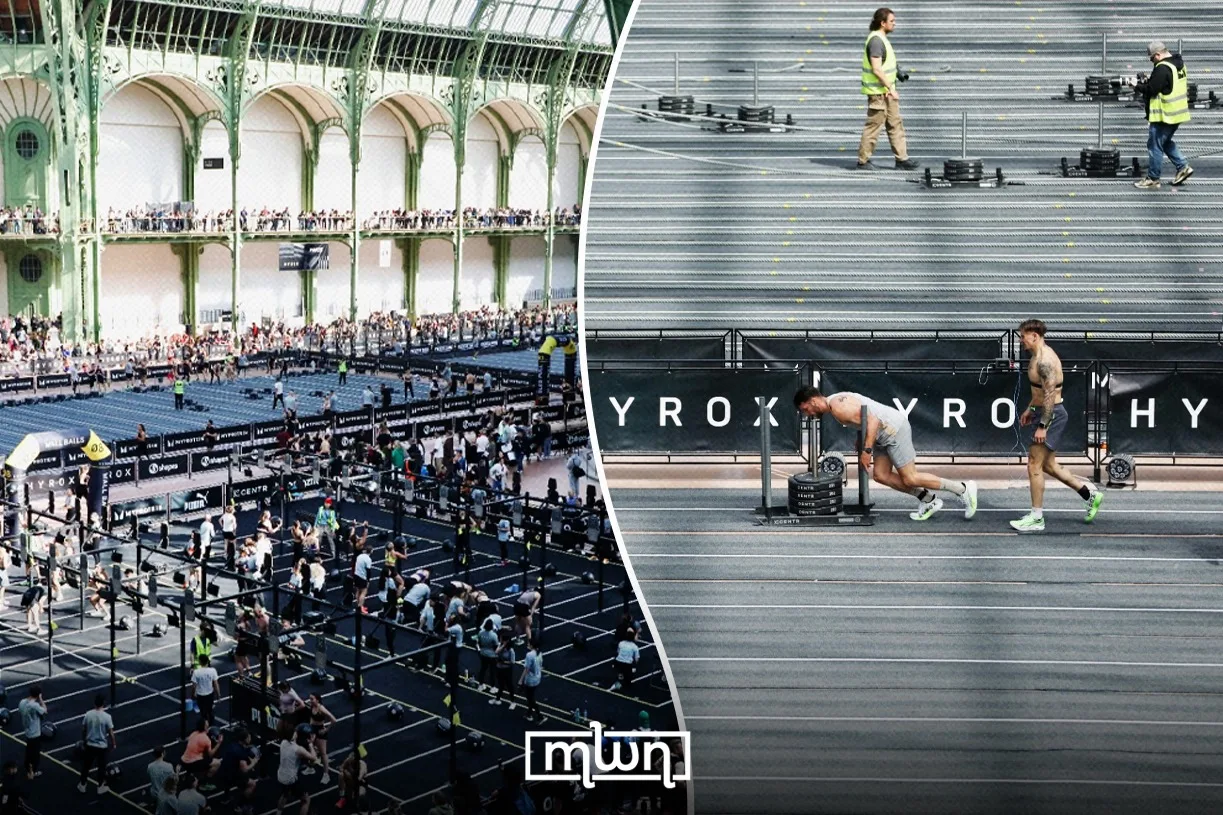
Every Hyrox, from Berlin to Dubai, follows an identical liturgy of eight one-kilometer runs, each broken by a functional station (a ski erg, a sled to push and drag, burpees, a rower, the farmers’ carry, a sandbag to lunge beneath, and wall balls), repeated until the body politely gives out.
Because the format never changes, the clock is universal, and a single global leaderboard becomes the sport’s great democratic fantasy, in which the amateur and the professional suffer to precisely the same standard.
It is also, not incidentally, extremely photogenic. Hyrox unfolds in cavernous exhibition halls under stadium lighting, heats released in waves, a chip on every wrist and a crowd that bellows for perfect strangers.
The whole spectacle is bottled, inevitably, for the feed, where the finish-line photograph has quietly become its own status symbol. The promise, printed everywhere in that severe black and yellow, is that Hyrox is for everybody, and the internet did the rest.
The geography has expanded at a fashionable clip. The circuit now spans dozens of races across nearly 30 countries, culminating each season at a World Championship in Stockholm that gathers more than 6,000 athletes from over 80 nations.
This year, for the first time, the phenomenon will reach African soil, in Cape Town.
Which leaves the question every sweat-slicked gym-goer in Casablanca and Marrakech is now asking. Where, exactly, is Morocco in all this?
For the moment, gracefully sidelined. No Hyrox has ever been staged on Moroccan ground, and the nearest start lines remain a short flight north, in Spain and France.
And yet the workout has slipped across the border well ahead of the event itself. In the Gueliz quarter of Marrakech, Dune Training runs a dedicated Hyrox hour, an unsparing sixty minutes built around the race’s exact stations, capped at a dozen athletes with a coach appraising every rep.
In Casablanca, trainers have begun programming for it, and a few fitness-travel outfits have started, discreetly, to build week-long Hyrox retreats around Marrakech.
None of which is an accident. CrossFit boxes and functional studios have proliferated from Casablanca to Rabat, and Hyrox is merely the logical next indulgence for a gym floor already stocked with sleds, rowers and a certain appetite for suffering.
It is the same hard-training set that took up CrossFit and the marathon, now quietly coveting a bib.
Some are already doing more than coveting. In late January, Hamza Najih, a young Moroccan who prepared without so much as a coach, flew to Turin and won his age category at a Hyrox, seeing off athletes from more than 20 countries in a little over an hour.
What Morocco lacks, for now, is a finish line to call its own, and so the ambitious pack a bag and go looking for one abroad, in Europe or, increasingly, all the way down to Cape Town.
The workout, in other words, has already arrived. The race is simply the part the country is still waiting to be invited to.