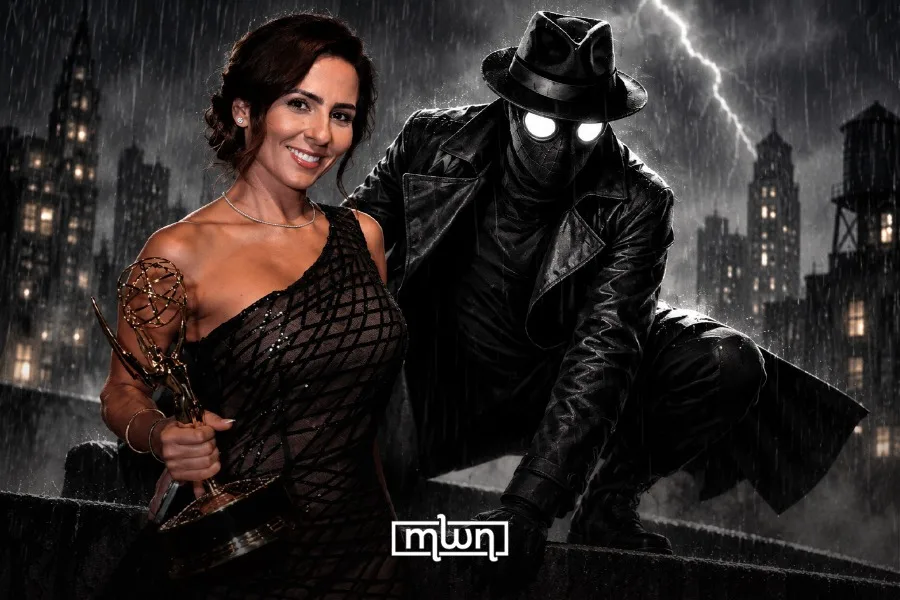
Fez — Moroccan Foley artist Sanaa Kelley has won her second Emmy, proving that some of Hollywood’s most important performances happen nowhere near a camera.
Kelley won Outstanding Sound Editing for a Comedy or Drama Series (One Hour) as part of the sound team behind “Spider-Noir.” The winning episode, “The Man in the Mask,” featured Kelley as a Foley artist alongside fellow Foley artist Matt Salib and the series’ wider sound team.
The “Television Academy” lists Kelley with six Emmy nominations and two wins. Her first came in 2024 for her Foley work on FX’s “Shōgun,” specifically the episode “Broken to the Fist.”
“Spider-Noir” had a strong night overall at the 78th Emmy Awards, picking up five trophies, including awards for cinematography, title design, visual effects, stunt coordination, and sound editing.
The woman making Hollywood sound real
Foley is one of those movie jobs most viewers never notice until someone explains it.
When a character walks across gravel, pulls on a jacket, drops a bag, opens a door, or gets punched, the sound audiences hear is not always the sound recorded during filming.
Instead, Foley artists recreate those noises afterward in a studio, performing them in sync with what happens on screen.
Kelley has spent nearly three decades doing exactly that.
Her process can involve surprisingly ordinary objects. In a 2024 interview, Kelley revealed that celery can help recreate the sound of breaking ribs, while glow sticks or carrots can imitate different-sized bones snapping.
That attention to anatomy is not entirely accidental. Before Hollywood sound became her career, Kelley studied biology and pursued medicine. She has said that her scientific background still influences the way she thinks about materials, movement, and even bone density when building sounds.
Snow can be similarly deceptive. At demonstrations, Kelley has used bags containing cornstarch and coarse sand to reproduce the sound of footsteps moving through it.
Hollywood, apparently, runs partly on vegetables and pantry supplies.
From Morocco to an invisible Hollywood craft
Born in Morocco, Kelley moved to the United States as a teenager before eventually discovering Foley.
Her entry into the profession was hardly an instant success. Kelley has recalled seeing Foley performed after high school and thinking it looked easy. When she tried it herself, she struggled.
She was even told she might not have the instinct for the job.
Instead of dropping the idea, Kelley began contacting studios until one allowed her to observe the process. She initially learned alongside a Foley mixer and practiced listening closely to scenes before eventually getting an opportunity to perform on a low-budget production.
She later founded “Reel Foley Sound” and built a career spanning projects including “Ted Lasso,” “The Walking Dead,” “Only Murders in the Building,” “Bad Monkey,” and “Shōgun.” Her professional biography also describes her as a California-based Foley artist with nearly three decades in the industry.
Her second Emmy puts a spotlight on a craft designed, paradoxically, to disappear. Great Foley works because audiences believe every footstep, scrape, crack, and rustle belongs naturally inside the scene.
For Kelley, that invisibility has become a very visible achievement: a Moroccan-born artist helping Hollywood sound convincing, one fake footstep and broken carrot at a time.