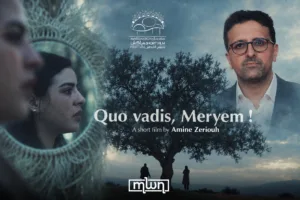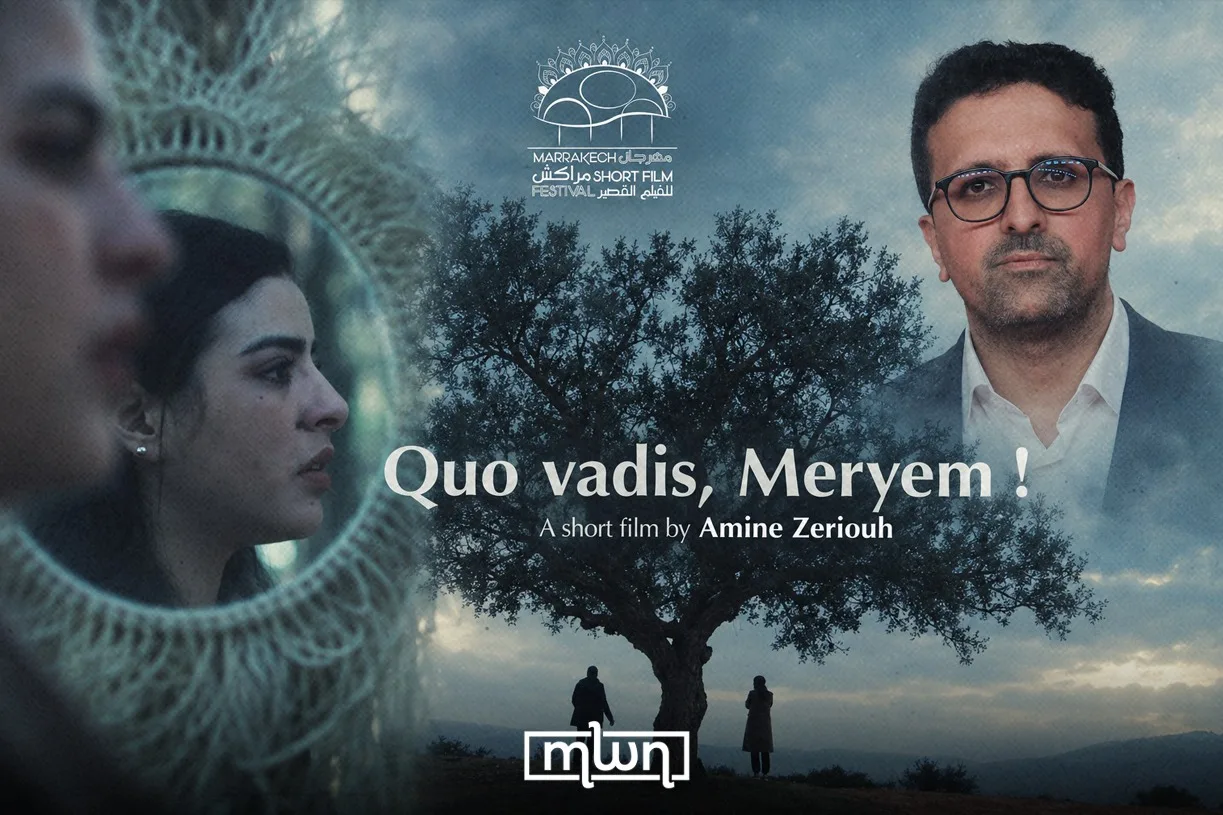
Rabat – A marriage can become a place where grief is shared yet experienced alone. In Amine Zeriouh’s “Quo Vadis, Meryem!,” silence is the language through which a couple confronts the death of a child, the erosion of intimacy, and the possibility that the life they once knew together may already be gone.
The Moroccan short film, which will participate in this year’s Marrakech Short Film Festival (MARRAKECHsFF), approaches grief not through dramatic confrontation but through glances, gestures, hesitation, memory, and the spaces that open between two people who can no longer reach one another.
For Zeriouh, the film’s journey to Marrakech is part of a wider trajectory that began long before he stood behind a camera. An industrial engineer by training and a filmmaker by passion, Zeriouh describes cinema as something that has accompanied him since adolescence, when writing became a way of making sense of the world around him.
“Cinema has been a lifelong passion, in many ways, it saved my life literally, during my adolescence, while navigating the world’s complexities,” Zeriouh tells MWN Lifestyle magazine.
Long before “Quo Vadis, Meryem!” became a film, it existed as one of the short stories he wrote during that period.
“I started writing, expressing my inner and personal vision of the world around me, and ‘Quo Vadis, Meryem!’ was one of the short stories that I wrote during that time,” he recalls.
That history helps explain the film’s literary sensibility. Rather than beginning with the mechanics of filmmaking, Zeriouh’s cinema appears to begin with an interior world: the private thoughts, memories, tensions, and questions that often resist straightforward expression.
From engineering to an instinctive cinema
Zeriouh’s path to filmmaking did not follow the conventional route of film school. His engineering background instead gave him practical tools that proved valuable once his literary ideas moved toward production.
He believes that his “engineering background has been immensely helpful with the practical side of production, particularly budget management and logistics.”.
That practical dimension was strengthened by his collaboration with his wife, Zakia Smidi, also an engineer, who served as the film’s chief producer.
“My wife, Zakia Smidi, who is also an engineer and serves as our Chief Producer, was instrumental in managing our production effectively,” Zeriouh explains.
Yet the technical discipline of engineering did not dictate the film’s artistic language. The directing process, he explained, was “purely instinctive.”
That instinct was supported by a crew composed largely of friends who were drawn to the emotional core of the story. Among them was actor Sandia Tajdine, whose performance became central to the film.
“I was especially lucky to collaborate with Sandia Tajdine, who stunned us with her performance, generosity, and patience for a first-time director,” Zeriouh says.
The contrast is revealing: a filmmaker trained in a field associated with precision and systems approached his first directing experience through instinct, collaboration, and emotional intuition.
That tension between structure and feeling also runs through “Quo Vadis, Meryem!” itself.
When marriage becomes a ‘laboratory of humanity’
At the center of the film is not the death itself, but the marriage left behind by it.
Zeriouh deliberately chose to tell the story through a couple. Rather than placing the deceased child at the center of the narrative, he focuses on the two people who remain and on the fundamentally different ways they process loss.
As he explains, “choosing a married couple allowed me to create tension between two forces and visions that process grief differently.”
Yet his interest in marriage goes beyond its role as a narrative device.
“I am fascinated by the institution of marriage, which I view as a ‘laboratory of humanity,’” Zeriouh elaborates.
The phrase captures much of what makes the film culturally resonant. Marriage, in his conception, becomes a confined but revealing space in which individual identities encounter another person’s expectations, frustrations, memories, desires, and values.
Zeriouh is “intrigued by how couples navigate expectations, frustrations, and aspirations within a shared framework involving another person’s ego and values.”
And that abundantly shows in “Quo Vadis, Meryem!,” where the director uses grief to expose those tensions. The couple shares the same loss, but their experience of that loss is not identical. The death that might have been expected to bring them closer instead reveals the distance that has accumulated between them.
The film therefore asks a difficult question: what happens when two people inhabit the same tragedy but cannot find a common language with which to mourn it?
The oppressive weight of silence
Perhaps the film’s most distinctive feature is what it refuses to say.
Rather than filling grief with exposition or emotional declarations, Zeriouh relies on silence. The characters’ pauses, looks, movements, and hesitations become as meaningful as spoken dialogue.
“I believe silence, the human gaze, and subtle gestures and hesitations often express the human condition far better than words,” he said.
For Zeriouh, silence is not simply an absence of dialogue, but a language in another form.
Silence, he argues, “is the unspoken words, the truth that can eventually become an oppressive wall or an unbearable weight separating two people.”
That distinction is crucial to the film. Silence initially creates space for emotions that cannot yet be articulated, but it can eventually become destructive. What remains unsaid begins to acquire its own force, turning the space between two people into a barrier.
In this sense, “Quo Vadis, Meryem!” treats silence almost as a physical presence.
The approach also reflects Zeriouh’s understanding of cinema itself. He draws on a tradition of filmmaking in which restraint can become a form of expression and resistance.
“Much of the films that shaped me as a filmmaker relied on silence as an essential narrative tool and an act of resistance against consumerism,” he said.
The statement places his short film within a broader cultural question about contemporary cinema: whether a film needs to constantly explain, accelerate, entertain, or consume the viewer’s attention, or whether it can instead ask audiences to remain with uncertainty.
Chekhov in the Moroccan present
The film’s literary foundations deepen that approach.
“Quo Vadis, Meryem!” loosely draws on Anton Chekhov’s “The Joke,” but Zeriouh did not approach the Russian writer’s work as a text to reproduce on screen. Instead, Chekhov provided a structural and thematic point of departure.
As he puts it, “Drawing on Chekhov’s ‘The Joke’ was not meant to be a literal translation, but a way to weave a classical literary structure into contemporary Moroccan reality.”
The choice is significant. Rather than treating literature as a source to be faithfully transferred into another medium, Zeriouh treats it as a reservoir of emotional structures that can be relocated across time, geography, and culture.
“I am less interested in faithful adaptations and more in how these timeless themes,” he offers, noting how “the fragility of joy and emotional misunderstanding, resonate within our modern context.”
The result is neither a conventional literary adaptation nor a film detached from its cultural environment. Instead, the way Zeriouch proceeds makes Chekhov an integral part of a Moroccan cinematic vocabulary.
The emotional misunderstanding at the heart of the original literary structure finds a new setting in contemporary Morocco, where the ancient city, the couple’s history, and the physical landscape surrounding Meryem become extensions of the characters’ inner lives.
“This allows the story to feel both deeply grounded in our culture and universally accessible,” Zeriouh explains.
That balance is particularly relevant as Moroccan cinema continues to engage with questions of identity, memory, family, social change, and the relationship between local experience and global audiences.
Walking through memory
Meryem’s physical journey through the ancient city is also a journey through a relationship that exists increasingly in the past.
The film begins with a discussion about a dying friend, a conversation that gradually takes on another meaning as the story unfolds.
“The film opens with a discussion about a dying friend, which mirrors the couple’s own relationship,” Zeriouh said.
“Meryem sees this clearly, while her husband does not.”
The distinction gives the film its emotional trajectory. Meryem is not simply confronting the death of someone else; she is confronting the possibility that something within her own marriage has already died.
As she moves through the ancient city, physical movement becomes a form of recollection, Zeriouh explains, stressing: “She attempts to remember who they were when they first fell in love, revealing how time changes things irreversibly.”
The city therefore functions as more than a backdrop. Its old streets and accumulated histories become a space through which Meryem searches for an earlier version of herself and of the relationship.
But memory cannot restore what time has altered.
And so, Zeriouh ultimately describes the film as “a mourning of her past life through which she discovers the truth about her marriage and, most importantly, herself.”
The line shifts the film’s center of gravity. What initially appears to be a story about bereavement gradually turns into a more complicated meditation on the many forms of mourning that accompany adulthood: mourning people, relationships, possibilities, identities, and versions of oneself that can no longer be recovered.
From the Red Sea to Marrakech
Before arriving at the MARRAKECHsFF, “Quo Vadis, Meryem!” premiered at the Red Sea International Film Festival and travelled to festivals abroad, allowing Zeriouh to observe how audiences from different cultural backgrounds interpret an intensely Moroccan story.
Those encounters have revealed both differences and common ground.
“Observing how audiences from different cultures react to the film, including the contrasting perspectives between male and female viewers, has been illuminating,” he maintains.
The reactions have reinforced the importance of the film’s Moroccan setting while also demonstrating that its emotional concerns extend beyond it.
“While the setting is undeniably Moroccan,” he notes, “the core themes of unspoken grief and relationship dynamics are profoundly universal.”
For a film like “Quo Vadis, Meryem!,” that duality matters. Its cultural specificity does not prevent international audiences from entering its emotional world. On the contrary, the Moroccan setting gives the story a distinct identity through which universal experiences become visible.
Although “the specific Moroccan backdrop gives the story its unique texture,” he concedes, “the emotional truth at its heart is what connects with viewers everywhere.”
Its participation in the MARRAKECHsFF consequently carries significance beyond another festival screening. The film returns to a Moroccan cultural environment after encountering audiences abroad, bringing with it the accumulated experience of those encounters.
A festival for the Intimate and the experimental
The MARRAKECHsFF offers a particularly fitting setting for that return.
Short films occupy an unusual place in cinema. They often provide filmmakers with the freedom to explore ideas, structures, characters, and forms that may be difficult to sustain within the commercial expectations surrounding feature-length productions. Their brevity does not necessarily limit their ambitions. In many cases, it allows filmmakers to concentrate intensely on a single emotional or philosophical question.
“Quo Vadis, Meryem!” belongs to that tradition.
Its concerns – grief, marriage, memory, silence, emotional estrangement, and self-discovery – are expansive, yet Zeriouh approaches them through a contained story and a carefully observed relationship.
The Marrakech festival also places the film within a broader conversation about the role of short cinema in Morocco: as a space for emerging filmmakers to develop distinctive voices, for established cinematic languages to be questioned, and for audiences to encounter stories that may not fit conventional commercial formulas.
For Zeriouh, the festival circuit has already demonstrated the ability of a small, intimate story to travel beyond its immediate cultural setting without losing its Moroccan character.
Marrakech now provides another audience for that conversation.
From Chekhov to Farrokhzad
But Zeriouh’s relationship with literature does not end with Chekhov.
His filmmaking practice continues to draw from writers and poets whose work explores the interior life. He recently completed a project inspired by the poetry of Jaime de Biedma and Iranian poet and filmmaker Forough Farrokhzad.
Both, he says, “profoundly understood the internal landscape of the human soul.”
That idea offers perhaps the clearest explanation of Zeriouh’s approach to cinema.
“Poetry and literature provide an emotional and metaphorical intensity that cinema can sometimes struggle to articulate,” he says.
For a filmmaker whose work is so invested in silence, the distinction between what can be seen and what can only be felt becomes central.
“While cinema is a medium of the visible, poetry offers a vocabulary for the invisible,” Zeriouh adds.
His challenge, then, is to translate that invisible vocabulary into images.
And he is actually quite aware that “translating this inner life into film is a constant and rewarding challenge.”
But perhaps the greater challenge lies at the heart of “Quo Vadis, Meryem!” The film does not attempt to explain grief in its entirety. It observes what grief does to a relationship, what it reveals about memory, and how it can expose truths that language has failed to articulate.
As the film arrives at the MARRAKECHsFF, its most powerful questions remain deliberately unresolved: What happens when love survives longer than intimacy? Can a shared loss bring two people together if they mourn differently? And when someone returns to the places where they once loved, are they searching for another person, or for the person they themselves used to be?
For Zeriouh, cinema appears to begin precisely in that uncertain territory, where words stop and the invisible begins.