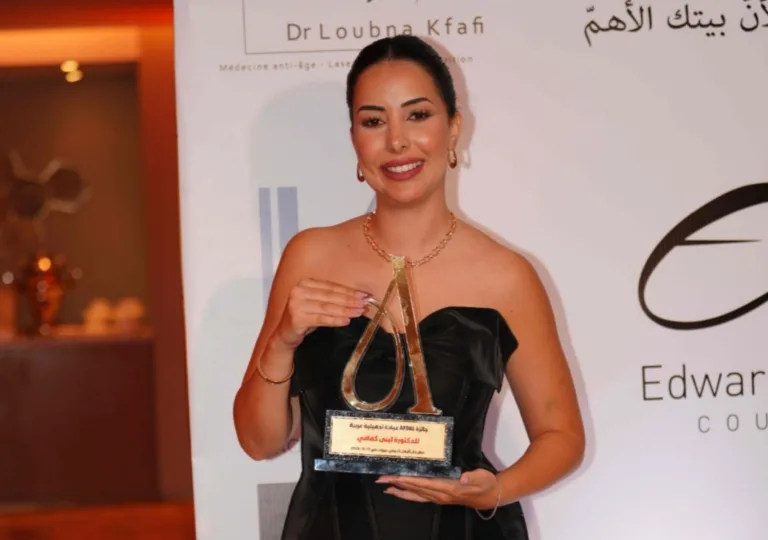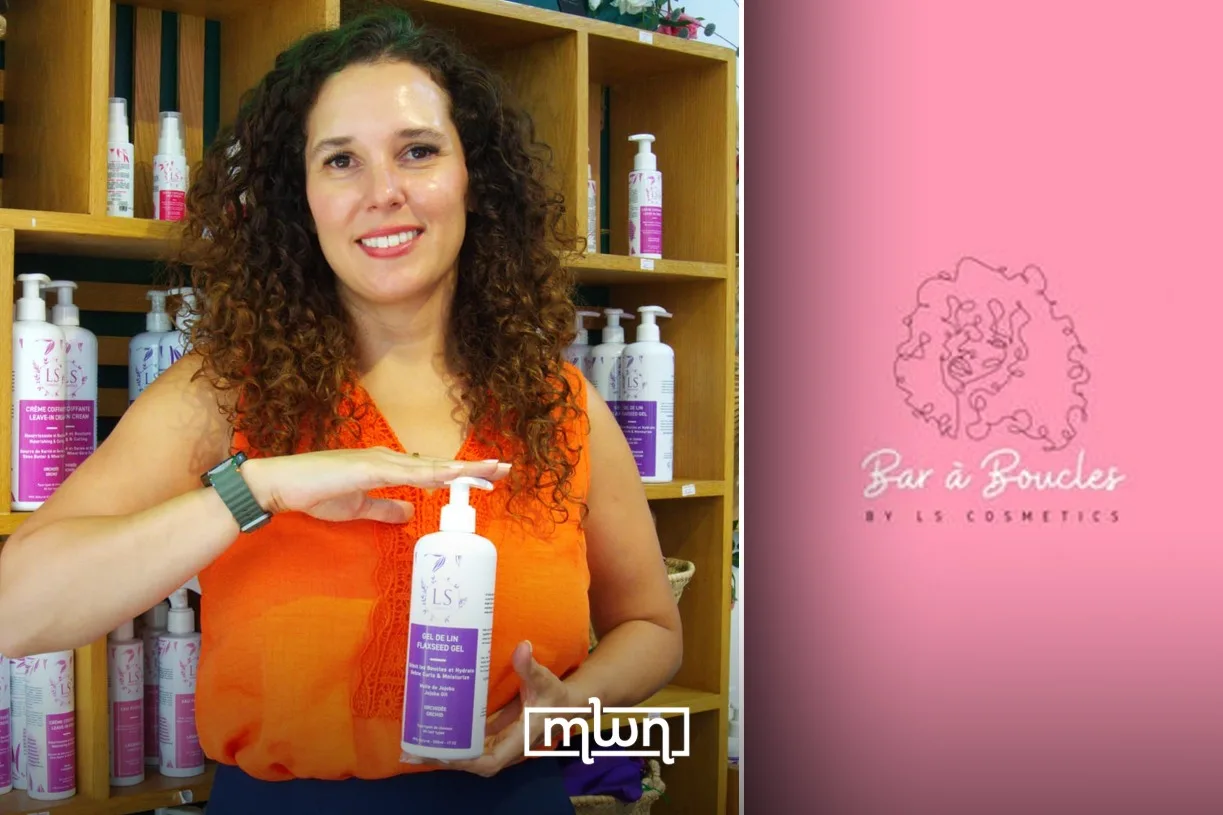
Casablanca – Sanaa Lahlou, founder of curly hair salon Bar à Boucles and haircare brand LS Cosmetics, is helping reshape how people in Morocco understand, care for, and embrace their natural curls.
Lahlou created LS Cosmetics in 2018 around the needs of curly and textured hair. Three years later, she opened the first Bar à Boucles, turning the idea into a physical space where people could learn how to care for their hair while receiving treatments adapted to its needs.
Today, Bar à Boucles has seven salons across Morocco, including four in Casablanca and others in Tangier, Marrakech, and Rabat.
The idea behind the business came from a realization that sounds simple but changed the way Lahlou approached curly hair.
“I realized that having good products was not always enough,” Lahlou told MWN Lifestyle magazine.
Many people, she explained, did not know how to care for or style their hair, or even which professional they could trust with it.
“I therefore wanted to create a place genuinely designed for this type of hair, with trained teams, adapted techniques, and above all, a real understanding of curls.”
When curly hair was treated as a problem
Lahlou remembers a beauty industry where many salons knew how to work with straight hair but had less expertise when it came to curls and textured hair.
People would hear that their hair was “dry,” “difficult,” or “puffy.” Instead of learning what the hair needed, straightening often became the easiest answer.
That is precisely the mindset Lahlou wanted to challenge.
“I wanted to reverse that logic: instead of trying to transform the hair, we should learn to work with its natural nature,” she said.
And that shift matters. Curly hair does not need to become straight to look polished, healthy, or beautiful. It needs the right care, the right techniques, and, perhaps most importantly, someone who understands what they are working with.
Bar à Boucles is also not limited to women. The salons welcome men and children as well.
“As soon as someone has curly, wavy, frizzy, or textured hair and wants to learn how to take better care of it, they have a place with us,” Lahlou told MWN Lifestyle magazine.
Your curl type isn’t the whole story
The world of curly hair comes with its own vocabulary. There are 2A, 2B, 3A, 3B, 4A, and more hair types. It can quickly feel like you need a degree just to figure out which letter belongs to your hair.
But Lahlou says the number or letter should not become an obsession.
“Curl type can be an interesting visual reference, but it is not, in my opinion, the most important criterion,” she explained.
Many people can have curls that look almost identical, she explained, but this doesn’t imply that they necessarily need the same products and routines. The process can be completely different.
Lahlou looks at several factors instead, including texture, density, thickness, dryness, hair history, coloring or chemical treatments, scalp condition, and the person’s everyday habits.
Porosity also plays an important role in understanding what hair needs.
The result is a much more individualized approach. A rich product that works beautifully for one person may weigh down another person’s finer hair. Someone with very dry hair may need more nourishment, while someone with fine curls may need a lighter routine.
“There are universal principles, but there is no universal routine,” Lahlou said.
Even washing frequency can change depending on a person’s scalp, lifestyle, and use of styling products.
In other words, the best routine is not necessarily the one trending online. It is the one that works for your hair and fits into your actual life.
Start simple, not with a bathroom full of products
If you are only beginning to understand your natural curls, Lahlou has one particularly practical piece of advice: do not buy everything at once.
“I would especially tell people not to buy ten products from the beginning,” she said.
Instead, start with the essentials: a gentle shampoo suited to the scalp, a moisturizing treatment when needed, a styling cream, and a fixing product such as gel.
Then comes the part that many people skip. Watch your hair.
Does it become weighed down quickly? Does it feel dry? Do your curls hold their shape for several days? Does a product leave your hair soft or heavy?
Those observations can tell you far more than a long list of viral recommendations.
“Observation is what gradually allows you to build your routine,” Lahlou explained.
This is also where LS Cosmetics connects with Bar à Boucles. The brand grew specifically around curly and textured hair, while the salons provide daily contact with different hair types and the people caring for them.
Lahlou describes the two as working together, with the products on one side and professional expertise and guidance on the other.
What a good curl routine actually look like
A good curly hair routine does not have to involve a dozen steps.
Lahlou starts with the scalp. A gentle shampoo should clean the scalp properly while avoiding excessive product buildup.
After that comes care and hydration whenever the hair needs them.
Then comes styling, which can make a noticeable difference in how curls look and hold throughout the day.
Lahlou generally recommends a styling cream for softness and definition, followed by a gel or another fixing product to help maintain the curl pattern and reduce frizz.
And then comes the step many people would happily skip: drying.
Yes, it takes time. Yes, leaving your curls to figure themselves out while you rush out the door can be tempting. But how you dry them can affect the final result.
“Instead of rubbing the hair with a regular towel, we use microfiber or a soft fabric, and then a diffuser at a reasonable temperature,” Lahlou said.
That small change can help reduce unnecessary friction while allowing the curls to keep more of their definition.
The lissage debate
Straightening has long been part of the conversation around textured hair, and Lahlou does not frame it as something people should simply stop doing.
Instead, she puts the choice back where it belongs: with the person wearing the hair.
“Everyone is free to do whatever they want with their hair,” she said. “The problem is not straightening your hair from time to time.”
What concerns her more is when someone feels that straightening is their only option because they have learned that their natural hair looks difficult, messy, or not beautiful enough.
Before permanently changing the texture of their hair, Lahlou believes people should at least have the opportunity to discover how their natural curls work.
If they still prefer straight hair afterward, that choice deserves respect.
That distinction is important. Curly hair care should not become another set of rules telling people what they are allowed to do with their own appearance.
Heat can change the curl
There is, however, a difference between styling choice and hair health.
Excessive heat and certain chemical treatments can significantly alter the appearance of curls and damage the hair fiber.
Once the fiber suffers damage, Lahlou points out, you cannot truly rebuild its original structure. You can improve its appearance, protect it, and reduce further breakage, but damaged hair does not simply return to its original condition because you added another product.
In some cases, curls can gradually return as people reduce heat and cut away severely damaged sections.
Hair texture can also change naturally throughout life. Age, hormones, pregnancy, and other physiological changes can all affect how hair behaves.
So if your curls suddenly seem different, your styling routine may not be the only explanation.
Why some people discover their curls late
For Lahlou, the relationship many Moroccans have with curly hair also has a cultural dimension.
“For a long time, especially in our culture, we did not really talk about curly hair,” she said.
Lahlou points to another common habit: brushing curls while they are dry.
Dry brushing can destroy curl definition and create the very volume and frizz that then convince someone their hair is simply impossible to manage.
Some people can spend years thinking they have “difficult” hair before discovering that what they actually have is a natural wavy or curly texture that needs a completely different approach.
It is a familiar story for many people who grew up in households where the easiest solution was simply to brush everything out, tie it back, or straighten it.
The Dos and Don’ts of curly hair
The basic rules are surprisingly simple.
Start with products that suit your hair, handle curls gently when detangling, and protect them while you sleep. Paying attention to how your hair responds to different products and techniques can also help you figure out what works best for you.
And perhaps most importantly, do resist the urge to constantly touch, rearrange, or manipulate your curls.
On the other side, avoid brushing curls while they are dry whenever possible. Avoid relying on very high heat, piling on products without knowing why you are using them, and copying every hair trend that appears on social media.
“A viral recipe is not necessarily suitable for your hair,” Lahlou said.
That applies to homemade mixtures, complicated routines, and products that suddenly become internet sensations overnight.
More products do not automatically mean better curls. Because sometimes, your hair is simply asking for less.
What parents should know
The conversation becomes even more important when children are involved.
Lahlou’s message to parents is simple: never make a child feel that their hair is a problem.
“The words used during childhood can stay with you for a very long time,” she said.
Constantly telling a child that their hair is difficult, too voluminous, or impossible to style can shape how they see their natural texture as they grow up.
For children, Lahlou recommends keeping the routine extremely simple. Gentle care, delicate detangling, limited products, and hairstyles that do not pull excessively on the hair can go a long way.
But beyond the products and techniques, there is one thing she considers even more important.
“Above all, teach them to love their natural texture.”
More than products and salon appointments
For Lahlou, the next chapter of Bar à Boucles and LS Cosmetics goes beyond expanding products or opening more salons.
She wants education to become a bigger part of the brand’s work.
One of the projects she is developing is a broader content library dedicated to textured hair. The goal is to help people understand the hair fiber, the scalp, routines, common mistakes, children’s hair, pregnancy, and postpartum hair changes.
The idea is to create a place where people can come not only to buy a product or book an appointment, but also to understand what is happening in their own heads.
That educational side also reflects what Lahlou sees as one of LS Cosmetics’ strengths. The brand does not operate separately from the salons. The daily experience at Bar à Boucles gives the team a closer look at the concerns people actually face.
“We work every day with different types of hair and speak extensively with our clients,” Lahlou said. “This allows us to see the problems they encounter, the gestures that work, and the needs that exist.”
At the end of the day, Lahlou wants Bar à Boucles and LS Cosmetics to offer something that goes beyond products and salon appointments. Her vision centers on helping people understand their own hair and make more informed choices about how they care for it.
“The goal is for Bar à Boucles and LS Cosmetics to be more than just places where people come to buy a product or receive a service. We also want them to be trusted references where people can come to understand their hair,” the founder concluded.
Read Also: The Curly Hair Paradox in Morocco: From Bullying to a Social Media Trend