

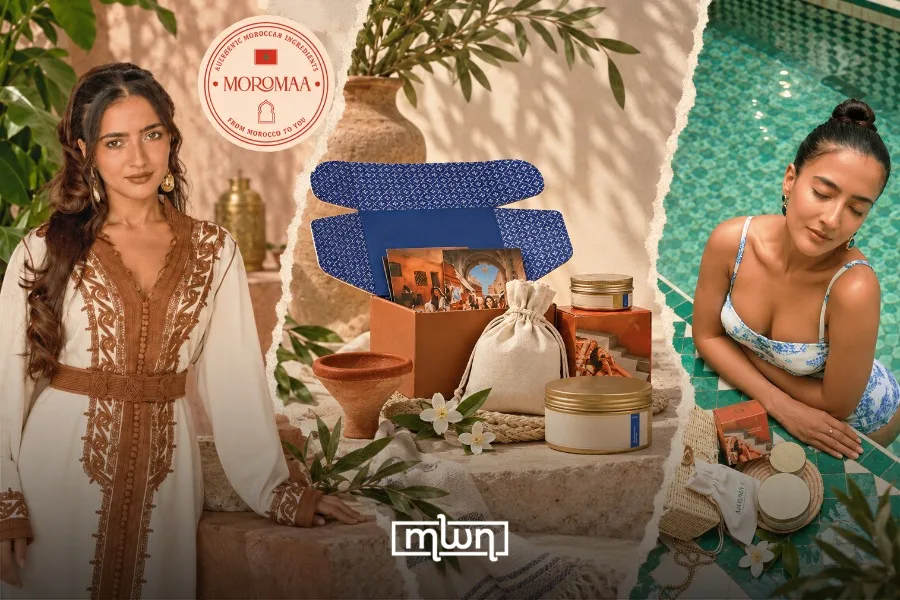
Fez — Korean beauty has K-Beauty. Japanese skin care has J-Beauty. Moroccan entrepreneur Soundous Moufakir believes Morocco should have a category of its own.
Her answer is “M-Beauty.” Moufakir is the founder of MoroMaa, a Mumbai-based beauty and personal care brand built around Moroccan ingredients and beauty rituals for Indian consumers.
The young company recently secured INR 15 million (MAD 1,6 million/$170,000), in backing from Aviral Bhatnagar of AJVC, with the investment expected to support new products, distribution, and expansion across India. Moufakir announced the investment this month.
The funding arrives only months after MoroMaa launched in 2026.
Taking the hammam to India
For Moufakir, the concept comes directly from her childhood in Morocco.
On its official website, MoroMaa explains that its founder grew up with argan oil, nila powder, rhassoul clay, black soap, rose water, and the exfoliation rituals associated with the Moroccan hammam.
After later moving to India, Moufakir saw an opening.
Indian consumers had become familiar with Korean, Japanese, and Ayurvedic beauty traditions, but she felt Morocco was often reduced to individual ingredients, particularly argan oil, rather than understood as a wider beauty culture.
MoroMaa is attempting to change that by sourcing ingredients from Morocco while developing products for concerns shaped by India’s climate, including humidity, heat, pollution, tanning, and skin buildup.
The company describes its products as a bridge between Moroccan heritage and contemporary personal care, with the hammam serving as a major reference point for its rituals.
That approach also turns culture into part of the brand itself.
Rather than simply putting Moroccan-inspired patterns on packaging, Moufakir has positioned provenance as the selling point. Where an ingredient comes from, how Moroccan women traditionally use it, and how that practice translates to an Indian routine are all part of the pitch.
Building an M-Beauty category
MoroMaa says two of its products sold out during its first two months of operation, early traction the company hopes to build on with its new funding.
The larger ambition, however, is not simply to sell more jars.
Moufakir wants “M-Beauty” to become recognizable in India as a distinct beauty category, giving Moroccan rituals the kind of cultural identity that Korean beauty has successfully built internationally.
That makes MoroMaa an unusual example of Moroccan cultural export.
It is not selling a destination, restaurant, or fashion collection. It is trying to turn practices passed through Moroccan homes and hammams into a modern beauty language for consumers thousands of kilometers away.
If the category catches on, India may become an unexpected new stage for one of Morocco’s oldest lifestyle traditions.