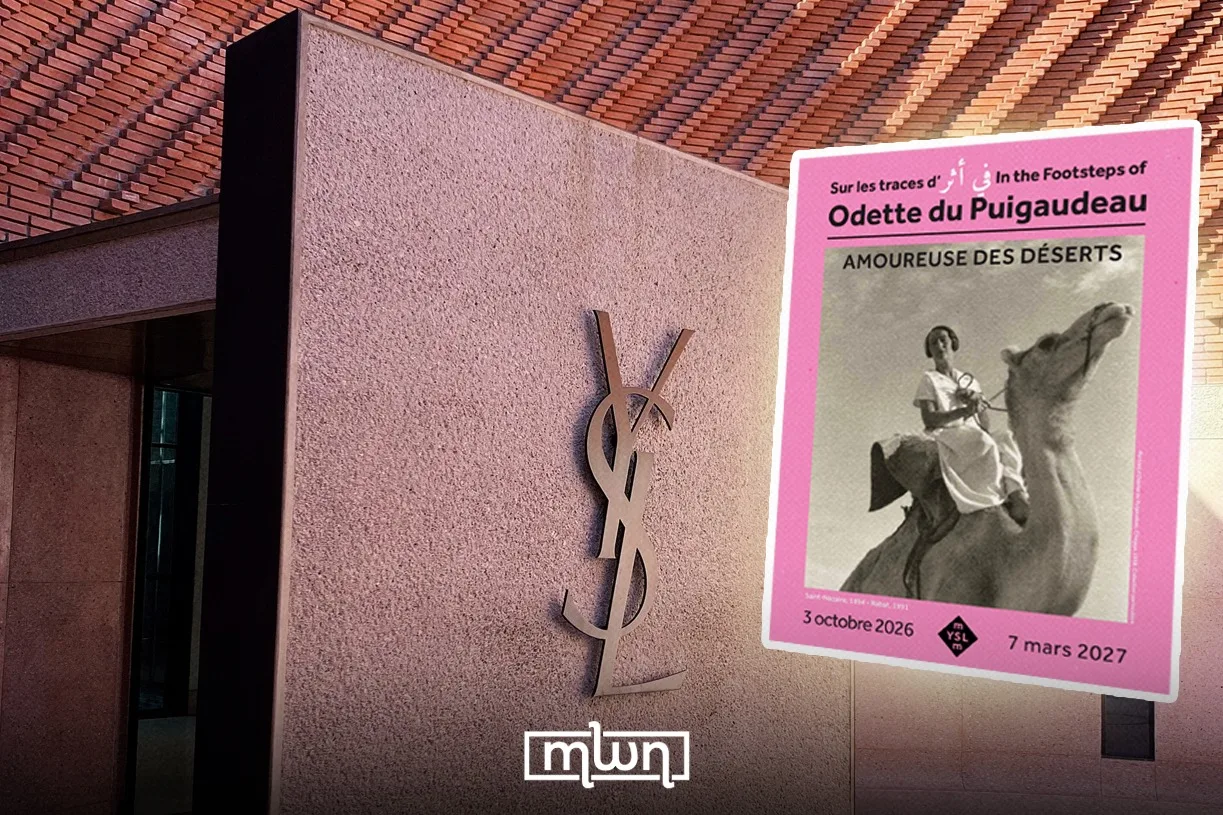
Fez — A new exhibition at the Yves Saint Laurent Museum Marrakech will turn its attention to a woman whose life moved between fashion, fishing boats, journalism, desert caravans, and decades of research in Morocco.
“In the Footsteps of Odette du Puigaudeau” will run from October 3 through March 7, 2027, bringing together more than 200 works and documents connected to the French explorer and ethnologist.
The exhibition will include photographs, drawings, manuscripts, objects, audio archives, and documentary excerpts drawn from the Pierre Bergé Museum of Berber Arts, the Jardin Majorelle Foundation, and private collections. It is the first exhibition in Morocco dedicated entirely to du Puigaudeau.
The Marrakech museum, located near Jardin Majorelle, regularly uses its temporary exhibition space to explore figures whose work intersects with Morocco’s artistic and cultural history. Its wider complex also includes the Pierre Bergé Museum of Berber Arts.
From fashion studios to fishing boats
Born in Saint-Nazaire, France, in 1894, du Puigaudeau followed anything but a conventional professional path.
After moving to Paris in 1920, she worked as a natural history illustrator, stage costume designer, and fashion designer for Jeanne Lanvin. She also wrote as a journalist and, according to the exhibition material, used a male pseudonym while covering the Paris Stock Exchange at a time when women were barred from entering it.
The sea eventually pulled her away from Paris.
In 1928, she obtained professional seaman’s papers and joined Breton tuna fishing boats, experiences that led to some of her first published writing.
A few years later, she met journalist and painter Marion Sénones, who became her longtime travel companion.
On November 28, 1933, the pair left Douarnenez aboard the lobster boat “Belle-Hirondelle,” heading toward Mauritania. They traveled without an official mission and financed the journey themselves.
That voyage became the beginning of more than two decades of exploration.
Five years inside nomadic communities
Du Puigaudeau traveled through Mauritania, southern Morocco, and areas reaching toward Timbuktu, documenting the cultures and daily lives she encountered.
She developed a particular interest in southern Morocco, including Tiznit, the Tamanart Valley, and Foum El Hassan, where she documented rock engravings.
In 1937, she also accompanied an azalai, a major camel caravan traveling between Timbuktu and the salt mines of Taoudenni. The journey lasted around 20 days across terrain with little water or pasture.
Over time, du Puigaudeau spent a combined five years immersed in nomadic communities.
Her notebooks and drawings recorded tents, jewelry, saddles, chests, hairstyles, domestic objects, and other details of Saharan life. The exhibition will recreate part of that world through objects including silver jewelry and clay dolls from Oualata.
Her writings included “Pieds nus à travers la Mauritanie,” “La Grande foire des dattes,” and “Le Sel du désert.” She eventually produced eight books, numerous articles, and an extensive ethnographic study of Moorish society.
Rabat became the final destination
In 1961, du Puigaudeau and Sénones settled permanently in Rabat.
Morocco was no longer simply somewhere du Puigaudeau studied. It became home.
She worked on cultural programming for Moroccan radio, continued her research, and directed the Prehistory Department at the Rabat Archaeological Museum from 1970 to 1977, according to the exhibition materials.
Her years in Morocco also allowed her to complete “Arts et coutumes des Maures” (“Arts and Customs of the Moors”), based on decades of fieldwork and observation.
The Marrakech exhibition will trace that life through three chapters, beginning with her years between Saint-Nazaire and Paris, moving into her desert expeditions, and ending with the three decades she spent in Rabat.
Co-curated by Hayate Machache and Monique Vérité, the exhibition also incorporates radio recordings and documentary footage, adding voices and movement to an archive built largely from travel, observation, and drawing.
For visitors, “In the Footsteps of Odette du Puigaudeau” offers more than the biography of an unconventional explorer. It also opens a window onto Saharan communities, landscapes, and traditions she spent decades trying to document before many of them underwent profound change.