Fez — Long before Esther Freud became a celebrated British novelist, she was a small child wandering through Marrakech with her sister and their fiercely independent mother.
Freud, the daughter of painter Lucian Freud and great-granddaughter of psychoanalysis pioneer Sigmund Freud, spent around 18 months in Marrakech during her childhood. Her mother, Bernardine Coverley, had left Britain with Esther and her older sister Bella during the countercultural years of the late 1960s.
What followed was a childhood of rented rooms, unfamiliar streets, uncertain money, spiritual searching, and the constant question of where home actually was.
More than two decades later, those memories became Freud’s debut novel, “Hideous Kinky.”
A mother searching for another way to live
Bernardine Coverley was not simply taking her daughters on an extended Moroccan holiday.
She was part of a generation of Europeans drawn south in search of alternatives to conventional family life. Coverley traveled extensively throughout her life and spent several years in Morocco with her daughters, Esther later recalled in an obituary for her mother.
For the children, however, their mother’s adventure looked different.

Freud remembered Morocco through fragments: hotels, conversations, Arabic lessons, strangers, hunger, adults disappearing and returning, and the intense desire children have for ordinary things.
She later said many scenes in “Hideous Kinky” came directly from memory. When details failed her, she interviewed her mother and tried to reconstruct Bernardine’s recollections through the eyes of her five-year-old self.
That perspective became the novel’s defining quality.
Published in 1992, “Hideous Kinky” does not judge its wandering mother through an adult narrator. Instead, readers experience Morocco from below, through a child trying to understand the unstable world adults have built around her.
The book was strongly autobiographical, although Freud always stressed that she had transformed experience into fiction. Critics sometimes blurred that distinction, occasionally judging Coverley herself through the behavior of the fictional mother. Freud later acknowledged that this was painful for her mother.
Then Kate Winslet became her mother
The story took another strange turn in 1998.
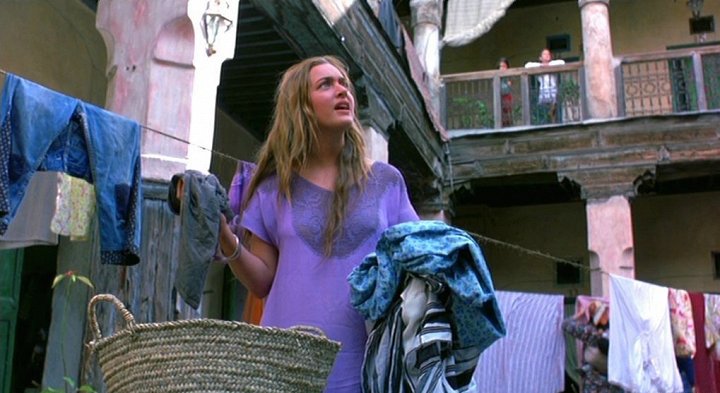
Director Gillies MacKinnon adapted “Hideous Kinky” for cinema, with Kate Winslet playing Julia, the fictional character inspired by Coverley. Saïd Taghmaoui played Bilal, a Moroccan street performer who becomes Julia’s lover, while Bella Riza and Carrie Mullan played the two daughters.

Winslet came to the project immediately after the extraordinary global success of “Titanic.”
Instead of corsets, ocean liners, and Hollywood spectacle, she found herself barefoot in Morocco, playing a broke young mother chasing spiritual enlightenment through Marrakech.
Winslet had already known Freud’s novel before receiving the screenplay and later recalled responding immediately to the role. After the enormous pressure surrounding “Titanic,” the comparatively intimate production offered something radically different.
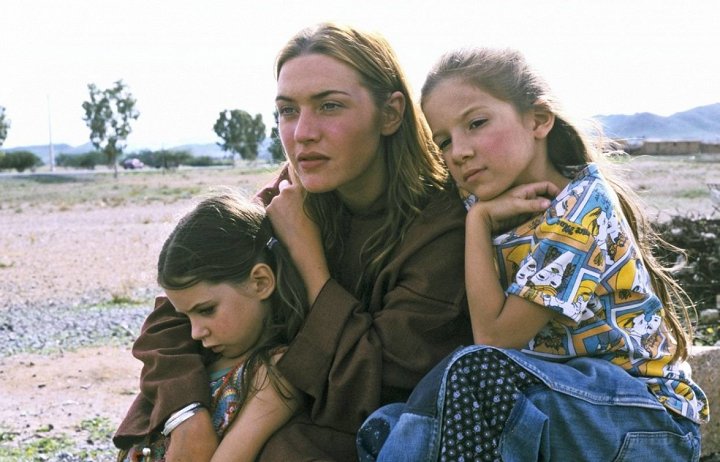
The film moves the story to 1972 and follows Julia as she arrives in Marrakech with her daughters, Bea and Lucy. She searches for spiritual meaning, becomes interested in Sufism, struggles financially, and begins a relationship with Bilal. Meanwhile, the children increasingly crave the stability their mother is trying to escape.
That tension is the heart of “Hideous Kinky.”
Julia sees Morocco as freedom. Her daughters sometimes see uncertainty.
Marrakech becomes the story again
The production also brought Freud physically back into the landscape she had turned into fiction.
“Hideous Kinky” was filmed in Marrakech, meaning Freud could watch actors recreate versions of experiences that had happened to her family decades earlier.
She was closely involved and later praised Winslet’s performance, saying the actress had made the character her own rather than attempting a literal impersonation of Coverley. Bernardine herself visited the set and met Winslet.
That distinction mattered. The real Bernardine had become “Mum” in a novel. “Mum” then became Julia in a screenplay. Julia finally became Kate Winslet walking through Marrakech in a story inspired by the childhood of Sigmund Freud’s great-granddaughter.
Each transformation moved the character further from biography while returning the story to the same city.
More than 30 years after the novel appeared, “Hideous Kinky” remains an unusual piece of Marrakech cultural history. It captures a period when Morocco became a destination for European counterculture, but it does so through the eyes of children who never chose to join that search.
For Esther Freud, Marrakech was first a childhood home, then a collection of memories, then a novel, and finally a film set. The city remained at the center of every version.