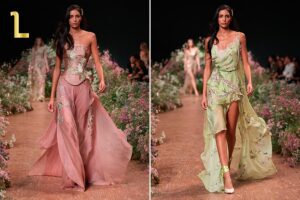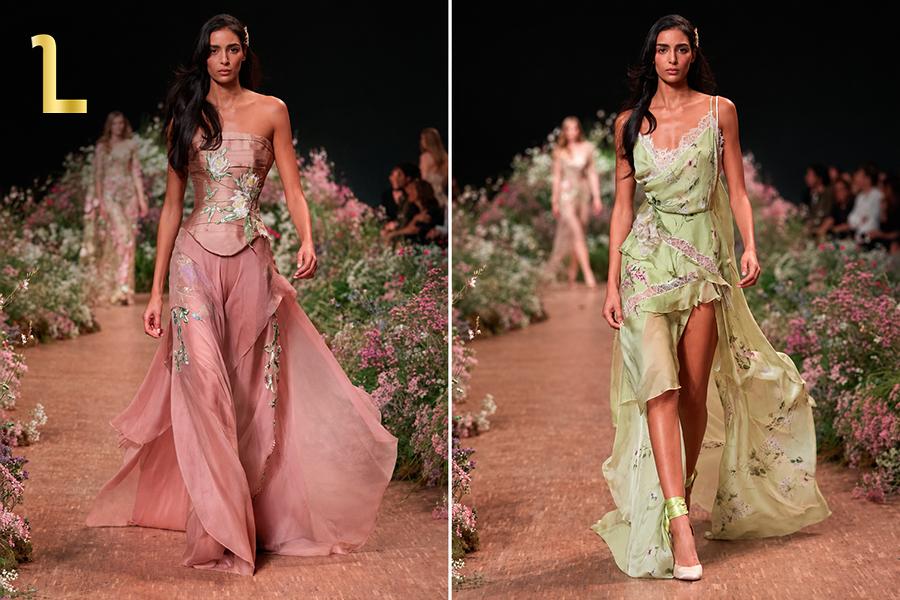
Rabat – British Moroccan model Nora Attal walked the runway for Lebanese designer Elie Saab, who unveiled his Spring/Summer 2027 collection on October 3, wearing looks 24 and 62, both covered in roses scattered across sage green and pink dresses.
Much of Elie Saab’s Spring/Summer 2027 Ready-to-Wear collection is inspired by Jean Harlow, the 1930s Hollywood actress. With fluid silhouettes, delicate lace, and soft pastel tones, it celebrates femininity and sensuality while balancing romantic intimacy with the art of revealing and concealing.
The palette included sage green, powder blue, and blush. Silk wraps were draped around the body, and slip-cut gowns in black lace or pale pink silk were embroidered with roses. Corsets came with small touches: a sprig of tiny flowers, a bolero slipping off one shoulder, a single satin strap. Ruffles, bows and ribbons appeared throughout.
Shoes were very high heels, including ballerina-style pumps and mules that crossed over the foot. Models wore small flowers and drops of water on their faces. The house also launched its first eyewear line, led by gold-plated butterfly frames with a monogram.
This season isn’t Nora Attal’s first time with Elie Saab. On September 29, 2018, she walked in the house’s Spring/Summer 2019 show at Paris Fashion Week, in a muted sequined look.
Nora Attal, British Moroccan supermodel
Nora Attal grew up in London in a Moroccan family. At 14, photographer Jamie Hawkesworth noticed her while scouting her school for a JW Anderson campaign. She kept up her studies while modelling for several years, and her breakthrough came in that same designer’s ad, where her intense gaze and strong brows made her the “mystery girl” of the campaign. Prada, Burberry, and Dior soon followed, and since 2019 she has become a Chanel regular, with more than a dozen of its runway shows behind her.
Attal often brings her Moroccan roots into her work, most visibly on a Vogue Arabia cover where she wore a ceremonial Amazigh headpiece. She also speaks openly about what immigrants go through, inspired by what her parents endured so she could get where she is.
Elie Saab, Lebanese fashion designer
At nine, Elie Saab was already sewing clothes for his family from whatever fabric he could find. He launched his label in Beirut in 1982 at 18, in the middle of the war. Models barely existed there, he said, so he cast ad workers and students, most of whom, he suspected, had never attended a fashion show.
He began with elaborate bridal gowns and built his house gradually, blending Eastern embellishment with Western silhouettes. He has said he values elegance over excess. Rome’s Camera Nazionale della Moda Italiana invited him to show in 1997, and the Chambre Syndicale de la Haute Couture brought him to Paris three years later, making him a correspondent member in 2006, the first Arab to receive that status.
His clients span royalty and red carpets. Queen Rania of Jordan wore his design to her husband’s 1999 coronation, and in 2002 Halle Berry wore his burgundy dress with floral embroidery to the Oscars. “The Elie Saab gown I wore the evening I won my historic Oscar is extremely meaningful to me, and that is exactly why I decided to donate it,” Berry told the Telegraph. The dress instantly propelled Lebanese designer Saab into global prominence.
Today Elie Saab is a leading haute couture house with ateliers in Paris and Beirut. It has expanded into ready-to-wear, bridal, accessories, eyewear, and fragrance, plus a home and interiors line, MAISON.