Casablanca – What happens when you take design out of one exhibition hall and let it wander through Casablanca? You get Morocco Design, a three-day creative journey that brings contemporary design, architecture, craftsmanship, and art into different corners of the city from October 5-7.
Instead of asking visitors to stay in one place, the inaugural platform invited them to move from showroom to gallery, atelier to cultural space, discovering a different side of Casablanca at every stop.
The program brought together Moroccan creators, international design houses, architects, artists, artisans, and galleries, creating conversations that felt as much about the city as they were about design.
Lifestyle Magazine was on the ground on the second day, following part of that journey and getting a closer look at what Morocco Design looks like when the city itself becomes the setting.
Behind the whole idea is Hanane El Moutii, the founder of Morocco Design, who built the platform around a simple ambition: give Moroccan creativity a place in the international design conversation.
A new way to see Casablanca
Speaking to Lifestyle Magazine, El Moutii explained that she wanted Morocco Design to become a meeting point between Moroccan creators and the wider creative world.
“I wanted to create a meeting point for the world and another reason to come to Casablanca,” she said. After years of traveling to international design events, she felt it was time to turn the tables.
“We always travel abroad for Milan Design Week, for Maison&Objet, and I thought it was about time that the world came to us for a change.”
That international outlook sits at the heart of the platform. El Moutii wanted to bring established global brands into the same conversation as Moroccan creators, giving local talent more visibility and room to grow.
“The idea was to bring together known international brands with Moroccan creators in order to facilitate growth and visibility for the talents that we have here in our country,” she explained.
But perhaps the most interesting part is where those conversations happened.
Casablanca was never supposed to be just a backdrop. El Moutii deliberately turned the city into part of the itinerary, allowing visitors to experience its creative energy from one place to another.
“Morocco is too beautiful for us not to see it,” she said. “The idea was to bring international collectors, designers into conversation with the city itself.”
While Marrakech has long enjoyed its reputation as Morocco’s design and hospitality darling, El Moutii believes the white city still has plenty left to reveal.
“We know Marrakech because of its hotels and its beauty, but we have not yet discovered Casablanca fully,” she said.
For her, that discovery lies precisely in the city’s contrasts. “Casablanca is a city of dichotomy between innovation and our traditions. This is where the young creators are working, making.”
Walking through the different locations, that contrast becomes easy to spot. The city’s architecture, its polished interiors, its contemporary galleries, and the hands behind the objects all become part of the same conversation.
“I think it’s a vibrant city, and I wanted the world to see it,” El Moutii concluded.
Honoring Hicham Lahlou
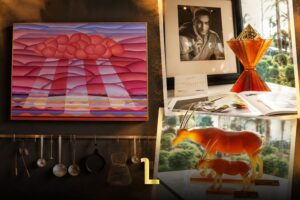
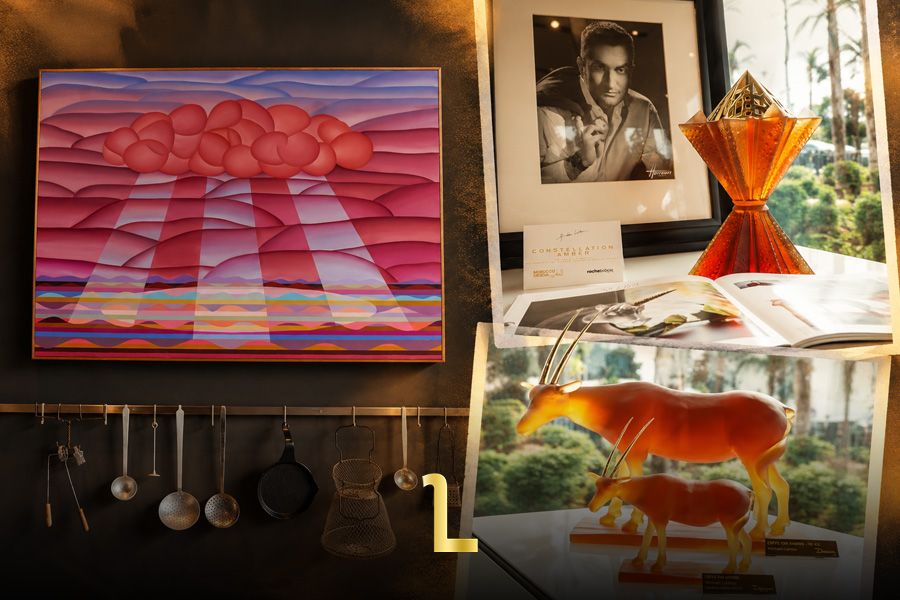
On the second day, one of those stops took us to Roche Bobois Maroc, where Moroccan international designer and interior architect Hicham Lahlou took center stage.
The exhibition brought together pieces from Lahlou’s career, celebrating 31 years of international design and offering visitors a glimpse into the work of one of Morocco’s most internationally recognized design voices.
The setting added its own layer to the experience. Rather than simply looking at individual objects, visitors could see how furniture, materials, architecture, and movement interact within a carefully designed space.
The program also included a meeting with design students, opening the conversation beyond established names and toward the next generation of Moroccan creatives.
Where art and design meet
From Roche Bobois, the journey continued to Boffi | DePadova, where Moroccan artist Radia Lamrani Karim presented a selection of her paintings alongside JK Contracting and Loft Art Gallery.
And this was one of those moments where the space almost became another artwork.
Lamrani Karim’s paintings did not sit apart from the furniture and architecture around them. Their pink tones, layered textures, and organic forms interacted with the clean lines of the studio, creating a conversation between the canvas and everything surrounding it.
For Lamrani Karim, that relationship comes naturally.
Her background in interior design and architecture has shaped the way she approaches painting, particularly when it comes to space, proportion, lines, and the relationship between an artwork and its environment.
That background becomes particularly visible in a setting like Boffi | DePadova. A painting is no longer simply something hanging on a wall. The furniture, materials, colors, and lines around it begin to influence how we see it.
Lamrani Karim also sees this dialogue as something deeply connected to Morocco.
“Morocco is particularly rich for this dialogue between art, architecture, design, and artisanal know-how, which have always been closely linked in our culture,” she said.
And you can feel that in her work. Colors, materials, textures, and spatial lines do not simply decorate the composition. They help shape how the painting lives inside a space.
For the artist, that connection also gives painting a more personal dimension. Her current work often explores nature, movement, and meditation, themes that emerge naturally from her own experience.
“Painting is also a form of meditation for me,” she said. “It’s a moment where I slow down and reconnect with myself.”
There was something fitting about hearing that inside a design studio. Surrounded by carefully considered furniture, architectural lines, and layers of color, her paintings seemed to slow the room down for a moment too.
A different way to experience design
That is perhaps what makes Morocco Design interesting. It does not ask visitors to look at design from a distance. It asks them to walk through it.
The first edition also extended into architecture, craftsmanship, installations, conversations, and creative encounters, reinforcing the idea that contemporary Moroccan design cannot be separated from the places and people that shape it.
And maybe that is exactly what El Moutii wanted the world to see: not a single definition of Moroccan design, but a living one. One that can sit comfortably beside international names while still sounding, looking, and feeling unmistakably Moroccan.