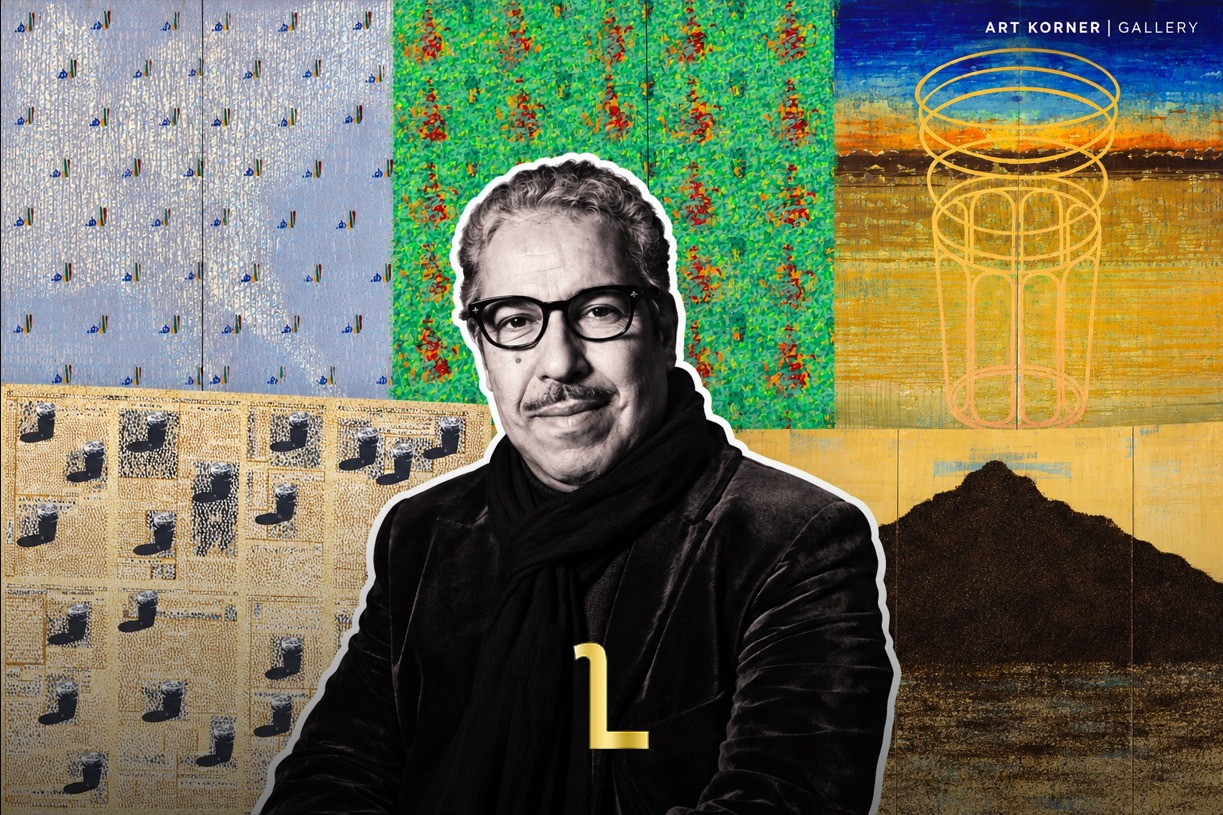
Fez — Moroccan painter Mustapha Boujemaoui will return to the spotlight in Casablanca with “Œuvres choisies,” an exhibition bringing together works from a career spanning more than half a century.
Curated by Youssef Bennani and presented by Art Korner Gallery, the exhibition will run from October 13 to November 10 at the American Arts Center in Casablanca. The opening is scheduled for October 13 at 7 p.m.
The exhibition arrives during an especially visible year for Boujemaoui. His retrospective “La Poétique des formes” is currently running at Villa Carl Ficke, Musée de la Mémoire de Casablanca, from June 10 through November 30. The National Foundation of Museums describes that presentation as a survey of roughly 50 years of artistic research.
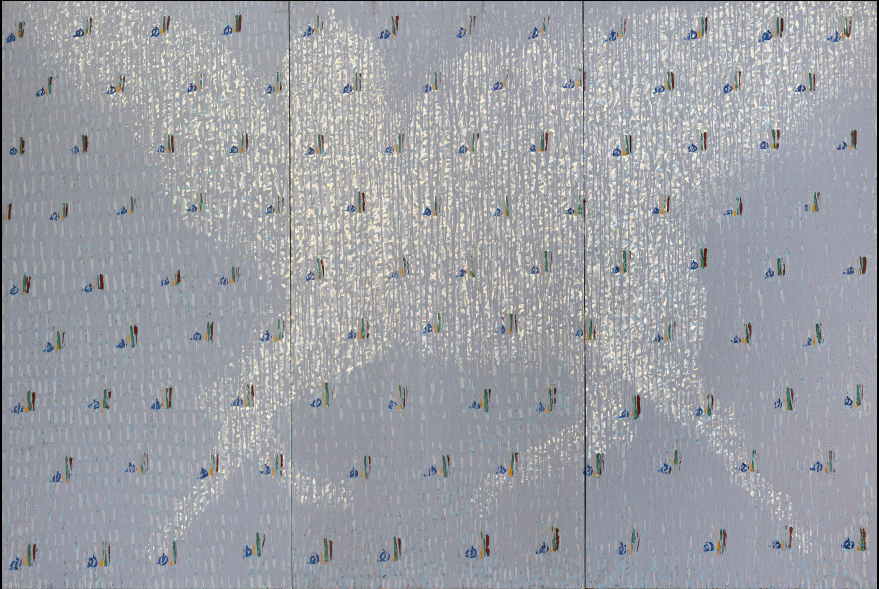
“Œuvres choisies,” however, takes a more concentrated approach, drawing attention to the consistency of Boujemaoui’s visual language and the way familiar objects have evolved across different periods of his practice.
The tea glass as a visual language
At the center of Boujemaoui’s work is an object so familiar in Morocco that it can almost disappear into everyday life: the tea glass.
Across decades, he has repeated, fragmented, layered, enlarged, and dissolved the form, using it as a starting point for experiments with transparency, memory, rhythm, and abstraction.
The exhibition’s press material describes the tea glass not simply as a subject, but as a language through which Boujemaoui continually revisits the possibilities of painting. In some periods, he even incorporated actual tea leaves into the pictorial surface, narrowing the distance between the represented object and the physical material itself.
That approach can be seen across works selected for the exhibition.
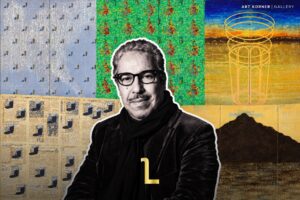
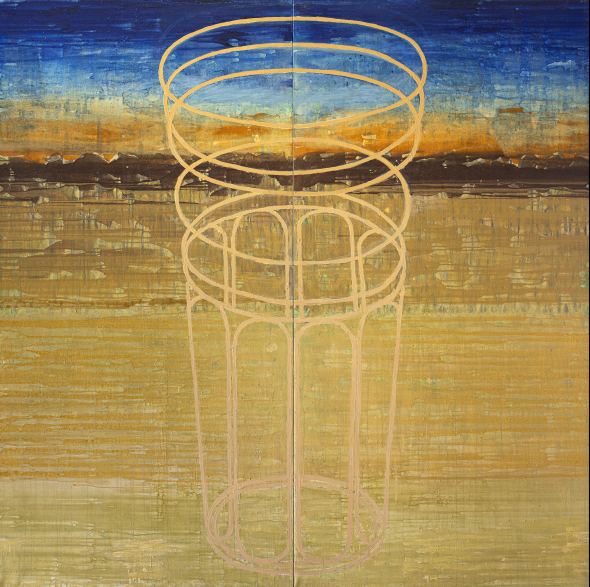
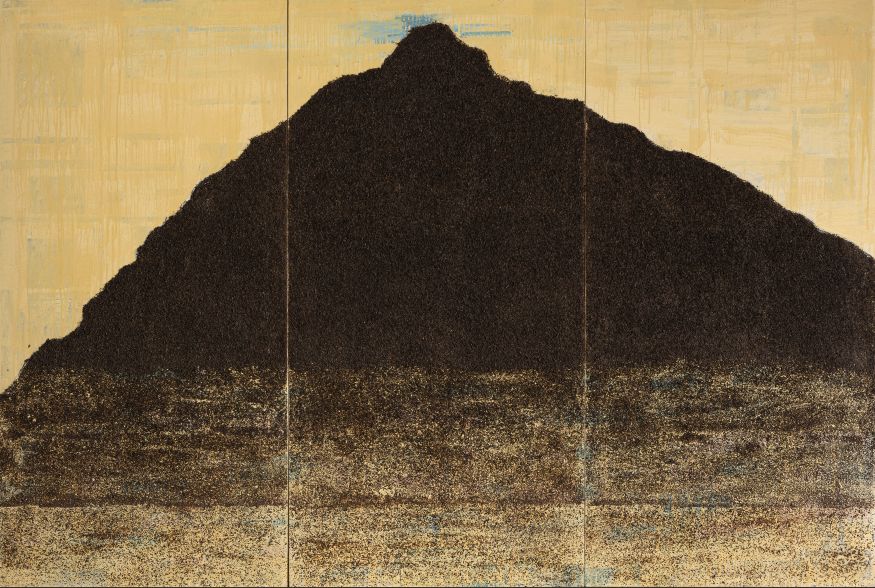
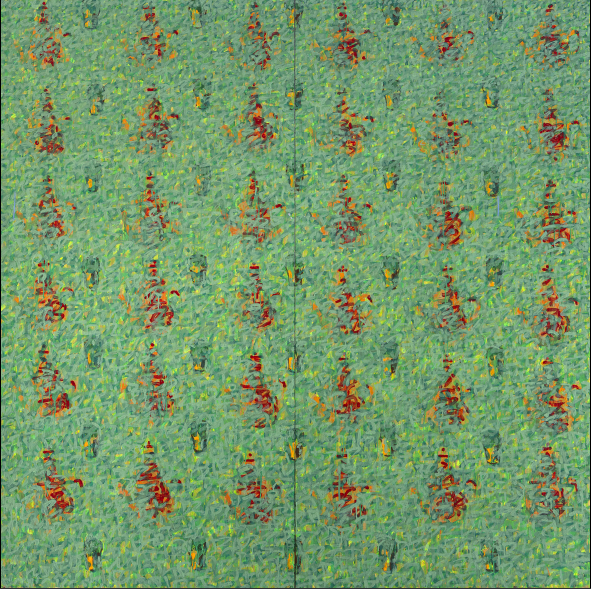
“Caravansérai,” from 2013, reduces the glass to a large, almost architectural outline suspended against bands of blue, ochre, and earth tones. The same year’s “Les théières rouges” approaches repetition differently, scattering small red forms across an expansive green field.
Other selected works extend as far back as “Picto-journal” from 1992 and “Le verre du roi” from 1995, alongside several pieces from the recurring “Les verres de ma vie” series produced in the late 1990s and 2000s.
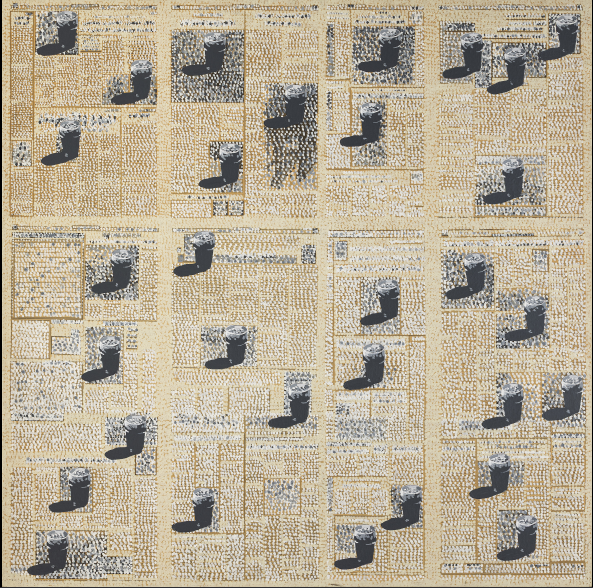
Together, they show how one motif can shift between object, sign, geometry, memory, and near-abstraction without disappearing entirely.
A career shaped by Moroccan modernism
Boujemaoui trained at the École des Beaux-Arts de Tétouan (Tetouan School of Fine Arts), before continuing his studies in Brussels, Paris, and at the Sorbonne.
His trajectory developed in the wake of the Moroccan modernist movement associated with artists including Farid Belkahia, Mohamed Melehi, and Mohamed Chebaa, while his work gradually established its own distinct vocabulary.
In 1982, Pauline de Mazières and Sylvia Belhassan began supporting his work through exhibitions at Rabat’s “L’Atelier” gallery and abroad.
His international appearances later included exhibitions of Moroccan painting in France, Portugal, Germany, Belgium, Spain, Brazil, and Greece during the 1980s and early 1990s.
Boujemaoui received a special mention from UNESCO’s Prize for the Promotion of the Arts in 1995 and the jury prize at the third Sharjah International Arts Biennale in 1997.
In 2003, Marrakech Museum hosted “Ataï,” an exhibition of his paintings and installations. That same year, he participated in “Beyond the Myth – Contemporary Moroccan Art” at London’s Brunei Gallery.
More than repetition
What gives Boujemaoui’s work continuity is not simply his return to the same object, but how that object changes.
A tea glass can become almost invisible beneath layers of paint, emerge as a precise outline, multiply across the canvas, or function as an architectural structure.
“Œuvres choisies” presents that repetition as an ongoing investigation rather than a fixed signature.
For Art Korner Gallery, the exhibition also fits a broader effort to revisit Moroccan and Arab artists whose careers merit renewed attention through archives, documentation, and historical context.
Seen alongside his current retrospective at Villa Carl Ficke, the new exhibition gives Casablanca audiences another opportunity to follow how Boujemaoui transformed one of Morocco’s most ordinary objects into a visual vocabulary sustained across generations of his work.