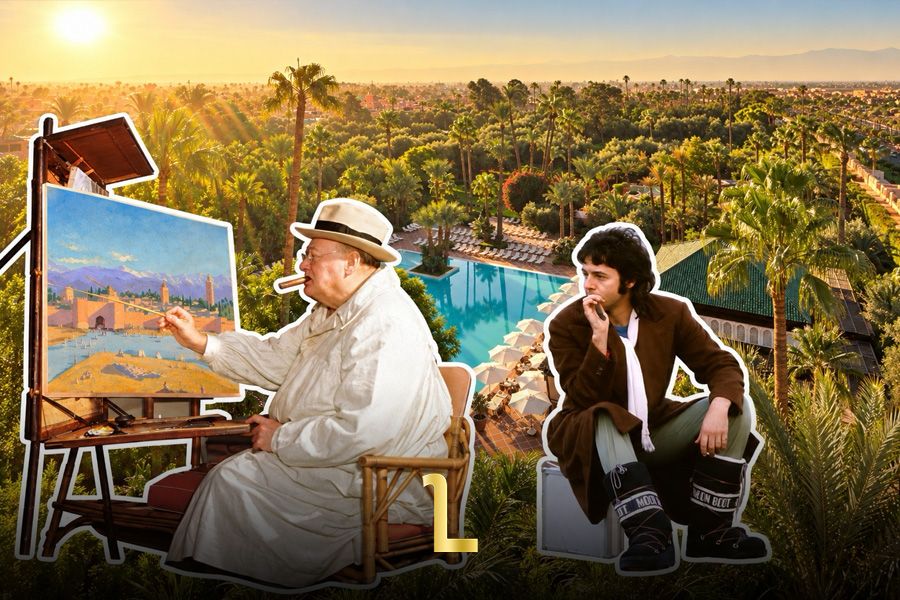
Fez — More than half a century after Paul McCartney released “Mamunia” with Wings, the song still carries a small piece of Marrakech inside one of the most celebrated albums of his post-Beatles career.
Its Moroccan connection has returned to attention as McCartney revisits the Wings years. A paperback edition of “Wings: The Story of a Band on the Run” was released on October 6, tracing the group’s travels through Morocco, Lagos, London, the Caribbean, and other stops during the 1970s.
Among the songs connected to that period is “Mamunia,” an airy track on the 1973 album “Band on the Run.”
But the story behind its name begins long before McCartney arrived in Marrakech.
Before McCartney, there was Al Mamoun
La Mamounia’s history stretches back to the 18th century, when Sultan Sidi Mohammed Ben Abdallah gave a 13-hectare orchard to his son, Prince Al Mamoun, as a wedding gift.
Prince Al Mamoun turned the gardens into a setting for elaborate outdoor gatherings, and the estate retained his name.
Two centuries later, the Moroccan Railway Company chose the site for a hotel. Architects Henri Prost and Antoine Marchisio combined Moroccan architectural traditions with Art Deco influences, and La Mamounia opened in 1923.
Its gardens quickly became as important to its identity as the hotel itself.
They would also help attract one of the most famous political figures of the 20th century.
Winston Churchill finds his Marrakech light
Winston Churchill developed a particular attachment to Marrakech during the 1930s.
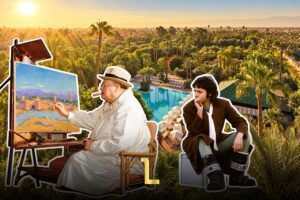
During the winter of 1935-1936, he stayed at La Mamounia while painting and writing. The light over the city, its orange and olive trees, the Atlas Mountains, and the views from the hotel’s balconies became recurring subjects.
“This is a wonderful place, and the hotel one of the best I have ever used,” Churchill wrote to his wife, Clementine.
Churchill’s connection to Marrakech later crossed into wartime diplomacy.
After the Casablanca Conference in January 1943, he persuaded US President Franklin D. Roosevelt to travel with him to Marrakech to see the sunset over the Atlas Mountains.
They stayed at Villa Taylor for that particular visit, rather than La Mamounia. After Roosevelt left, Churchill painted “Tower of the Koutoubia Mosque,” the only painting he completed during World War II, and later gave it to Roosevelt.
The painting eventually became one of Churchill’s most famous works. In 2021, it sold at Christie’s for £8.285 million (MAD 109 million) including buyer’s premium.
La Mamounia has preserved Churchill’s association with the hotel through a suite and a bar carrying his name.
From politicians to artists and rock stars
By the middle of the century, La Mamounia had developed into more than a hotel.
Its official history recalls visits from filmmakers, actors, politicians, fashion designers, and musicians as Marrakech became increasingly prominent on the international cultural map.
Alfred Hitchcock filmed parts of “The Man Who Knew Too Much” in Marrakech, while the hotel later welcomed figures from cinema including Charlie Chaplin.
When Pierre Bergé and Yves Saint Laurent arrived in Marrakech in 1966, they initially stayed at La Mamounia before establishing their own home in the city.
Then came rock music.
The Rolling Stones visited Marrakech in 1968, part of a broader movement that turned Morocco into a destination for musicians seeking distance from London, Paris, and the usual circuits of the music industry.
By the early 1970s, Paul McCartney was travelling through that same cultural landscape.
Paul McCartney arrives in Marrakech
McCartney travelled to Morocco with Linda McCartney and their family in early 1973, during the formative years of Wings.
Contemporary reporting placed the family en route to Marrakech in February. McCartney-related archives also confirm that “Mamunia” was developed during this period and that Morocco formed part of Wings’ increasingly international story.
La Mamounia itself states that McCartney composed “Mamunia” in 1973.
The precise origin of the title, however, has been told in slightly different ways over the years.
Notes associated with the 25th-anniversary edition of “Band on the Run” say McCartney took “Mamunia” from a house nameplate he saw in Marrakesh during the Wings holiday, and gloss the word as meaning a “safe haven.”
An older issue of McCartney’s official “Club Sandwich” fan publication gave another version, saying “Mamunia” was the name of a house in Lagos and that the similar name of the Marrakech hotel later caused confusion over the title’s origin.
That discrepancy makes the history more interesting rather than less.
The hotel connection became part of the song’s mythology, while Marrakech itself remains firmly connected to its creation. Music databases also record the song as having been written in the Marrakech region in 1973.
From Marrakech to Lagos
“Mamunia” eventually became part of “Band on the Run,” the album that transformed Wings from McCartney’s uncertain post-Beatles project into a major international success.
Recording was far from straightforward.
Before sessions began in Lagos, drummer Denny Seiwell and guitarist Henry McCullough left the band. McCartney, Linda, and Denny Laine continued as a trio. McCartney took on additional instruments himself, including drums.
The Lagos sessions brought further problems.
Paul and Linda were robbed, losing money, a camera, and demo tapes. The studio was still being completed, equipment was unreliable, and the recording period coincided with heavy rain.
That weather became part of the atmosphere surrounding “Mamunia.”
McCartney later remembered the Lagos monsoon while discussing the song, linking its imagery of rain to the conditions around the recording sessions.
Musically, “Mamunia” became one of the album’s gentler moments, built around acoustic textures rather than the dramatic rock arrangements heard elsewhere on the record.
It sits alongside songs including “Band on the Run,” “Jet,” “Bluebird,” and “Let Me Roll It.” The album was released in December 1973 and eventually became Wings’ most successful studio record.
A Marrakech name that travelled
What makes “Mamunia” unusual is how far one word traveled.
Its story moves from an 18th-century Moroccan prince to gardens beside Marrakech’s medina, from Churchill’s paintbrush to the musicians and artists who followed him, and finally into a Wings album recorded thousands of kilometers away in Lagos.
The exact route by which McCartney settled on the spelling “Mamunia” may remain disputed in archival accounts.
What is not disputed is Marrakech’s place in the story.
Long before McCartney arrived, La Mamounia had already become a refuge for politicians, painters, filmmakers, and designers. By the 1970s, it belonged to a Marrakech that international musicians also associated with escape, experimentation, and creative distance from home.
“Mamunia” became another piece of that cultural afterlife: a quiet Moroccan echo embedded in one of the defining albums of McCartney’s second act.