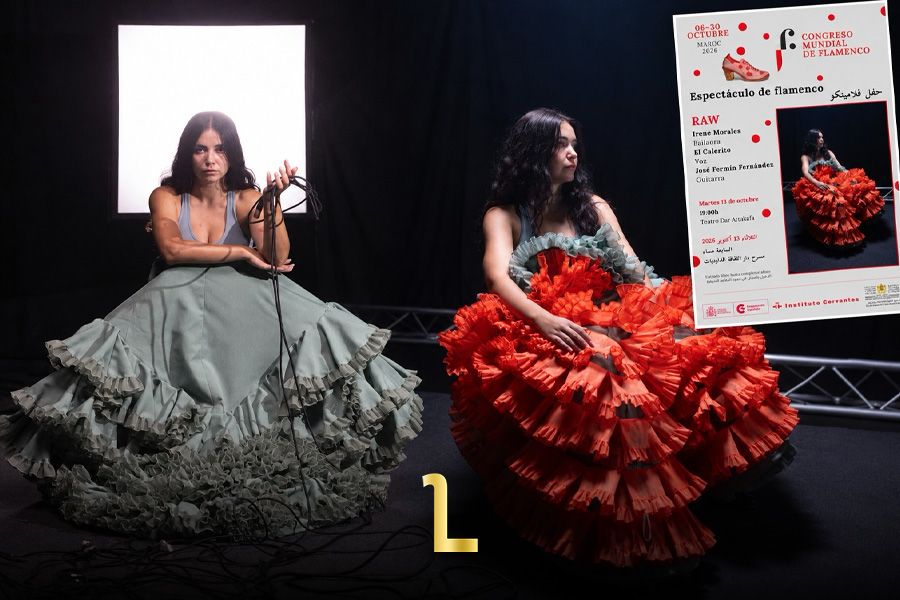
Fez — Flamenco will take the stage in Marrakech this month as dancer Irene Morales presents “RAW,” a performance built around the tension between tradition and contemporary expression.
The show is scheduled for October 13 at 7 p.m. at Théâtre Dar Attakafa as part of the “Congreso Mundial de Flamenco” (World Flamenco Congress), presented in Morocco by the Instituto Cervantes and the Embassy of Spain.
Admission is free, subject to available seating.
“RAW” brings Morales together with singer Francisco Blanco, known as El Calerito, and guitarist José Fermín Fernández. The trio reduces flamenco to some of its most fundamental elements: body, voice, guitar, rhythm, space, and silence.
Flamenco stripped to its core
Morales approaches “RAW” through contrasts. Her movement shifts between precision and instinct, control and vulnerability, while the production places flamenco’s inherited language beside a more contemporary stage aesthetic.
The Instituto Cervantes describes the work as a search for essentiality, where gesture, sound, and silence reveal the emotional core of flamenco.
Electronic textures also enter the performance alongside live instrumentation, allowing Morales to push the form forward without severing its connection to traditional flamenco.
The title reflects that approach.
For Morales, “RAW” has evolved to represent something pure and without artifice, but also a contemporary desire to move away from excess and return to the essence of things.
On stage, El Calerito provides the vocal intensity of cante, while Fernández brings the guitar element. Together, their different languages create a performance built around contrast rather than uniformity.
Flamenco itself combines cante, baile, and toque — singing, dance, and musicianship. UNESCO recognizes the form as Intangible Cultural Heritage of Humanity, highlighting its deep roots in Andalusia and its transmission through families, communities, and flamenco circles.
Morocco joins a wider flamenco circuit
The Marrakech performance forms part of a much larger Moroccan program running throughout October.
For the fifth consecutive year, the World Flamenco Congress is bringing performances to Morocco, with 14 shows across eight cities: Rabat, Fez, Tangier, Marrakech, Tetouan, Agadir, Casablanca, and Nador.
The wider program also includes film screenings and workshops, with particular attention given this year to emerging performers and women shaping contemporary flamenco.
The Instituto Cervantes frames the congress as an international platform exploring how flamenco can evolve while remaining connected to its popular roots.
That balance sits at the center of “RAW.”
Rather than treating tradition and experimentation as opposites, Morales places them on the same stage. The result presents flamenco as a living form — one capable of carrying inherited rhythms into new visual and emotional territory.
In Marrakech, that conversation also becomes part of a broader cultural exchange between Morocco and Spain, two neighboring countries whose artistic histories have long moved across the Mediterranean.