

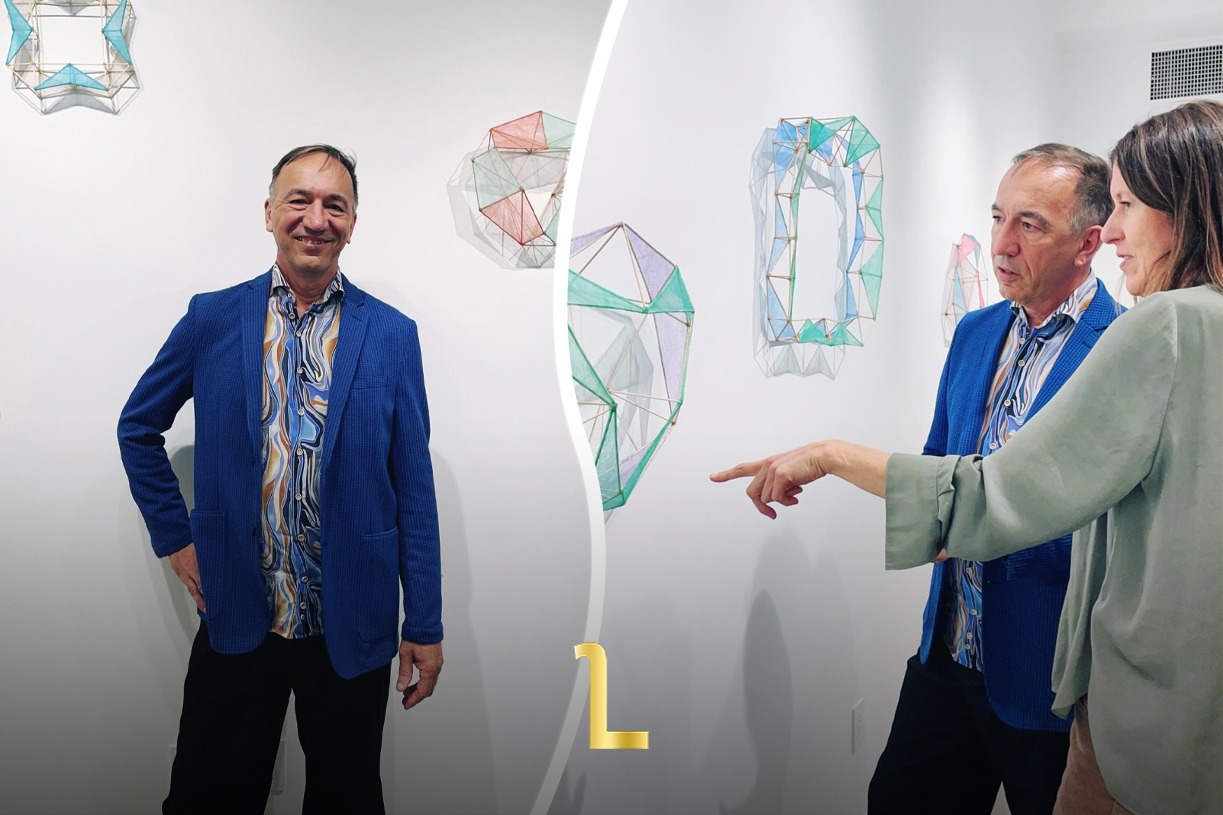
Fez — The disposable shopping bags found in Moroccan markets are hardly the kind of objects most people expect to encounter in a contemporary art exhibition in New York.
Yet these familiar materials have found their way into the work of Michael Kukla, a Prague-born sculptor whose exhibition “Cagettes/Brochettes” is currently on view at Project ARTspace in Manhattan.
The show brings together sculptures assembled from agricultural crates, wooden skewers, discarded fabrics, and translucent shopping bags collected from Moroccan markets.
What makes the work unusual is not simply its use of recycled materials, but the way Kukla transforms ordinary objects into delicate architectural structures.
Items originally designed for carrying groceries or transporting produce become part of abstract compositions exploring shape, transparency, and the relationship between solid and fragile forms.
From the marketplace to the gallery
The artist’s interest in discarded materials intensified during the COVID-19 lockdowns in France.
At the time, Kukla began collecting wooden agricultural crates, known in French as cagettes, that vendors routinely left outside markets.
Rather than allow the crates to become waste, he started taking them apart and examining their structural possibilities.
According to the exhibition’s official description, Kukla cuts the wood into narrow strips, combines it with geometric plywood elements, and uses wooden skewers to create lightweight frameworks.
He then adds fabric and other materials, allowing parts of the underlying structure to remain visible.
Among those materials are nonwoven shopping bags sourced from Moroccan markets.
Their colors and translucent surfaces make them particularly interesting for an artist concerned with the relationship between visibility, vulnerability, and form.
Kukla also incorporates materials such as pantyhose, using their elasticity and transparency to create surfaces that resemble a second skin around the sculptural structures.
The result combines familiar objects in arrangements that no longer resemble their original functions.
Finding unexpected beauty in ordinary objects
For Kukla, the attraction lies partly in the physical properties of materials that people rarely examine closely.
“I’ve always been intrigued by what enables matter to take shape,” he explains in the exhibition statement.
The sculptures reflect that curiosity through their open frameworks and unusual combinations of materials.
The wooden crates retain traces of their original purposes, sometimes including printed graphics or lettering associated with produce vendors.
Rather than erase these markings, Kukla incorporates them into the finished compositions.
The discarded materials therefore retain something of their previous lives, even as they become part of entirely new objects.
For Moroccan viewers, the presence of familiar market bags offers an unexpected connection to everyday life.
Objects that might otherwise be discarded after a shopping trip appear in a Manhattan exhibition devoted to contemporary sculptural experimentation.
Their transformation also highlights how materials can travel between places and acquire different meanings depending on their context.
A different perspective on reuse
Born in Prague, Kukla studied sculpture in the United States and Germany and has exhibited internationally for more than three decades.
His practice frequently involves transforming discarded materials into structures inspired by organic forms and architectural systems.
“Cagettes/Brochettes” continues that interest, placing waste materials at the center of a conversation about design, improvisation, and the value of overlooked objects.
The exhibition opened September 25 at Project ARTspace on Madison Avenue.
According to the gallery’s official schedule, it will remain open through December 3, when a conversation between Kukla and Leonardo Bravo is also scheduled.
Although Kukla is not a Moroccan artist, the exhibition offers an unusual international connection to Moroccan everyday culture.
It demonstrates how even the most ordinary objects can acquire unexpected artistic significance once removed from their original surroundings.
In this case, something as simple as a colorful shopping bag from a Moroccan souk has become part of an artwork thousands of miles away, revealing creative possibilities in materials most people barely notice.