

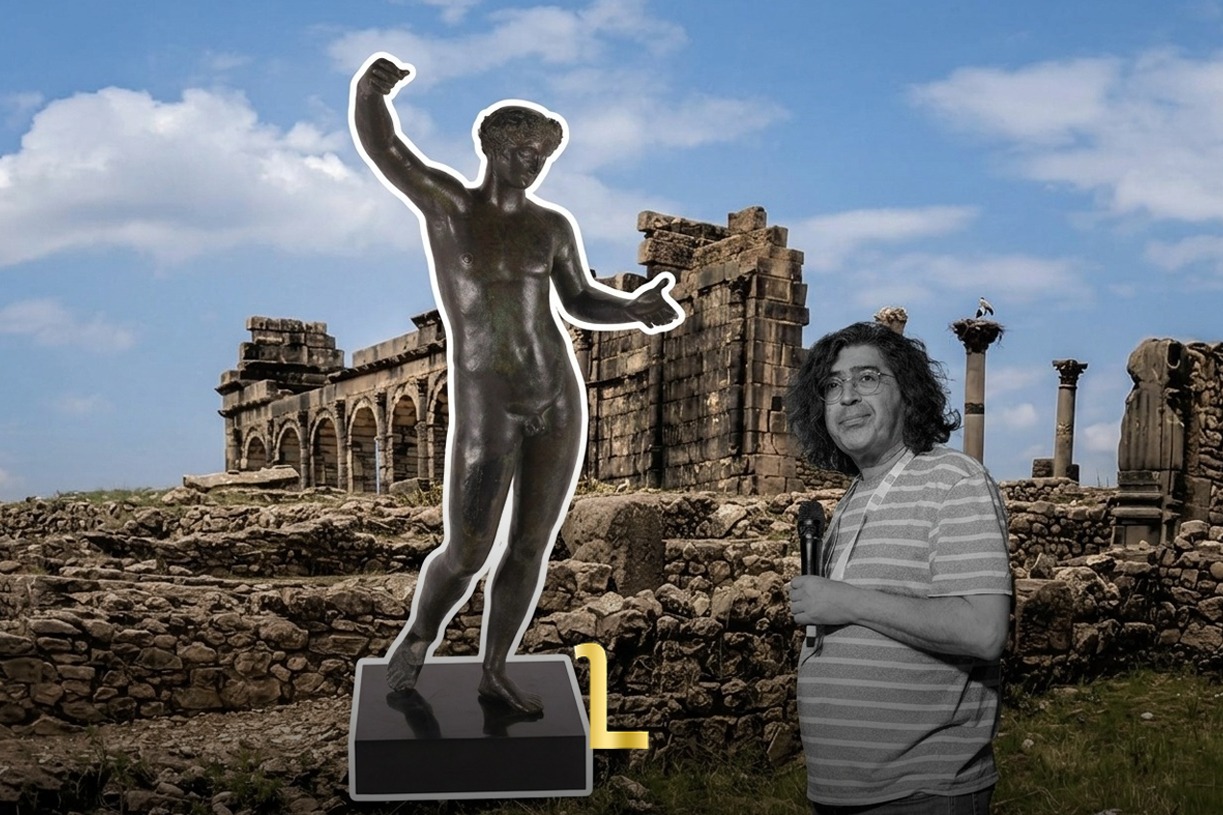
Fez — In 1982, a marble statue of Bacchus disappeared from Volubilis. The Roman deity of wine and ecstasy became the subject of a search whose consequences reached beyond the archaeological site.
Moroccan filmmaker Ali Essafi takes up that history in “Looking for Bacchus,” a documentary project supported by the Arab Fund for Arts and Culture.
The fund’s published synopsis describes a neighboring village wrongly suspected of involvement. According to that account, military and intelligence personnel surrounded the village, and residents suffered severe physical and psychological torture. The synopsis states that the statue remains missing.
The people behind the missing object
The allegations also appeared in earlier reporting. An AFP article published in August 2018 recounted the statue’s disappearance and, citing Moroccan press accounts, described residents being interrogated and beaten during the search.
That report quoted a resident of nearby Moulay Driss Zerhoun describing lasting trauma. It reported that efforts to recover the statue had failed. These accounts provide historical context for Essafi’s project, although they do not establish what testimony or evidence the finished film will contain.
The premise places two losses alongside each other: an ancient artwork removed from its setting, and the security of people drawn into the investigation. It raises a question about whose experiences survive in the public memory of an art theft.
A filmmaker working with difficult histories
Essafi’s interest in the past extends across his filmmaking. After studying psychology in France, he entered cinema and later undertook extensive research into North African film and visual archives.
His work has included “Crossing the Seventh Gate,” which premiered at the Berlinale Forum in 2017, and “Before the Dying of the Light,” presented at Amsterdam’s International Documentary Film Festival in 2020.
“Looking for Bacchus” received development support through AFAC’s 2024 documentary selection. The IDFA Bertha Fund also listed it among its development grants in 2024. These are funding milestones, rather than evidence of a completed film or an announced premiere. A public release date has not been verified.
For now, the project brings attention to a troubling chapter behind a familiar heritage destination. Its central question reaches beyond the whereabouts of Bacchus: what remains with a community after the search for a missing object ends?