

Rabat – The connection between generations of women, the urge for looking beautiful, and the history of cosmetics is a profound one. Before the mass production of makeup, beauty was a matter of tradition, creativity, and knowledge passed down from one generation to another.
For centuries, self-expression, and looking beautiful have been of great importance to all women around the world. This feminine urge pushed them to make minimal, less costly, functional, and most importantly safe beauty products.
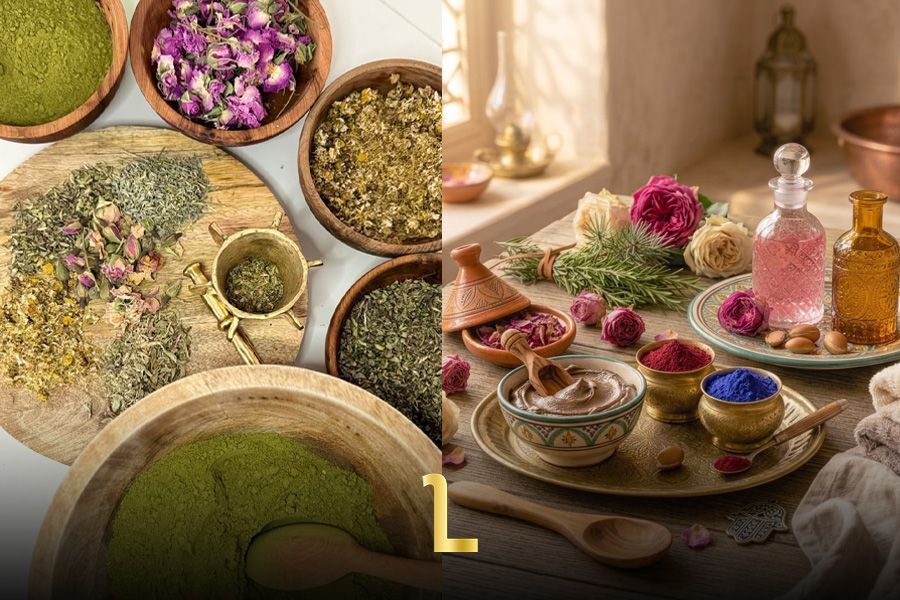
Beauty routines did not rely on commercial products, or sophisticated cosmetic techniques. Instead, kohl, akar el fassi, rose water, and henna held a place in traditional beauty practices. Each ingredient served a distinct purpose that reflected an eternal relationship with nature.
More than a way to look beautiful, these beauty tips have formed a cultural inheritance that has endured way beyond their time. Beauty secrets were shared between mothers, daughters, and granddaughters.
Moroccan Traditional Make-up
From the fresh rose water, to the dark intensity of kohl to the redness of Akar el Fassi, and intricate designs of henna; these beauty tips tell a story of femininity and creativity.
Rose water: A refreshing step in the beauty routine
Rose water is an important element in traditional Moroccan beauty practices, known for its use as a refreshing skin preparation. Made by distilling roses, it is an essential ingredient in personal care.
Traditional beauty tips emphasised skin preparation, instead of using foundation to hide imperfections. Rose water was applied to treat some skin problems. It could be applied with the hands or a piece of cotton. Its simplicity makes it convenient for everyday use, whether alone or alongside other products.
Kohl: the timeless appeal of defined eyes
Usually preserved in a small decorated container, kohl is a charred plant-based substance, and it is applied by using a thin wooden stick. It has long been used to accentuate the eyes, giving them an expressive, defined, and bold look for the eyes.
Kohl’s appeal is its simplicity; without mascara or eyeliner, women relied on the dark pigment of kohl to draw attention to the eye.
It is applied with a fine applicator, and requires high familiarity to apply it. Moroccan women use it to trace the eye area, creating a dark outline that emphasizes the natural shape of the eye.
Aker el Fassi: a red touch from the nature
For hints of color on cheeks, and lips, Moroccan women turned to “akar el fassi,” a pigment made from sun-dried poppy petals,and pomegranate rinds.
Poppy petals are harvested at full maturity, then air-dried to keep their bright colors, pomegranate rinds might be added to intensify red tone, then both ingredients are fully ground into a fine powder.
The substance is usually pressed against a clay pot to protect it from spoiling. The user will later have to wet his finger with rose water, and rub it against the surface of the pot, then apply it on the cheeks, or the lips.
Its charm lies in the simplicity of the materials, and the color it produces; it is still an important reference in the Moroccan cultural heritage.
Henna: body art, and hair care
For a reddish-brown natural-hair dye, Moroccan women used henna; it is a powder made of leaves of lawsonia inermis shrub.
Henna is mixed with warm water, and other herbs to extract a smooth paste, which is ultimately applied to the root and hair ends for approximately 3 hours.
Henna also carries a cultural connotation; it is heavily used in pre-wedding and birth ceremonies.
Moroccan make-up is not only about doing without mascara, blush, or foundation; it reflects a deep human nature relationship.