

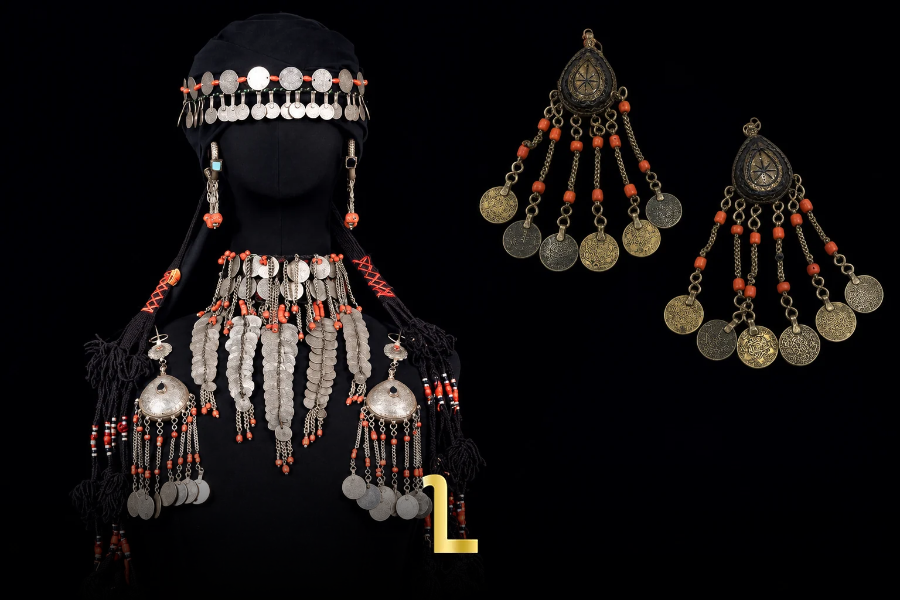
Fez — Imagine wearing part of your savings around your neck, fastening your clothes with silver, and carrying coins that could help support your family during difficult times.
For generations, jewelry served precisely these purposes in parts of Morocco.
Among Amazigh communities, elaborate ornaments could communicate identity, prosperity, and cultural belonging. Their materials also represented tangible wealth.
Museum collections reveal another remarkable detail. Some of these ornaments were designed to move and produce sound, transforming the wearer’s movements into an audible expression of adornment.
When jewelry became portable wealth
At the Metropolitan Museum of Art in New York, a pair of fibulae attributed to Morocco’s Zayan Amazigh community offers a particularly revealing example.
Dating from the late 19th or early 20th century, the ornaments feature silver, enamel, and coral.
Their pear-shaped forms served a practical function, fastening draped garments at the shoulders.
But something unexpected hangs beneath them.
Silver chains support Moroccan rials bearing the date 1903.
The museum’s description explains that Moroccan coins, alongside obsolete Spanish and French currency, frequently appeared in Amazigh jewelry.
These ornaments effectively transformed money into something wearable.
Rather than keeping wealth exclusively in separate possessions or stored currency, women could carry valuable materials directly on their bodies.
The same silver that adorned a garment also represented an economic resource.
The necklace that could help a family survive
An object in the Smithsonian’s National Museum of African Art reveals how practical this relationship could become.
The museum’s collection includes elaborate hair pendants associated with communities in southeastern Morocco, decorated with coral, amber, glass beads, and small shells.
Its accompanying research explains that individual beads of valuable materials could be sold when a family needed money.
Selling a single bead could be preferable to surrendering an entire ornament.
This detail changes how such pieces can be understood.
A necklace was not necessarily a fixed luxury object. Its components could represent assets that the wearer or household might exchange under difficult circumstances.
Another Smithsonian piece, associated with Ida ou Semlal women of the western Anti-Atlas, combines substantial amber beads, silver pendants, coral, and coins.
The museum interprets its impressive arrangement as a visible demonstration of accumulated wealth.
Adornment and economic security were closely connected.
The jewelry that made its own music
The Zayan fibulae at the Metropolitan Museum reveal an additional dimension that photographs cannot fully capture.
Their suspended coins struck one another as the wearer moved.
The resulting sounds became part of the jewelry’s aesthetic experience.
Every step could produce a subtle metallic rhythm.
The museum specifically identifies this auditory element as an important feature of the ornaments.
It suggests a different understanding of historical fashion, one in which appearance and movement worked together.
These pieces did not simply decorate the body. They accompanied its gestures.
Their sounds made adornment an experience that others could hear as well as see.
Symbols of protection and identity
Other Amazigh ornaments carried meanings extending beyond their material value.
A 19th- to early-20th-century Moroccan pectoral ornament in the Metropolitan Museum’s collection features two circular fibulae connected by a chain and an egg-shaped pendant known as a tagmut.
The museum explains that this form was associated with fertility.
Other geometric patterns and decorative motifs could carry protective or auspicious meanings.
Jewelry therefore existed at the intersection of economic life, bodily adornment, and symbolic belief.
Its materials and forms also reflected regional identities, with different communities developing recognizable approaches to silverwork, enameling, and ornamentation.
A history written in silver
The making of these objects also reveals Morocco’s interconnected cultural history.
The Jewish Museum in New York documents a set of fibulae from the Ida ou Semlal region, describing the role of Jewish silversmiths who worked for Amazigh communities.
Its collection record also connects these artisans with Tiznit, a city celebrated for its silver craftsmanship.
Such objects preserve histories of artistic exchange between Moroccan communities, as well as the technical knowledge passed between generations.
Today, museums preserve many historical examples, while contemporary jewelers continue to engage with the country’s diverse metalworking traditions.
Yet the surviving ornaments reveal much more than changing tastes in fashion.
Their coins recall economic transactions. Their beads represent resources that could sustain a household. Their symbols preserve cultural beliefs, and their moving parts evoke sounds that once accompanied everyday life.
What appears behind museum glass as an elaborate piece of traditional jewelry may once have been something far more personal: a woman’s adornment, a family’s reserve of wealth, and a record of Moroccan history carried directly on the body.